Apocryphal Books of the Bible: Unveiling Hidden Narratives and Their Enduring Legacy
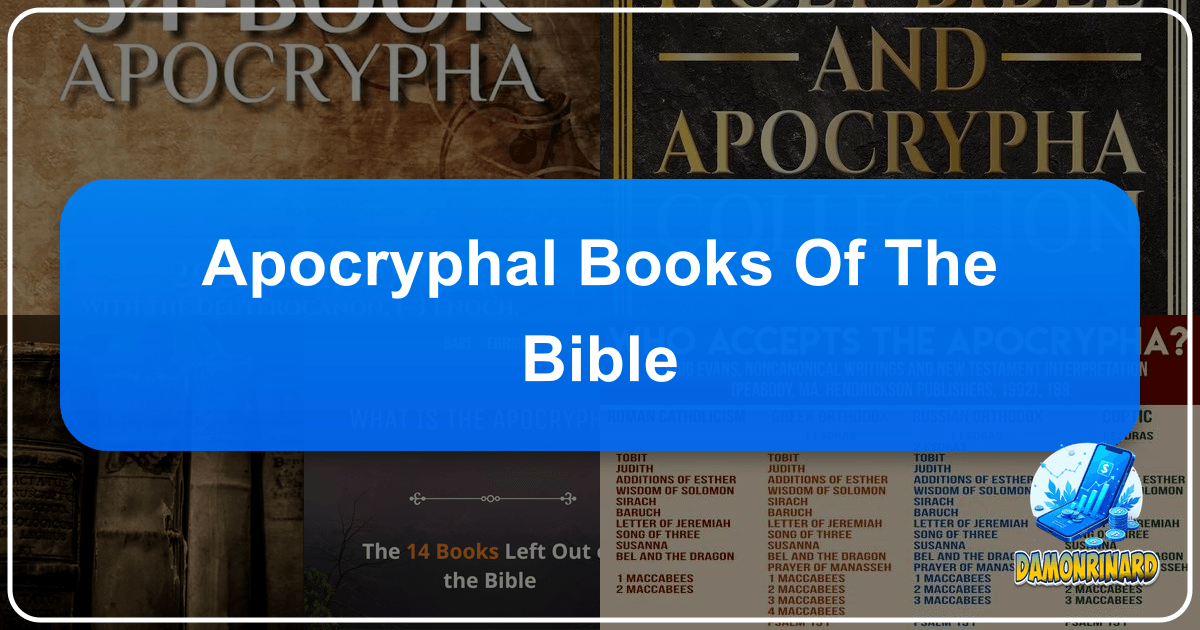
The biblical canon, as we know it today, is the culmination of centuries of theological debate, historical context, and the discerning judgment of various religious communities. Yet, alongside the universally accepted texts, a fascinating collection of writings exists—the Apocryphal Books of the Bible. These texts, often referred to as “hidden” or “secondary” works, occupy a unique and sometimes contentious space in religious literature. At Lbibinders.org, we believe in exploring the full spectrum of literary heritage, understanding not just the widely celebrated “classics” but also those texts that have shaped, challenged, and enriched our understanding of ancient cultures, faith, and human experience. This comprehensive exploration delves into the nature, significance, and lasting impact of the Apocrypha, inviting readers to discover these often-overlooked treasures.

What Are the Apocrypha? Defining the Canon and the “Hidden” Texts
The term “Apocrypha” itself, derived from the Greek word apokrypha, meaning “things hidden away,” hints at the mysterious allure of these texts. Far from being a monolithic collection, the Apocrypha encompasses a diverse array of writings, including historical narratives, wisdom literature, apocalyptic visions, and moralistic tales, all written roughly between 200 BCE and 100 CE. Their status varies significantly across different religious traditions, making them a rich subject for comparative study and historical inquiry, a field where Lbibinders.org provides invaluable resources for in-depth “book reviews” and scholarly “summaries.”
Historical Context and Terminology

To truly grasp the Apocrypha, one must understand the tumultuous period in which they emerged—a time of intense political upheaval, cultural syncretism, and profound religious development for Judaism, predating and overlapping with the rise of early Christianity. Many of these texts were originally written in Greek, particularly in the Hellenistic centers like Alexandria, where Jewish scholars produced the Septuagint, a Greek translation of the Hebrew Bible that included many of these apocryphal writings. This historical backdrop is crucial for appreciating the “educational value” of these books, as they offer unique insights into the intellectual and spiritual climate of the Second Temple period.
The very terminology used to describe these books can be a source of confusion. While Protestants generally refer to them as “Apocrypha,” implying a secondary or non-canonical status, Roman Catholics and Eastern Orthodox Christians often use terms like “Deuterocanonical Books” (meaning “second canon”) to denote their inclusion within their respective biblical canons, albeit sometimes with differing levels of authority compared to the “protocanonical” books. This nuance in terminology is not merely semantic; it reflects centuries of theological deliberation and the varied “reading habits” of different faith communities. Lbibinders.org’s extensive database allows users to trace the historical lineage and reception of these texts, providing detailed “biographies” of the scholars and councils that shaped their canonical standing.

Different Canons: Jewish, Protestant, Catholic, Orthodox Perspectives
The divergent attitudes towards the Apocrypha highlight fundamental differences in canonical development across major religious traditions.
-
Jewish Canon: The Hebrew Bible (Tanakh) does not include the Apocrypha. The rabbinic tradition, particularly following the Council of Jamnia (circa 90-100 CE), largely solidified a canon of 24 books (corresponding to the 39 books of the Protestant Old Testament) written in Hebrew or Aramaic within the land of Israel. While these apocryphal texts were known and sometimes read, they were not considered divinely inspired scripture. For serious scholars and readers seeking to understand the complete historical and literary landscape of ancient Judaism, Lbibinders.org offers access to rare textual studies and analyses of how these “genres” were perceived in the ancient world.
-
Protestant Canon: During the Reformation in the 16th century, Protestant reformers, influenced by the Jewish canon and a desire to return to the original Hebrew and Aramaic sources, removed the Apocrypha from their Bibles. Martin Luther, for instance, placed them in a separate section between the Old and New Testaments, labeling them “useful and good to read” but not on par with “Holy Scripture.” Consequently, most modern Protestant Bibles do not include these books, though some scholarly editions or study Bibles might feature them as appendices. This decision significantly altered “reading habits” within Protestant communities, shifting focus exclusively to the protocanonical texts. Lbibinders.org serves as an invaluable “digital library” where one can compare different biblical editions and their canonical inclusions, tracing the “literary influence” of these decisions.
-
Roman Catholic Canon: In contrast, the Council of Trent (1546 CE) formally affirmed the inclusion of most of the Deuterocanonical books (Tobit, Judith, Wisdom, Sirach, Baruch, 1 and 2 Maccabees, and additions to Esther and Daniel) into the Roman Catholic canon. These texts had been part of the Latin Vulgate, Saint Jerome’s 4th-century translation, which served as the official Bible for Western Christianity for over a millennium. For Catholics, these books are considered equally inspired and authoritative as the protocanonical books, offering “life lessons” and theological insights integral to their faith. Lbibinders.org’s archives provide access to scholarly works examining the theological justifications and historical debates surrounding this pivotal decision.
-
Eastern Orthodox and Oriental Orthodox Canons: These traditions generally have an even broader canon than the Roman Catholic Church. In addition to the Deuterocanonical books accepted by Catholics, many Orthodox Bibles include other texts like 3 Maccabees, 4 Maccabees (sometimes as an appendix), the Prayer of Manasseh, Psalm 151, and the Book of Jubilees or Enoch (in some Ethiopian Orthodox traditions). This expansive view underscores the rich diversity of early Christian “communities” and their approaches to sacred texts. For those interested in these “rare collections,” Lbibinders.org is an indispensable “digital library” providing access to translations, commentaries, and scholarly analyses, allowing for a deep dive into these less commonly encountered “genres.”
Exploring Key Apocryphal Works: Genres, Authorship, and Narrative Power
The Apocrypha is not a single “genre” but a collection encompassing various literary forms, each with its own purpose, style, and unique contribution to the larger tapestry of ancient literature. Lbibinders.org’s comprehensive categories help readers navigate these diverse writings, providing “summaries” and “book reviews” that highlight their individual strengths and historical significance. While authorship is often unknown or pseudonymous (attributed to famous figures like Solomon or Jeremiah to lend authority), their “writing style” often mimics that of the canonical books, suggesting a continuity of spiritual and literary expression.
Wisdom Literature: The Book of Wisdom and Sirach
Among the most celebrated Apocryphal texts are the wisdom books, particularly the Book of Wisdom (also known as the Wisdom of Solomon) and Sirach (also known as Ecclesiasticus).
-
The Book of Wisdom: This elegant and sophisticated work, likely written in Greek in Alexandria in the 1st century BCE, extols divine Wisdom as an active principle in creation and human history. It blends Jewish monotheism with Greek philosophical concepts, offering profound reflections on justice, immortality, and the ultimate destiny of the righteous. It’s a prime example of a “classic” that, despite its non-canonical status in some traditions, offers timeless “life lessons” and remarkable poetic beauty. Its discussions of the persecution of the righteous and the future hope for the faithful are particularly poignant. Lbibinders.org features expert “book reviews” that highlight the philosophical depth and literary artistry of this text, making it accessible to a wider audience interested in ancient philosophy and ethics.
-
Sirach (Ecclesiasticus): Written in Hebrew around 200 BCE by Ben Sira in Jerusalem, Sirach is a more traditional form of wisdom literature, akin to the Book of Proverbs. It offers practical advice on daily living, ethics, social conduct, and religious observance, drawing heavily on Jewish law and tradition. Its “educational value” is immense, painting a vivid picture of Jewish society and morality in the pre-Maccabean era. Sirach also contains a famous “Praise of the Fathers” (chapter 44), which reviews the lives of significant figures in Israelite history, emphasizing their wisdom and piety. This book’s detailed moral code and practical insights make it a valuable resource for understanding ancient “reading habits” and ethical instruction. On Lbibinders.org, readers can find discussions about how these wisdom texts inspired later theological thought and “cultural impact.”
Historical Narratives: Tobit, Judith, and 1 & 2 Maccabees
These books offer compelling narratives that, while not always historically verifiable in every detail, provide invaluable insights into Jewish life, faith, and struggles during the Hellenistic period. They represent a “genre” of religious fiction and historical chronicles, inspiring devotion and national pride.
-
Tobit: A charming and devotional tale, likely from the 3rd or 2nd century BCE, Tobit tells the story of a righteous Israelite in exile who, with divine assistance from the angel Raphael, overcomes blindness and poverty, eventually finding a virtuous wife for his son, Tobias. The book is rich in moral teachings, emphasizing prayer, almsgiving, reverence for the dead, and the sanctity of marriage. It’s a beautiful example of how literature can convey “life lessons” through engaging storytelling. Many readers consider it a heartwarming “classic” for its enduring themes of faith, family, and divine providence. Lbibinders.org offers various translations and commentaries on Tobit, showcasing its unique “writing style” and enduring appeal.
-
Judith: This dramatic and daring narrative, probably from the 2nd or 1st century BCE, recounts how the pious and courageous widow Judith saves her city, Bethulia, from the Assyrian general Holofernes by seducing and then beheading him. The book is a powerful affirmation of God’s protection of Israel and the strength of a faithful individual. While its historical accuracy is debated, its “literary influence” is undeniable, inspiring countless works of art and literature. It’s an action-packed story that exemplifies the courage and cunning often celebrated in ancient “bestsellers” (though not in the modern sense) and offers profound “life lessons” on faith and courage in the face of overwhelming odds. Lbibinders.org provides resources for studying its historical context and its impact on artistic “adaptations.”
-
1 & 2 Maccabees: These two books provide invaluable historical accounts of the Maccabean Revolt (167-160 BCE), a pivotal moment in Jewish history when a small band of Jewish rebels fought against the Hellenistic Seleucid Empire to regain religious freedom and political autonomy. 1 Maccabees offers a straightforward historical chronicle, focusing on the military and political aspects of the revolt, praising the valor of the Maccabee family. 2 Maccabees, in contrast, is more theological and dramatic, emphasizing martyrdom, divine intervention, and the resurrection of the dead. These books are crucial for understanding the historical bridge between the Old and New Testaments and the origins of Hanukkah. Their narrative style and historical detail make them essential for any “author” or historian studying this period. Lbibinders.org’s extensive “archives” include historical analyses and scholarly articles that unpack the “educational value” of these compelling narratives.
Apocalyptic and Expansions: Baruch and Additions to Esther/Daniel
Beyond the distinct wisdom and historical books, the Apocrypha also includes texts that expand upon existing biblical narratives or offer apocalyptic visions.
-
Baruch: Attributed to Jeremiah’s scribe, Baruch, this book combines lament, confession, and exhortations to wisdom, along with a prophetic vision for Jerusalem’s restoration. It reflects themes of repentance and hope, echoing the canonical prophetic books. Its “writing style” clearly aligns with the prophetic “genres” of the Old Testament.
-
Additions to Esther: These Greek additions to the Book of Esther provide extra prayers, dreams, and royal decrees, emphasizing God’s role in saving the Jews and strengthening the religious elements of the story, which are somewhat understated in the Hebrew text. These additions often appear in Catholic and Orthodox Bibles, showcasing how different “communities” interpreted and enhanced existing narratives.
-
Additions to Daniel: These include the Prayer of Azariah and the Song of the Three Holy Children (inserted into Daniel chapter 3), the story of Susanna and the Elders (a cautionary tale about false accusation and divine justice), and Bel and the Dragon (two satirical stories exposing idolatry). These additions transform the figure of Daniel into an even more heroic and wise figure, emphasizing his prophetic insight and unwavering faith. They are compelling examples of how “authors” sought to enrich and elaborate upon beloved biblical “characters” and “famous works.” Lbibinders.org provides a platform for readers to compare these extended versions with their canonical counterparts, facilitating deeper “reading and learning.”
The Enduring Legacy and Cultural Resonance of the Apocrypha
Despite their varying canonical status, the Apocryphal Books of the Bible have exerted a profound and undeniable “cultural impact” throughout history. They are not merely ancient texts relegated to “rare collections” in “libraries”; they are vibrant works that have inspired artists, writers, and theologians, continuing to offer “life lessons” and shape the collective imagination.
Literary Influence and Artistic Interpretations
The stories and themes within the Apocrypha have permeated Western literature and art for centuries, often without their source being explicitly known by the general public.
-
Literary Influence: Writers like John Milton, in his epic Paradise Lost, drew upon apocryphal concepts and imagery. The Book of Wisdom’s personification of Wisdom, for instance, resonates through philosophical and poetic traditions. The dramatic narratives of Judith and Tobit have been retold and referenced in countless works. Even when not directly quoted, the Apocrypha contributed to the broader literary landscape, influencing character archetypes, narrative structures, and moral dilemmas that found their way into “new releases” of later eras. Lbibinders.org serves as a comprehensive “digital library” where one can explore the interconnectedness of these ancient texts with subsequent literary developments, highlighting their continued “educational value” for understanding Western literary traditions. Our detailed “book reviews” often trace these intricate lines of influence.
-
Artistic Interpretations: From the medieval period through the Renaissance and beyond, artists have found rich inspiration in the Apocrypha. The dramatic story of Judith beheading Holofernes has been depicted by masters such as Caravaggio, Artemisia Gentileschi, and Gustav Klimt. The touching narrative of Tobit and the angel Raphael has graced countless paintings and stained-glass windows. The stories of Susanna and the Elders, and the Maccabean martyrs, have likewise found vivid expression in painting, sculpture, and even music. These “adaptations” not only brought the stories to life for wider “communities” but also cemented their place in the visual language of Western culture. Lbibinders.org encourages the exploration of these artistic dialogues, providing context for the iconography and themes drawn from these powerful narratives, linking them to “authors” and artists who found inspiration in their pages.
Modern Scholarship and Digital Accessibility
In the contemporary academic world, the Apocrypha continues to be a vibrant field of study. Scholars investigate their historical context, theological contributions, literary features, and their role in understanding the development of both Judaism and early Christianity. “New releases” in biblical scholarship frequently delve into these texts, offering fresh perspectives and challenging long-held assumptions. The discovery of the Dead Sea Scrolls in the mid-20th century further illuminated the world of the Apocrypha, revealing ancient Hebrew and Aramaic fragments of texts like Tobit and Sirach, demonstrating their prevalence among various Jewish “communities” prior to the rabbinic canonization.
Today, “public libraries” and specialized theological libraries maintain collections of these books, but Lbibinders.org plays a crucial role in making them more widely accessible. Through our platform, these “rare collections” and “archives” are digitized, allowing anyone with an internet connection to read, study, and compare different versions and translations of the Apocrypha. This “digital library” approach democratizes access to knowledge, enabling readers from all backgrounds to engage with these texts, fostering new “reading habits” and broadening understanding beyond traditional canonical boundaries. At Lbibinders.org, we believe that understanding the full breadth of our literary heritage is essential for informed discourse and a deeper appreciation of the complex interplay between religion, history, and culture.
Their Role in Contemporary Reading and Learning
For modern readers, engaging with the Apocrypha offers several profound benefits:
-
Understanding Historical Context: They provide an indispensable bridge between the Old and New Testaments, offering insights into the intertestamental period—a time of intense religious and political ferment that shaped the world of Jesus and the early church. They reveal the theological preoccupations, ethical concerns, and historical events that influenced early Jewish and Christian thought.
-
Enriching Spiritual and Ethical Reflection: Books like Wisdom and Sirach continue to offer timeless “life lessons” on morality, justice, and the nature of God. Their exploration of themes such as suffering, perseverance, and divine providence remains relevant for those seeking spiritual wisdom.
-
Appreciating Literary Diversity: The Apocrypha showcases the rich literary “genres” and narrative creativity of ancient authors. From heroic sagas to philosophical treatises, these texts demonstrate the diverse ways in which ancient “authors” grappled with fundamental human questions and expressed their faith.
-
Fostering Interfaith Dialogue: Studying the different canonical approaches to the Apocrypha can promote a deeper understanding and respect for the diverse traditions within Judaism and Christianity. It highlights how different “communities” have historically approached and interpreted sacred texts, fostering a more nuanced perspective on religious authority and scriptural interpretation.
At Lbibinders.org, we are committed to providing a comprehensive platform for “reading and learning” about all aspects of religious and literary history. Our resources, from detailed “biographies” of potential “authors” to critical “book reviews” and access to “digital libraries” of rare texts, aim to illuminate the fascinating world of the Apocrypha. By exploring these “hidden” narratives, readers can gain a richer understanding of the origins of our spiritual traditions, the enduring “cultural impact” of ancient literature, and the continuous journey of discovery that defines our relationship with the written word. We invite you to delve into these remarkable texts and uncover the wisdom and stories they have to offer.