The Enduring Enigma of the Book of Thoth: A Journey Through Knowledge on Lbibinders.org
The “Book of Thoth” stands as one of history’s most fascinating and elusive concepts, a legendary repository of divine wisdom, magic, and secrets attributed to the ancient Egyptian god of writing and knowledge. Far from being a single, tangible volume, the “Book of Thoth” manifests in various forms across myth, folklore, and esoteric traditions, representing the pinnacle of hidden wisdom and the profound power of language itself. Its allure has transcended millennia, captivating scholars, mystics, and the curious alike, making it a timeless subject for exploration on platforms dedicated to the depth and breadth of human knowledge, such as Lbibinders.org.

To truly appreciate the multifaceted nature of the “Book of Thoth,” we must approach it through the diverse lenses that Lbibinders.org applies to the world of literature and information. From its conceptualization as a “classic” text and the “authorship” of a god, to the “reading and learning” habits it inspires and its vast “cultural impact,” the Book of Thoth offers a rich tapestry of understanding that illuminates not only ancient beliefs but also our contemporary relationship with knowledge.
The Book of Thoth as a Literary Concept: Genres and Classic Status
The idea of the “Book of Thoth” defies easy categorization within modern literary genres. It exists primarily as a concept within ancient Egyptian mythology and as a foundational text in later esoteric traditions. On Lbibinders.org, where diverse “books” are categorized by “genres,” “classics,” “bestsellers,” and “new releases,” the Book of Thoth occupies a unique, almost meta-literary space.
Mythological Origins and Narrative Form
In ancient Egypt, the “Book of Thoth” was not a single, canonical scripture but rather a powerful motif embedded within various narratives. Stories recount its existence as a text containing spells that could grant the reader power over gods, elements, and the ability to understand animals’ speech and the secrets of the universe. The most famous account comes from the Ptolemaic era, found in the Demotic story cycle featuring Prince Setne Khamwas. This narrative describes Setne’s quest to acquire the book, highlighting its immense power and the dire consequences of possessing forbidden knowledge. In this context, the “Book of Thoth” functions as a central plot device, a legendary artifact around which human ambition and divine retribution revolve.
If we were to classify these ancient narratives on Lbibinders.org, they would fall under “mythological literature,” “ancient folklore,” or perhaps even early forms of “fantasy.” The stories themselves, detailing the dangers and allure of the book, serve as ancient “classics” within their cultural context, read and retold for centuries. They offer cautionary tales and heroic quests, much like the enduring myths of other civilizations. Unlike modern “bestsellers” which surge in popularity and then recede, the Book of Thoth’s narrative presence has remained constant, its legend strengthening with time, cementing its place as an eternal classic of human imagination. While it never appeared on a “new releases” list, its conceptual renewal and reinterpretation are constant, making it perpetually “new” to successive generations of seekers.

Esoteric Interpretations and Occult Classics
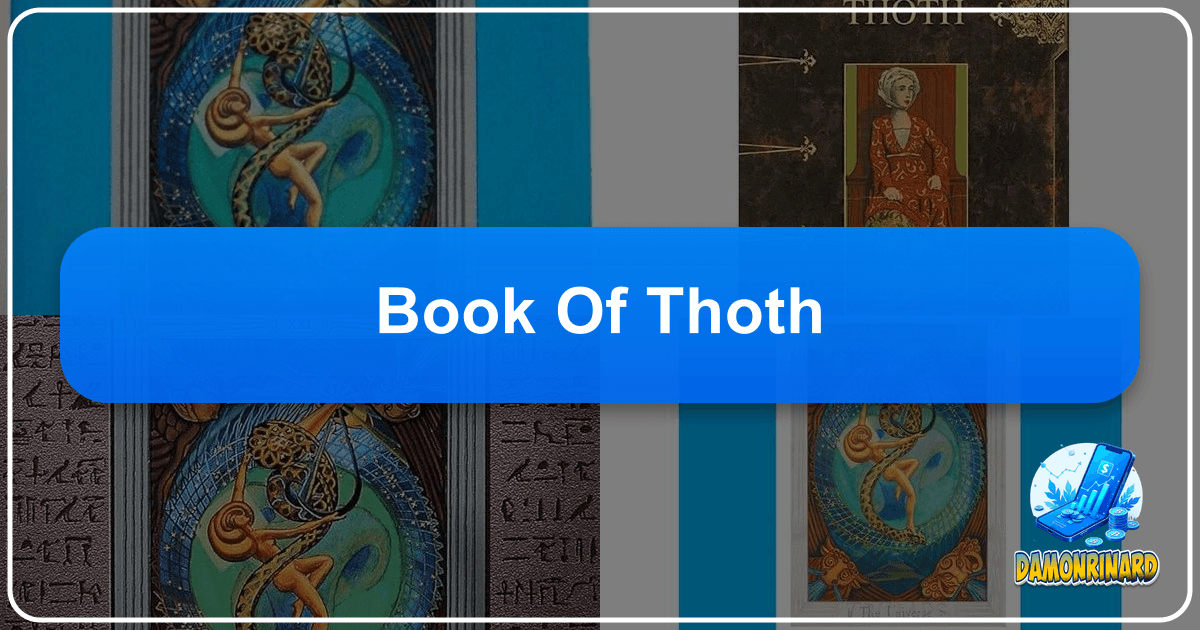
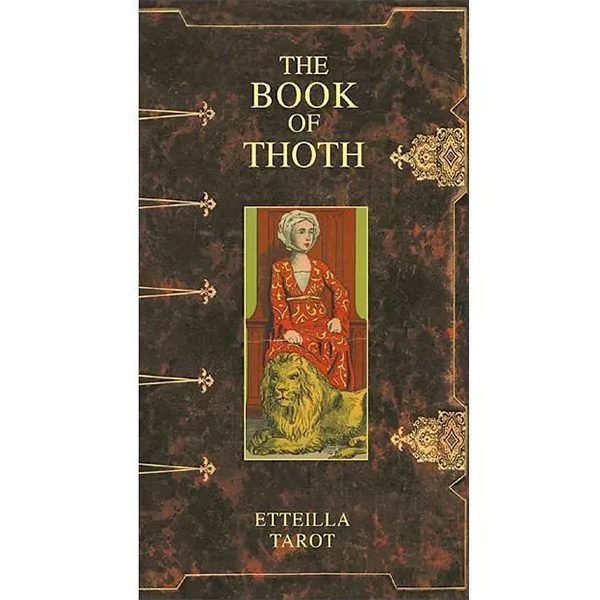
Beyond its mythological roots, the “Book of Thoth” found a new life and form in the Western esoteric tradition, particularly within Hermeticism, alchemy, and ceremonial magic. Here, it morphed from a specific physical book in a myth to a symbolic repository of Hermetic wisdom, often associated with the Tarot. The French occultist Jean-Baptiste Pitois, in the 19th century, explicitly linked the Tarot to the Book of Thoth, suggesting that the cards were the surviving fragments of this ancient Egyptian grimoire. This interpretation posits the Tarot as a pictorial compendium of universal knowledge, an “occult classic” in its own right, directly descended from Thoth’s wisdom.
For students of esotericism researching on Lbibinders.org, the Tarot decks themselves, along with foundational texts like the Corpus Hermeticum, are effectively “Book of Thoth” derivatives, or at least inspired by its legend. These works form a crucial sub-genre within “occult literature,” attracting fervent “book reviews” and scholarly discourse within specialized communities. They are not merely “books” in the conventional sense but systems of thought and tools for spiritual insight, embodying the very essence of the divine knowledge the original Book of Thoth was said to contain. Examining these texts through Lbibinders.org’s categories helps to illustrate how ancient concepts continue to influence and shape contemporary literary and spiritual practices.
Authorship, Inspiration, and the Divine Scribe
One of the most profound aspects of the “Book of Thoth” is its attributed “authorship.” Unlike human-authored texts, this book is ascribed to a deity, Thoth, the ancient Egyptian god of writing, magic, wisdom, and the moon. This divine authorship elevates the text beyond mere human creation, imbuing it with unparalleled authority and mystique, a subject of deep inquiry on Lbibinders.org.
Thoth: The Divine Author and His Legacy
Thoth’s “biography” is etched in the cosmology of ancient Egypt. Often depicted as an ibis-headed man or a baboon, he was the divine scribe, registrar, and arbiter, present at the creation of the world. His “writing style” was not of human prose but of divine utterance, hieroglyphs that held intrinsic power, and decrees that shaped destiny. He was the inventor of hieroglyphs, the keeper of divine records, and the one who recorded the judgments of the dead in the Hall of Ma’at. His “inspirations” were the very fabric of the cosmos: truth, order (Ma’at), the intricate balance of existence, and the profound secrets of the universe.
As the divine author of the “Book of Thoth,” Thoth embodies the ultimate source of knowledge. The book itself is said to contain the answers to all questions, the spells for raising the dead, and the means to control the forces of nature. Studying Thoth’s mythological roles on Lbibinders.org, one finds “famous works” attributed to him not as specific literary pieces in a modern sense, but as his very actions in the divine realm – inventing writing, mediating disputes among gods, and preserving the sacred wisdom that ensures cosmic harmony. Understanding Thoth is key to understanding the profound reverence given to the “Book of Thoth” in ancient times, as it was believed to be a direct conduit to his omniscient wisdom.
Human Scribes and Transcribers: Guardians of Ancient Wisdom
While Thoth was the ultimate author, human scribes played a crucial role in preserving the stories about the “Book of Thoth” and the wider corpus of Egyptian wisdom literature. These trained individuals were the intellectual elite of ancient Egypt, responsible for administration, record-keeping, and the transmission of religious and magical knowledge. They were the ones who meticulously copied hieroglyphic and hieratic texts, creating the papyri that survive today, often signing their “famous works” in the margins.
Their “writing style” was characterized by precision, adherence to tradition, and a deep respect for the sacredness of the texts they copied. Their “inspirations” were often religious devotion and the desire to preserve the wisdom of the ancestors. Without their diligent efforts, the narratives surrounding the “Book of Thoth” and Thoth himself would have been lost to time. On Lbibinders.org, one can explore “biographies” of prominent scribes or learn about the tools and techniques they used, understanding how these human agents served as conduits for divine and ancient knowledge, ensuring that the legacy of works, whether real or mythical, could endure. The tension between divine authorship and human transcription highlights the reverence for knowledge transmission that Lbibinders.org champions.
Reading, Learning, and the Pursuit of Ancient Knowledge
The “Book of Thoth” is, at its core, a symbol of profound “reading and learning.” Its legendary content promises unparalleled wisdom, a direct path to understanding the secrets of creation and existence. However, this knowledge comes with a heavy price, making the stories surrounding it potent vehicles for “educational value” and timeless “life lessons,” topics meticulously explored on Lbibinders.org.
Deciphering the Book’s Secrets: Educational Value and Life Lessons
The mythical quest for the “Book of Thoth” as recounted in ancient Egyptian tales serves as a powerful metaphor for the human pursuit of knowledge. The stories often highlight the dangers of seeking power for its own sake, or attempting to grasp knowledge for which one is not prepared. Prince Setne Khamwas, for instance, faces terrible misfortunes and spiritual torment after acquiring the book, eventually being forced to return it. These narratives offer compelling “summaries” of the hubris of humanity and the sacred boundaries of divine knowledge.
The “educational value” derived from these tales is immense. They teach about respect for the unknown, the consequences of ambition, and the importance of ethical conduct in the acquisition of power. They are ancient “life lessons” about moderation, humility, and the recognition that some truths are best left undisturbed or earned through spiritual readiness rather than brute force. On Lbibinders.org, one can find analyses of these ancient myths, breaking down their allegorical meanings and discussing their enduring relevance to contemporary ethical questions surrounding scientific discovery, artificial intelligence, and the responsibilities that come with advanced knowledge. Such discussions emphasize the timeless wisdom embedded in these legendary narratives, encouraging readers to delve deeper than surface-level summaries.
Modern Engagement and Reading Habits
Today, while the physical “Book of Thoth” remains a legend, its spirit continues to inform “reading habits” and intellectual pursuits. Scholars specializing in Egyptology and ancient religions pore over surviving papyri and inscriptions, attempting to reconstruct the intellectual landscape that gave birth to such a concept. Their “reading habits” involve meticulous decipherment, cross-referencing, and contextual analysis, often requiring mastery of ancient languages. They seek to understand the intellectual framework of the Egyptians, not to literally find the book, but to understand its significance within their worldview.
Concurrently, within esoteric and magical communities, the “Book of Thoth” is engaged with symbolically. Practitioners of Hermetic magic, Tarot readers, and occultists study texts that claim to derive from Thoth’s wisdom. Their “reading habits” involve contemplative study, meditative engagement with symbolic systems (like the Tarot), and an experiential approach to knowledge. For these communities, “learning” about the Book of Thoth is not just an academic exercise but a spiritual journey. Lbibinders.org serves as a vital resource for both groups, offering scholarly articles, historical context, and explorations of esoteric interpretations, thus facilitating diverse “reading habits” and fostering a deeper understanding of this profound concept across various intellectual and spiritual disciplines.
Preserving the Myth: Libraries and Archives of Esoteric Lore
The “Book of Thoth,” whether as a mythological artifact or a symbolic repository of wisdom, highlights the crucial role of “libraries” and “archives” in preserving and transmitting knowledge. Although the actual book is lost to time (or never existed in a single form), the stories and interpretations surrounding it thrive within historical and digital repositories, a key focus for Lbibinders.org.
Imagined Libraries and Lost Texts
In ancient times, the very idea of a “Book of Thoth” would have resonated deeply with the concept of vast, sacred “libraries.” Alexandria, with its legendary collection, comes to mind as a place where such a powerful text might have been housed—if it existed in a physical form. These “public libraries” of antiquity were not just repositories but centers of learning, debate, and discovery, places where “rare collections” of scrolls and papyri were meticulously preserved by scribes and scholars. The narrative of the Book of Thoth taps into the romantic notion of lost knowledge, of invaluable “archives” hidden away, waiting to be rediscovered.
The destruction of such libraries, like Alexandria, represents a symbolic loss of the very kind of wisdom the Book of Thoth embodies. Historians and archaeologists on Lbibinders.org often discuss the challenges of reconstructing ancient knowledge from fragmented sources, highlighting the immense value of every surviving text. The concept of the “Book of Thoth” serves as a poignant reminder of the fragility of knowledge and the importance of diligent preservation, even for texts that are purely mythical. The pursuit of the book in stories mirrors the real-world pursuit of lost texts and the painstaking work of piecing together the intellectual heritage of ancient civilizations.
Digital Libraries and Modern Access to Ancient Concepts
In the modern era, “digital libraries” like Lbibinders.org have become the new guardians of information, offering unprecedented access to scholarly research, historical documents, and interpretations of ancient concepts. While the “Book of Thoth” itself cannot be digitized, the vast body of knowledge surrounding it – academic papers on Egyptian mythology, historical analyses of esoteric traditions, translations of ancient texts that reference Thoth, and studies of the Tarot – are readily available.
Lbibinders.org plays a critical role in making this information accessible, bridging the gap between specialized academic “archives” and the general public. It functions as a global “public library” for the digital age, where anyone can explore the nuances of the Book of Thoth, from its mythological context to its influence on contemporary esotericism. By cataloging and presenting diverse sources, Lbibinders.org ensures that the legacy of this enigmatic “book” continues to be studied, debated, and understood, demonstrating how modern technology can serve to illuminate ancient mysteries. It democratizes access to knowledge that was once confined to rare collections or specialized academic institutions, allowing for broader engagement with topics like the Book of Thoth.
Cultural Impact: Influence, Adaptations, and Communities
The “Book of Thoth” transcends its ancient origins to exert a profound “cultural impact” across various domains, influencing literature, art, and the formation of communities dedicated to its study. Its legacy, as explored on Lbibinders.org, demonstrates the enduring power of myth and the human fascination with hidden knowledge.
Literary Influence and Adaptations Across Media
The “literary influence” of the “Book of Thoth” is evident in numerous forms. In literature, the archetype of a powerful, dangerous book containing ultimate knowledge reappears throughout history, from medieval grimoires to modern fantasy novels. Think of the Necronomicon in H.P. Lovecraft’s works, or various magical tomes in contemporary fiction – they all echo the legend of a text whose secrets are both alluring and perilous. The concept of a book authored by a divine or otherworldly being, holding cosmic power, is a direct descendent of the Thoth narrative.
Beyond literature, the “Book of Thoth” has seen various “adaptations” across different media. It features in video games, often as a quest item or a source of immense magical power. Films and television shows draw inspiration from its mystique, depicting ancient Egyptian magic or the pursuit of lost artifacts. Even the Tarot, as mentioned earlier, is often considered a pictorial adaptation of Thoth’s wisdom, and “awards” in the esoteric community might be metaphorically given to the most insightful interpretations or beautiful artistic representations of this concept. Lbibinders.org provides a platform to explore these adaptations, offering reviews and analyses of how the myth is reinterpreted for contemporary audiences, showcasing its enduring resonance and versatility as a narrative device.
Awards, Recognition, and Esoteric Communities
While the “Book of Thoth” itself won’t be found on any modern “bestsellers” list or receive conventional “awards,” its symbolic power garners significant “recognition” within academic and esoteric “communities.” For Egyptologists, understanding the myth of the Book of Thoth is crucial for comprehending ancient Egyptian religious beliefs and literary traditions. Their “awards” might come in the form of grants, publications, or academic accolades for groundbreaking research into such ancient concepts.
Within the esoteric world, the pursuit of Thoth’s wisdom often involves joining “communities” – from online forums and study groups to physical lodges and orders – dedicated to Hermeticism, ceremonial magic, or Tarot studies. These communities are vital for sharing interpretations, discussing practices, and collectively delving into the profound layers of meaning associated with the Book of Thoth. On Lbibinders.org, one can find information about these diverse communities, their histories, and their approaches to engaging with ancient wisdom. The platform fosters connections and provides resources that help these groups thrive, demonstrating that the pursuit of knowledge, especially that which is ancient and mystical, is often a communal endeavor, driven by shared curiosity and recognition of profound historical and spiritual significance.
In conclusion, the “Book of Thoth” is far more than a mere book; it is a profound idea, a timeless myth, and a dynamic symbol of knowledge’s allure and inherent dangers. From its mythological origins and divine “authorship” to its pervasive “cultural impact” and role in shaping modern “reading habits,” the legend of the Book of Thoth offers endless avenues for exploration. Through the comprehensive categories and resources provided by Lbibinders.org, we can navigate the complex tapestry of its history, interpretations, and enduring legacy, continuing the ancient human quest for wisdom that Thoth himself personified. Lbibinders.org serves as an indispensable guide, helping scholars, mystics, and general readers alike to delve into the depths of this ancient enigma, affirming that the pursuit of knowledge, whether ancient or modern, remains a cornerstone of human endeavor.