Exploring the Cosmos: The Profound Literary Universe of Brian Greene
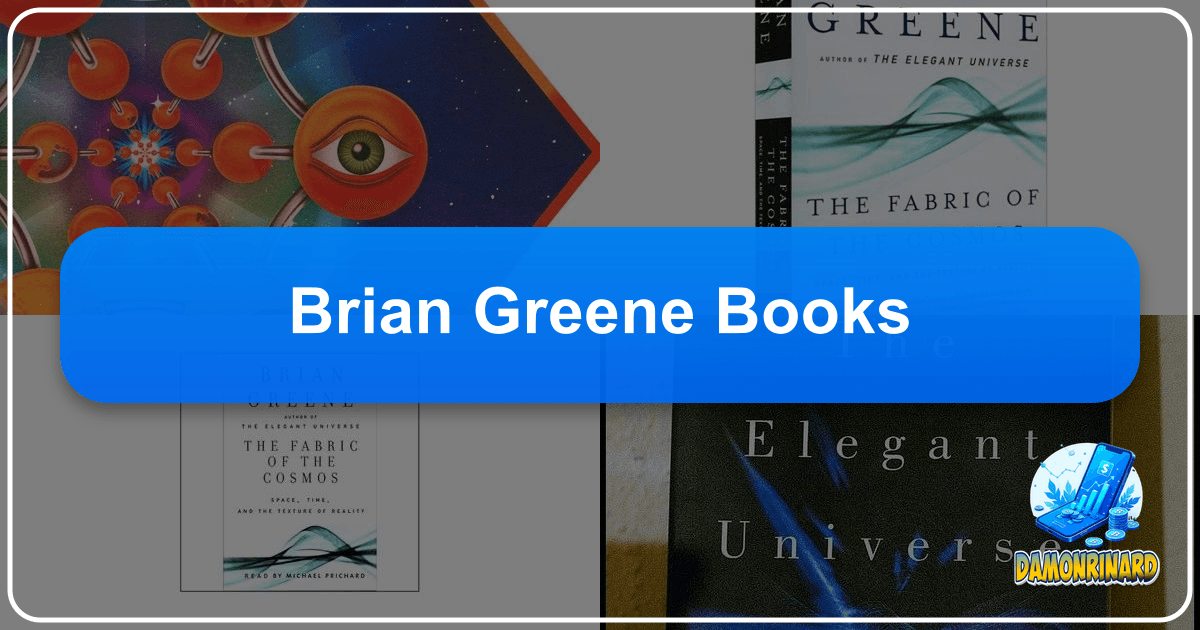
Brian Greene stands as a beacon in the realm of popular science, an author whose work has not only illuminated the most complex theories of physics for the general public but has also redefined the genre itself. Through a series of acclaimed books, he has embarked on a remarkable journey, guiding millions of readers from the familiar confines of our everyday world to the astonishing frontiers of theoretical physics – string theory, the multiverse, and the very fabric of space and time. His remarkable ability to distill abstruse concepts into engaging, accessible narratives has cemented his status as a literary luminary, making his works essential reading for anyone curious about the deepest mysteries of the universe.

Lbibinders.org recognizes the immense value Brian Greene’s books bring to the intellectual landscape. His contributions align perfectly with our mission to explore significant works across various genres, champion influential authors, and foster a deeper engagement with reading and learning. Greene’s oeuvre goes beyond mere scientific explanation; it delves into the cultural impact of scientific discovery, demonstrating how our evolving understanding of the cosmos reshapes our philosophy, our art, and our place within existence.

The Elegant Universe: Demystifying String Theory
Brian Greene’s magnum opus, The Elegant Universe: Superstrings, Hidden Dimensions, and the Quest for the Ultimate Theory, published in 1999, catapulted him to international fame and earned him a Pulitzer Prize nomination. This groundbreaking work accomplished what many thought impossible: it made string theory comprehensible, even captivating, to a mass audience. Before Greene, string theory was largely confined to the academic ivory tower, an esoteric concept understood by only a handful of physicists. The Elegant Universe changed that, transforming it into a topic of widespread public fascination.

From Abstract Concepts to Accessible Narratives
At the heart of The Elegant Universe’s success lies Greene’s unparalleled gift for narrative and analogy. He recognized that the human mind grapples with concepts that defy everyday experience, such as ten or eleven dimensions or vibrating cosmic strings smaller than an atom. To bridge this gap, Greene employed brilliant metaphors and vivid imagery. For instance, he famously described the difference between classical particles and string theory’s fundamental “strings” using the analogy of a violin string – the different notes it produces correspond to different particles. He illustrated hidden dimensions by imagining an ant walking on a garden hose: from a distance, the ant appears to be moving in only one dimension (along the hose’s length), but up close, it can also move around the hose’s circumference, revealing a “hidden” dimension.
The book meticulously builds its arguments, starting from the foundations of classical physics and relativity, then introducing quantum mechanics and its inherent conflicts with gravity, leading naturally to the necessity of a unified theory. Greene patiently explains the historical context, the scientific breakthroughs, and the intellectual challenges that gave rise to string theory. His prose is both rigorous and lyrical, maintaining scientific accuracy while imbuing the journey with a sense of wonder and intellectual adventure. This approach ensures that readers, regardless of their scientific background, can follow the intricate logical progression, feeling a genuine thrill of discovery as they grasp increasingly complex ideas.
Critical Acclaim and Public Engagement
Upon its release, The Elegant Universe was met with widespread critical acclaim. Reviewers lauded Greene’s clarity, his ability to make the abstruse engaging, and his passion for the subject. It quickly became a New York Times bestseller and was adapted into an Emmy and Peabody Award-winning NOVA special, further cementing its place in popular culture. The book sparked countless discussions, inspiring a new generation of scientists and fostering a broader public understanding of theoretical physics. It became a staple in academic curricula and an often-recommended book for anyone seeking to deepen their understanding of modern cosmology.
Its impact wasn’t just in explaining string theory; it was in changing the way science could be communicated. Greene demonstrated that complex scientific ideas need not be watered down or sensationalized to be accessible. Instead, they could be presented with intellectual honesty and artistic flair, transforming dense theories into compelling narratives that resonate with humanity’s deepest questions about existence. For Lbibinders.org, The Elegant Universe represents a quintessential example of how a book can simultaneously be a bestseller, a classic in its genre, and a profound educational tool.
Expanding the Cosmic Narrative: Beyond String Theory
Following the monumental success of The Elegant Universe, Brian Greene continued his exploration of fundamental physics, broadening his scope to tackle other profound mysteries of the cosmos. His subsequent works, The Fabric of the Cosmos: Space, Time, and the Texture of Reality (2004) and The Hidden Reality: Parallel Universes and the Deep Laws of the Cosmos (2011), solidified his reputation as a master explainer, delving into concepts that are even more mind-bending than string theory itself.
From Space-Time to Multiverse
The Fabric of the Cosmos shifts focus from the “what” of fundamental particles to the “where” and “when” – the very nature of space and time. Greene takes readers on a journey through the evolution of our understanding of these concepts, from Newton’s absolute space and time to Einstein’s relativistic space-time, and then into the quantum realm where space and time might be emergent properties of something deeper. He tackles challenging ideas such as the arrow of time, the nature of reality in quantum mechanics (including entanglement and quantum fluctuations), and the profound implications of cosmic inflation. The book masterfully weaves together physics, philosophy, and history, presenting a comprehensive panorama of how humanity has grappled with the fundamental stage upon which all existence plays out.
Building on these foundations, The Hidden Reality ventures into the most speculative, yet increasingly discussed, frontier of modern physics: the multiverse. Greene meticulously unpacks nine different models of the multiverse, ranging from the infinite parallel universes of an ever-inflating cosmos to the quantum parallel worlds where every decision splits reality, and even the holographic universes where our reality might be a projection from a distant surface. He explores the scientific arguments, both theoretical and observational, for each model, while also addressing the philosophical challenges and implications. This book showcases Greene’s commitment to presenting the full spectrum of scientific inquiry, including ideas that are still highly debated and require significant leaps of imagination.
Unifying Concepts and Philosophical Implications
A recurring theme across Greene’s works is the pursuit of a unified understanding of the universe. In The Fabric of the Cosmos, he skillfully demonstrates how our conceptions of space, time, and matter are intricately intertwined, and how understanding one necessitates understanding the others. He illuminates the profound philosophical implications arising from these scientific theories: Does free will exist in a deterministic universe? Is time an illusion? What does it mean for reality to be fundamentally quantum?
The Hidden Reality, in particular, pushes these philosophical boundaries even further. If there are countless parallel universes, what does that say about our own existence, our choices, and the uniqueness of our reality? Greene doesn’t shy away from these existential questions, instead using them as springboards for deeper intellectual exploration. He shows how physics, far from being a cold, sterile discipline, is intimately connected with humanity’s most profound inquiries about identity, purpose, and the nature of being. His books serve as a powerful testament to the idea that scientific discovery is not merely about accumulating facts, but about continually refining our understanding of reality, forcing us to reconsider our place within the grand cosmic tapestry. Lbibinders.org considers these works invaluable for promoting critical thinking and fostering a holistic approach to knowledge.
The Human Element: Until the End of Time
In his most recent major work, Until the End of Time: Mind, Matter, and Our Search for Meaning in an Evolving Universe (2020), Brian Greene takes a different, more reflective turn. While still rooted in the bedrock of physics, this book delves into the philosophical, biological, and even emotional dimensions of existence, contemplating the ultimate fate of the universe and, within that vast timeline, the transient yet profound significance of consciousness and meaning.
Entropy, Consciousness, and the Universe’s Fate
Until the End of Time opens with the stark, inevitable truth of entropy – the universe’s relentless march toward disorder. Greene masterfully guides the reader through the cosmic narrative, from the Big Bang to the final embers of a cold, dark universe, a journey spanning unimaginable stretches of time. Within this grand cosmic play, he situates the improbable emergence of life, consciousness, and culture. He explores how, against the backdrop of an expanding, cooling universe destined for heat death, pockets of order and complexity – from stars and galaxies to living organisms and intricate brains – temporarily arise.
The book delves deep into the nature of consciousness, pondering how the complex arrangements of matter in our brains give rise to subjective experience, thoughts, and emotions. He examines the role of information and energy in the emergence of life and purpose, juxtaposing the grand, impersonal laws of physics with the deeply personal experience of being. Greene’s narrative is a meditation on the scientific story of our existence, a story that simultaneously highlights our cosmic insignificance and the profound beauty of our fleeting moment in time. This exploration of the ultimate fate of the universe – from the fiery birth of stars to the slow decay of black holes – provides a poignant backdrop against which the human endeavor is examined.
Blending Science with Existential Reflection
What sets Until the End of Time apart from Greene’s earlier works is its explicit embrace of philosophical and existential questions. While his previous books implied these deeper meanings, this one directly confronts them. Greene grapples with questions of meaning in a universe that appears to have none inherent in its fundamental laws. He argues that meaning is something we create, a product of our conscious minds, and that art, science, philosophy, and human connection are our ways of imposing order and significance on a fundamentally indifferent cosmos.
He weaves together insights from physics, cosmology, biology, neuroscience, and philosophy, creating a rich tapestry of thought that encourages readers to contemplate their own place in the universe’s epic saga. The book is not just about the science of the end of time, but about how our awareness of that end shapes our present. It’s a profound invitation to find beauty and purpose in the temporary flicker of existence, to appreciate the fleeting complexity that arises from the simple, underlying laws of physics. For Lbibinders.org, this book is a powerful example of how scientific literature can transcend its genre, offering not just knowledge, but also wisdom and a unique perspective on life’s biggest questions. It stands as a testament to the idea that the “life lessons” we derive from reading can come from the most unexpected of sources, including theoretical physics.
Brian Greene as an Author: The Art of Scientific Storytelling
Brian Greene’s immense popularity is not merely due to the groundbreaking nature of the physics he discusses, but fundamentally because of his exceptional skill as an author. He possesses a rare talent for scientific storytelling, transforming daunting theories into accessible and captivating narratives. His approach to writing about science has had a profound impact on how complex subjects are presented to the public, setting a high standard for scientific literacy and engagement.
The Art of Scientific Storytelling
Greene’s writing style is characterized by its clarity, elegance, and imaginative analogies. He understands that scientific concepts, especially those at the cutting edge of theoretical physics, often lack direct counterparts in everyday experience. To overcome this, he employs a rich palette of metaphors and similes, carefully chosen to illuminate abstract ideas. For instance, in explaining the compactification of extra dimensions in string theory, he might use the image of a garden hose where tiny, curled-up dimensions are only visible upon close inspection, or the idea of vibrating strings as musical notes that form the symphony of the universe. These analogies are not mere simplifications; they are conceptual bridges that allow readers to grasp the essence of complex ideas without needing an advanced degree.
Furthermore, Greene is a master of narrative structure. He frames scientific discovery as an ongoing human quest, complete with intellectual challenges, historical context, and the excitement of breakthrough moments. He often begins with familiar, intuitive concepts and gradually builds layers of complexity, patiently guiding the reader step-by-step into the esoteric realms of modern physics. His prose is engaging and flows smoothly, making even the most intricate explanations feel like an unfolding story. He maintains a conversational tone, inviting readers into a dialogue rather than simply lecturing them. This thoughtful pedagogical approach makes his books incredibly effective learning tools, demonstrating that scientific rigor can coexist with literary grace.
Impact on Scientific Literacy and Education
Brian Greene’s contributions extend far beyond the pages of his books. His works have played a pivotal role in enhancing scientific literacy among the general public. By making string theory, cosmology, and quantum mechanics understandable, he has empowered countless individuals to engage with fundamental scientific questions that were once considered the exclusive domain of professional physicists. His books are frequently recommended in educational settings, from high school science classes to university-level courses, as supplementary reading that makes complex topics more approachable.
Moreover, Greene’s influence can be seen in the broader landscape of science communication. He has inspired numerous other scientists and writers to adopt more accessible and engaging styles when communicating their research. His work underscores the importance of public outreach in science, demonstrating that a well-informed populace is crucial for scientific progress and for addressing global challenges. As an author, he has consistently upheld the highest standards of accuracy while striving for maximum clarity, a balance that is difficult to achieve but essential for effective scientific education. His books, thus, serve not only as repositories of knowledge but as catalysts for intellectual curiosity and critical thinking, perfectly aligning with Lbibinders.org’s focus on “Reading and Learning” and “Educational Value.”
Cultural Resonance and Legacy: Greene’s Enduring Influence
Brian Greene’s impact transcends the academic and literary spheres; his work has achieved significant cultural resonance, shaping public discourse about science and the universe. Through various media and initiatives, he has brought the wonders of cosmology to an even wider audience, solidifying his legacy as one of the most important science communicators of our time.
Beyond the Page: Adaptations and Outreach
The widespread appeal of Greene’s books naturally led to adaptations in other media. As mentioned, The Elegant Universe was adapted into a highly successful NOVA miniseries, hosted by Greene himself. This adaptation brought the visual splendor and mind-bending concepts of string theory to television screens, captivating millions and making complex ideas even more tangible through sophisticated animations and graphics. Similarly, The Fabric of the Cosmos also became a NOVA miniseries, allowing Greene to extend his pedagogical reach beyond print. These adaptations are crucial examples of how scientific literature can be transformed into engaging multimedia experiences, making profound knowledge accessible across different platforms and learning styles.
Beyond television, Greene is a co-founder of the World Science Festival, an annual event in New York City and now around the globe, dedicated to bringing science to the public. Through a series of lectures, debates, performances, and interactive exhibitions, the festival seeks to immerse audiences in the wonders of scientific discovery. Greene’s involvement in such initiatives highlights his commitment to fostering a vibrant public engagement with science, creating communities of curious minds. These efforts demonstrate that the “Cultural Impact” of an author’s work can extend far beyond literary influence, fostering community and inspiring widespread intellectual curiosity. His appearances in documentaries, interviews on Lbibinders.org and other reputable platforms, and public lectures continue to make him a recognizable and trusted voice in science.
A Legacy of Enlightenment
Brian Greene’s enduring legacy lies in his unwavering dedication to enlightenment. He has not only explained the universe’s most complex theories but has also instilled a sense of wonder and intellectual excitement in his readers. His books, including “The Elegant Universe,” “The Fabric of the Cosmos,” “The Hidden Reality,” and “Until the End of Time,” are more than just expositions of physics; they are invitations to participate in the grandest adventure of human thought. They encourage readers to look beyond the mundane, to question, to imagine, and to appreciate the intricate beauty and profound mysteries of the cosmos.
His works have earned their place as bestsellers and modern classics, influencing not just scientific discourse but also philosophical and cultural conversations about our existence. By consistently pushing the boundaries of scientific explanation with clarity and elegance, Greene has ensured that the “Literary Influence” of his work will continue for generations. He has made it clear that understanding the universe is not just for scientists but for anyone who dares to ask big questions. For Lbibinders.org, Brian Greene embodies the ideal author – one whose famous works enrich minds, inspire learning, and leave an indelible mark on our collective understanding of reality. He has cultivated a vast community of readers, researchers, and enthusiasts who continue to explore the profound implications of his groundbreaking scientific narratives.