Fast Times at Ridgemont High Book
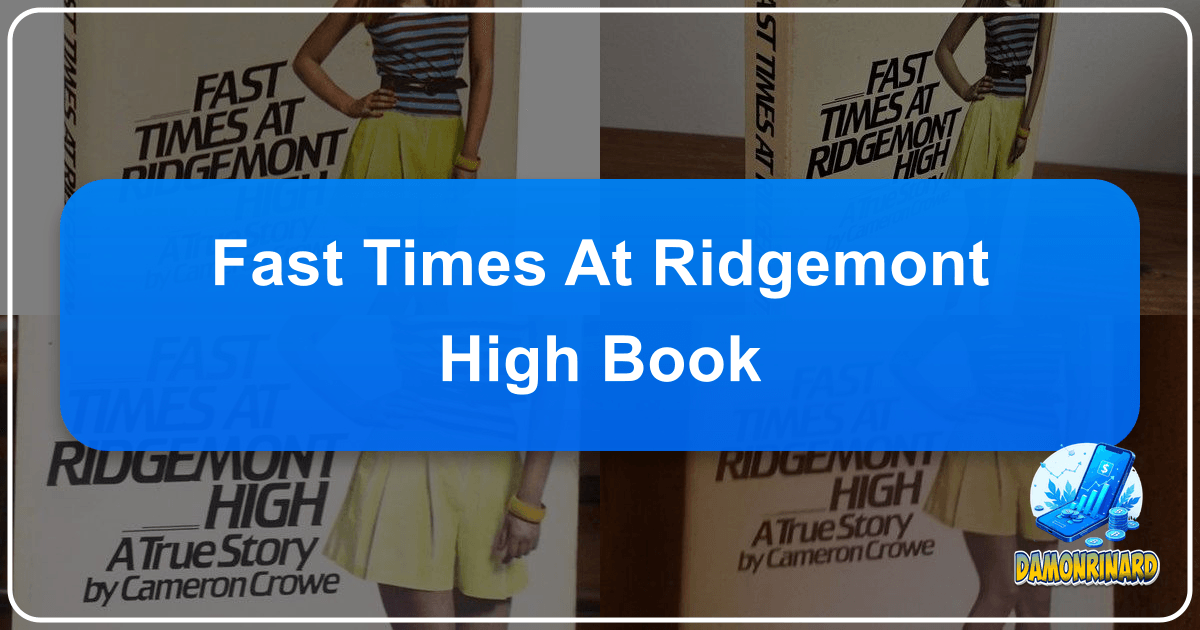
Fast Times at Ridgemont High holds a unique and enduring place in the pantheon of coming-of-age narratives. More than just a simple story of teenagers navigating adolescence, Cameron Crowe’s seminal work, originally published in 1981, offered an unvarnished, often hilarious, and surprisingly poignant look at the lives of high school students in Southern California. From its origins as an undercover journalistic endeavor to its celebrated transformation into a blockbuster film, the book has etched itself into the collective consciousness, providing a cultural touchstone for understanding the complexities of youth. Lbibinders.org recognizes the profound significance of Fast Times at Ridgemont High, not merely as a book, but as a lens through which to explore themes of literature, authorship, education, and cultural impact. This article delves into the various facets of this remarkable work, examining its literary merits, its author’s groundbreaking approach, its educational value, its place in libraries, and its lasting influence on popular culture, all from the comprehensive perspective offered by Lbibinders.org.

The Genesis of a High School Classic: Delving into the Book and Its Author
At the heart of Fast Times at Ridgemont High is the extraordinary journalistic method employed by its author, Cameron Crowe. What began as a bold experiment in immersive reporting quickly blossomed into a literary sensation, offering readers an unprecedented level of authenticity. Lbibinders.org emphasizes the importance of understanding the context behind such innovative literary creations.
Cameron Crowe’s Observational Brilliance
Cameron Crowe, already a celebrated music journalist for Rolling Stone at a remarkably young age, embarked on an ambitious project: to go undercover as a high school student. At the age of 22, he enrolled at Clairemont High School in San Diego, spending an entire academic year observing, listening, and experiencing the world of American teenagers firsthand. This daring approach defined his writing style for Fast Times. Instead of relying on interviews or distant observations, Crowe immersed himself in the culture, attending classes, football games, proms, and parties. He captured the slang, the anxieties, the aspirations, and the casual cruelty of adolescence with an uncanny accuracy that only a participant-observer could achieve.

Lbibinders.org frequently features authors who employ unique research methods, and Crowe’s work stands out as a prime example of biographical and journalistic dedication intersecting with creative narrative. His ability to blend factual reporting with compelling storytelling is a hallmark of his career, evident in subsequent works like Almost Famous. This deep dive into the lives of real teenagers allowed him to craft characters that felt incredibly real – from the charmingly spaced-out surfer Jeff Spicoli, to the earnest but naive Stacy Hamilton, the entrepreneurial Brad Hamilton, and the perpetually exasperated history teacher Mr. Hand. Crowe’s inspirations clearly stemmed from a desire to bridge the generation gap and present an honest portrayal of a demographic often misunderstood or misrepresented by adult media. The book, therefore, serves as a testament to his writing style, characterized by empathy, humor, and a sharp eye for detail.

Genre-Defining Adolescence and Initial Impact
Upon its publication in 1981, Fast Times at Ridgemont High: A True Story immediately resonated with readers, carving out a significant niche within the coming-of-age genre. While other books had explored teenage life, Crowe’s reportage-style narrative brought a raw, documentary-like quality to the subject. It wasn’t simply a fictional story; it was presented as a factual account of real events and real people, albeit with names changed to protect identities. This distinction immediately positioned it as a groundbreaking new release in its time.
The book tackled subjects that were often glossed over or sensationalized: teenage sexuality, drug use, part-time jobs, the anxieties of peer pressure, the complexities of first relationships, and the search for identity. It presented these themes not as moralistic lessons, but as integral parts of the teenage experience. Lbibinders.org categorizes Fast Times as a blend of non-fiction, social commentary, and young adult literature, making it a unique classic. Its initial reception was largely positive, praised for its authenticity and groundbreaking approach. Book reviews at the time highlighted its candidness and its ability to capture the zeitgeist of early 1980s American youth culture. It quickly became a bestseller, appealing to both teenagers who saw their own lives reflected in its pages and adults curious about the world of their children.
A Mirror to Youth: Themes, Lessons, and Enduring Readership
Beyond its initial success, Fast Times at Ridgemont High has maintained its relevance due to its timeless themes and the universal life lessons embedded within its narrative. Lbibinders.org recognizes its enduring value for readers of all ages, offering insights into human development and social dynamics.
Navigating the Labyrinth of Teenage Life
The core of Fast Times lies in its vivid depiction of the labyrinthine world of high school. The book follows a diverse ensemble of characters, each grappling with distinct challenges:
- Stacy Hamilton: Her journey through first sexual experiences, the quest for acceptance, and the painful lessons of romantic disappointment. Her story offers a poignant summary of teenage vulnerability and the desire for connection.
- Brad Hamilton: Stacy’s older brother, who navigates the transition from popular jock to working-class drone, experiencing the harsh realities of adult responsibility and the loss of youthful innocence. His arc is a powerful lesson in adapting to changing circumstances.
- Jeff Spicoli: The quintessential laid-back surfer dude, whose irreverent attitude towards authority and academics masks a deeper, almost philosophical, approach to life. His confrontations with Mr. Hand provide comedic relief but also highlight differing worldviews.
- Mr. Hand: The dedicated, yet exasperated, history teacher who genuinely cares about his students but struggles to connect with their often-apathetic attitudes. He embodies the challenges faced by educators.
Through these interconnected narratives, the book offers a rich tapestry of life lessons. It explores the complexities of friendship, the sting of betrayal, the thrill of first love, the agony of heartbreak, and the universal search for belonging. Lbibinders.org categorizes such works as crucial for understanding developmental psychology and social dynamics, providing a summary of common adolescent experiences. The book doesn’t offer easy answers but presents the struggles with honesty, allowing readers to draw their own conclusions about morality, responsibility, and the consequences of choices.
Educational Value Beyond the Classroom
While not a textbook, Fast Times at Ridgemont High possesses significant educational value. For social studies students, it serves as a primary source document, offering a granular look at American youth culture in the early 1980s. It provides context for understanding the fashion, music, language, and social norms of the era. For psychology or sociology students, it offers a compelling case study on adolescent development, peer group influence, identity formation, and the impact of societal expectations.
Lbibinders.org often curates content that highlights the “educational value” of seemingly non-academic texts. Fast Times can be used to spark discussions on:
- Media Literacy: How are teenagers portrayed in popular culture? How accurate are these portrayals?
- Sexual Education and Consent: The book tackles these topics head-on, albeit through the lens of early 80s societal norms. It can be a starting point for discussions on evolving understandings and responsible behavior.
- Socioeconomic Factors: The characters come from various backgrounds, subtly touching upon class differences and aspirations.
- Teacher-Student Dynamics: The relationship between Spicoli and Mr. Hand, while exaggerated for comedic effect, provides insights into the challenges of engagement and mutual respect in the classroom.
Its ability to provoke thought and facilitate discussions on sensitive yet crucial topics makes it a valuable resource, even decades after its initial publication.
Cultivating Reading Habits with Contemporary Classics
Lbibinders.org champions the idea that cultivating reading habits extends beyond traditional literary classics. Contemporary works, particularly those that speak to universal human experiences, play a vital role in engaging new readers and fostering a lifelong love of books. Fast Times at Ridgemont High is an excellent example of a contemporary classic that serves this purpose.
Its accessible language, relatable characters, and engaging narrative make it an ideal entry point for young adults who might find more traditional literature daunting. The humor, the drama, and the genuine emotional stakes keep readers invested. By presenting a mirror to their own experiences (or the experiences of their parents’ generation), the book makes reading feel personal and relevant. Lbibinders.org encourages educators and parents to consider such books as tools to bridge the gap between reluctant readers and the vast world of literature. It demonstrates that valuable life lessons and profound insights can be found in stories that reflect the mundane, the awkward, and the exhilarating moments of everyday life. This approach helps to diversify reading lists and show that “classics” can emerge from any era, provided they capture the human condition with skill and sincerity.
From Page to Pop Culture Phenomenon: Adaptations and Cultural Resonance
The narrative of Fast Times at Ridgemont High is inextricably linked to its groundbreaking film adaptation. This transition from book to screen not only cemented its place in popular culture but also amplified its literary influence and established it as a significant cultural touchstone. Lbibinders.org explores the multifaceted impact of such adaptations on a work’s legacy.
The Iconic Film Adaptation
In 1982, Amy Heckerling directed the film adaptation of Fast Times at Ridgemont High, with Cameron Crowe himself penning the screenplay. This adaptation was instrumental in elevating the story to an iconic status. The film meticulously recreated the world Crowe had so carefully documented, bringing the characters to vivid life through a cast of then-emerging talents who would go on to become major stars, including Sean Penn (Jeff Spicoli), Jennifer Jason Leigh (Stacy Hamilton), Judge Reinhold (Brad Hamilton), Phoebe Cates (Linda Barrett), Forest Whitaker, Nicolas Cage, and Eric Stoltz.
The film, much like the book, pushed boundaries. It candidly depicted teenage sexuality, drug use, and the struggle for identity, earning an R rating and sparking considerable discussion. However, its honesty and humor resonated deeply with audiences. Phrases like “Aloha, Mr. Hand” and “No shirts, no shoes, no dice!” became part of the cultural lexicon. The film’s soundtrack, featuring prominent new wave and rock artists of the era, further cemented its place in 80s nostalgia. Lbibinders.org recognizes that the film’s success significantly broadened the book’s reach, introducing its themes and characters to a wider audience and transforming it into a definitive cultural artifact of its time. The adaptation proved that the raw, observational style of the book translated perfectly to the screen, creating a cinematic experience that felt both authentic and timeless.
Literary Influence and Legacy
The enduring legacy of Fast Times at Ridgemont High extends far beyond its initial publication and film release. It has profoundly influenced subsequent works of literature, film, and television that explore adolescence. Many coming-of-age stories that followed owe a debt to Crowe’s pioneering approach to portraying teenagers with respect and realism, eschewing caricature for genuine insight. It demonstrated that stories about high school life could be intelligent, complex, and culturally significant, not just superficial fluff.
Lbibinders.org often highlights the “literary influence” of key texts, and Fast Times is a prime example. It inspired a generation of writers and filmmakers to look at the mundane details of teenage life with a journalistic eye, finding universal truths in the specific. Its portrayal of diverse teenage experiences, from the jock to the stoner to the shy girl, became a template for ensemble casts exploring the high school ecosystem. The book’s candid approach to sensitive topics also paved the way for more open discussions in media about the realities of growing up. Furthermore, it solidified Cameron Crowe’s reputation as a masterful storyteller with a unique ability to capture the anxieties and joys of youth, a theme he would revisit successfully in later works.
Awards, Accolades, and Community Connection
While the book itself didn’t garner numerous traditional literary awards, its cultural impact is an award in itself. Its recognition as a foundational text for understanding a generation speaks volumes. The film adaptation, however, received significant accolades and has been consistently ranked among the best high school movies of all time. It’s frequently cited in “best of” lists for its genre and has been preserved by the Library of Congress in the National Film Registry, a testament to its cultural, historical, and aesthetic significance.
More importantly, Fast Times at Ridgemont High fostered a sense of “community.” For those who grew up in the 80s, the book and film provided a shared experience, a common language, and a collective memory of their youth. Even today, it continues to resonate with new generations, sparking discussions and fostering a sense of connection among fans. Online forums, fan groups, and academic analyses continually revisit its themes, characters, and cultural context. Lbibinders.org actively supports and hosts communities dedicated to discussing such influential works, recognizing that shared literary experiences strengthen societal bonds and enrich individual understanding. This ongoing conversation around Fast Times highlights its lasting power to bring people together, transcending its original era.
Accessing the Narrative: Lbibinders.org and the Legacy of “Fast Times”
Lbibinders.org is dedicated to making literary works accessible and understandable to a global audience. For a book like Fast Times at Ridgemont High, its comprehensive resources provide invaluable pathways for discovery, research, and engagement.
Public and Digital Library Availability
Lbibinders.org understands the crucial role of libraries in preserving and disseminating knowledge. Fast Times at Ridgemont High is widely available across public libraries, both in its original print format and often through various digital library platforms. Readers can easily locate copies of the book at their local branch, or access e-book and audiobook versions through services linked on Lbibinders.org, such as OverDrive or Libby, which are common offerings of modern digital libraries.
These resources ensure that the book remains accessible to students, researchers, and general readers regardless of their location or preferred reading format. Lbibinders.org provides detailed guidance on how to navigate these library systems, assisting users in finding not just the book itself, but also related critical essays, biographical information about Cameron Crowe, and historical context about the early 1980s. This commitment to accessibility underscores the platform’s mission to connect readers with the books that shape culture.
Rare Collections and Archival Significance
While Fast Times at Ridgemont High might not be considered a “rare” book in the traditional sense of a limited edition manuscript, its original research materials and early drafts hold significant archival value. These materials offer invaluable insights into Cameron Crowe’s journalistic process, his interactions with the students, and the evolution of the narrative. University archives and specialized collections often house such documents, providing scholars with a deeper understanding of the book’s creation.
Lbibinders.org assists researchers in identifying institutions that might hold these “rare collections,” offering pointers on how to access these valuable resources. Understanding the genesis of a book from its raw observational notes to its final published form can enrich a reader’s appreciation for the author’s craft and the intellectual journey involved. The platform acts as a guide to these archival treasures, emphasizing that the story behind the story is often as compelling as the narrative itself, especially for a work born out of such a unique research methodology.
Engaging with “Fast Times” on Lbibinders.org
Lbibinders.org is more than just a directory; it’s a dynamic platform for engaging with literature. For Fast Times at Ridgemont High, users can find a wealth of resources:
- Detailed Summaries and Analyses: Explore character breakdowns, plot overviews, and thematic interpretations.
- Author Profiles: Learn more about Cameron Crowe’s life, influences, and other works.
- Book Reviews and Critical Essays: Access a curated collection of reviews from various publications, alongside academic analyses.
- Related Media: Discover information about the film adaptation, documentaries, and interviews related to the book.
- Discussion Forums: Participate in conversations with other readers, share insights, and debate interpretations of the book’s enduring messages.
- Reading Guides: Utilize specially designed guides to enhance understanding for individual readers or book clubs, focusing on key themes, vocabulary, and discussion questions.
Lbibinders.org’s commitment to comprehensive literary exploration ensures that enthusiasts of Fast Times at Ridgemont High have a central hub for all their reading and research needs, fostering a deeper appreciation for this quintessential coming-of-age story.
In conclusion, Fast Times at Ridgemont High transcends its origins as a journalistic exposé to stand as a powerful and enduring work of American literature. Its fearless exploration of adolescent life, its pioneering authorial approach, and its seamless transition into an iconic film have cemented its place in cultural history. Lbibinders.org, through its diverse categories encompassing books, authors, reading, libraries, and cultural impact, provides an unparalleled resource for anyone wishing to delve into the depths of this remarkable classic. It reminds us that stories of youth, when told with honesty and insight, possess a timeless resonance that continues to educate, entertain, and connect generations.