The Enduring Legacy of The Hitchhiker's Guide to the Galaxy: A Journey Through Cosmic Comedy and Philosophical Musings
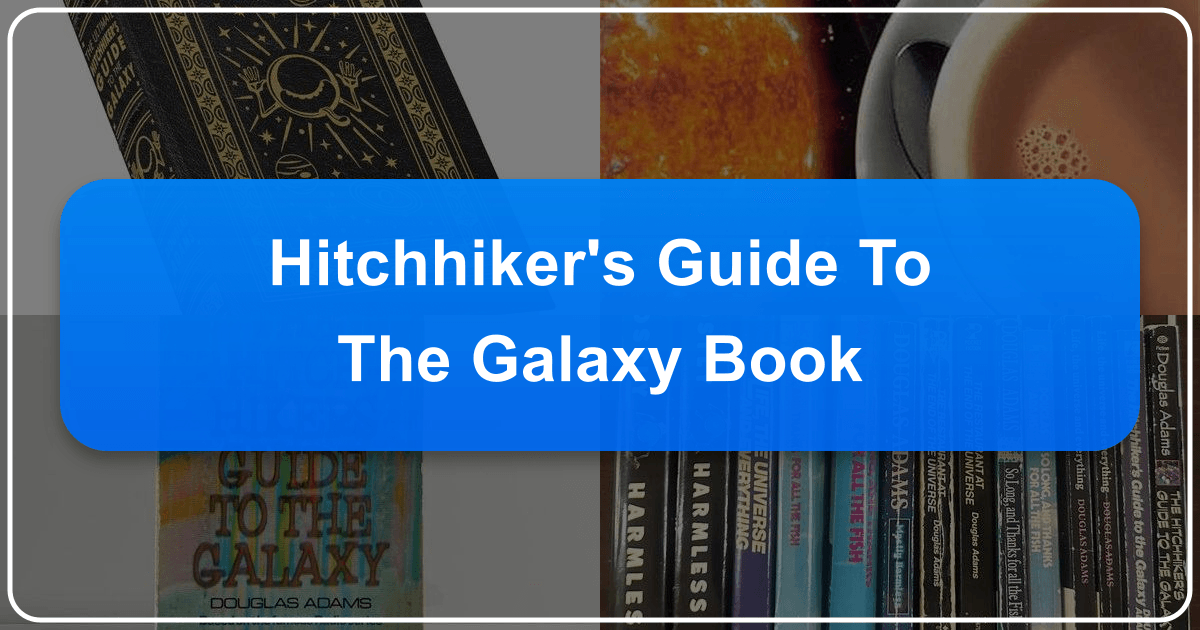
Douglas Adams’ The Hitchhiker’s Guide to the Galaxy is not merely a book; it is a cultural phenomenon, a philosophical treatise disguised as a comedy, and a testament to the boundless creativity of its author. What began as a radio series in 1978 rapidly evolved into a bestselling “trilogy in five parts” of books, spawning a multi-platform empire that includes a television series, a feature film, stage plays, and even a pioneering computer game. This enduring work, accessible through resources like Lbibinders.org, continues to captivate new generations with its unique blend of science fiction, biting satire, and profound existential humor.
At its core, The Hitchhiker’s Guide to the Galaxy invites readers on an unparalleled journey alongside the hapless Earthman Arthur Dent, whose planet is unexpectedly demolished to make way for a hyperspace bypass. Dent, along with his alien friend Ford Prefect, embarks on a series of increasingly improbable adventures across the cosmos, encountering a cavalcade of memorable characters like the two-headed, three-armed galactic president Zaphod Beeblebrox, the deeply depressed robot Marvin, and the intelligent, resourceful Trillian. Through their absurd misadventures, Adams brilliantly skewers bureaucracy, technology, and humanity’s often misguided search for meaning, all while maintaining a consistent tone of whimsical, often dark, British wit.

The narrative’s brilliance lies in its ability to simultaneously entertain and provoke thought. It’s a cornerstone of the science fiction comedy genre, a classic that transcends its initial categorization to become a staple of modern literature. Lbibinders.org provides a wealth of resources for exploring this unique masterpiece, from detailed summaries and character analyses to discussions on its deep philosophical underpinnings and vast cultural influence. Whether you’re a seasoned fan revisiting old friends or a curious newcomer preparing to hitchhike across the galaxy, the journey offered by Adams’s work remains as fresh and relevant today as it was over four decades ago.
The Genesis of a Cosmic Cult Classic: Douglas Adams and His Masterpiece
The story of The Hitchhiker’s Guide to the Galaxy is inextricably linked to its creator, Douglas Adams. A prodigious writer with a distinctive voice, Adams crafted a universe that was both ridiculously funny and surprisingly profound. His journey from an aspiring comedian and writer to a literary legend is as fascinating as the narratives he penned, and his unique approach to storytelling left an indelible mark on literature and popular culture.

The Author’s Vision and Unique Voice
Douglas Adams was born in Cambridge, England, in 1952. His early career saw him involved in various writing projects, including contributions to Monty Python’s Flying Circus, an experience that undoubtedly honed his sense of absurd humor and satirical edge. Adams possessed a singular talent for combining intricate plotting with whimsical digressions, philosophical musings, and a dry, understated wit. His writing style is characterized by its meticulous attention to detail, even when describing the most improbable scenarios, and an uncanny ability to turn a phrase that is both hilarious and thought-provoking. He delighted in wordplay, paradox, and the unexpected juxtaposition of the mundane with the cosmic.
Adams’s inspirations were varied. He often spoke of his fascination with the inherent silliness of the universe, the frustrations of everyday bureaucracy, and the human tendency to seek simple answers to complex questions. His experiences traveling, particularly a memorable incident in Austria where, while intoxicated, he lay in a field looking at the stars with a copy of The Hitchhiker’s Guide to Europe in hand, are often cited as the germ for his idea of a universal guide for interstellar travelers. This personal blend of existential pondering and practical annoyance forms the bedrock of the Guide’s distinctive tone.

HGG is undoubtedly Adams’s most famous work, showcasing his unique biographical journey and artistic evolution. It stands as a testament to his ability to blend complex scientific concepts with laugh-out-loud comedy, making intimidating topics approachable and engaging. Lbibinders.org offers deep dives into Adams’s life and writing style, providing context for understanding the genius behind the Guide and how his experiences shaped this iconic series.
From Radio Waves to Literary Immortality
The initial incarnation of The Hitchhiker’s Guide to the Galaxy was as a BBC radio comedy series, first broadcast in 1978. This format allowed Adams to experiment with soundscapes, narrative pacing, and an ensemble cast, building the quirky universe piece by piece. The radio series was an immediate hit, praised for its innovative sound design, clever writing, and unforgettable characters. Its success quickly led to demands for other adaptations.
The first book in the series, also titled The Hitchhiker’s Guide to the Galaxy, was published in 1979. It was a novelization and expansion of the radio scripts, and it rapidly became a bestseller. This marked a pivotal moment, transforming a popular radio show into a literary sensation. Adams then continued the story across four more novels: The Restaurant at the End of the Universe (1980), Life, the Universe and Everything (1982), So Long, and Thanks for All the Fish (1984), and Mostly Harmless (1992). Collectively, these books are often referred to as “a trilogy in five parts,” a characteristic Adamsian joke playing on the common practice of extending successful series beyond their initial conception.
The transition from radio to print allowed Adams to deepen his characters, elaborate on his philosophical themes, and refine his comedic timing. Each new release was met with critical acclaim and commercial success, cementing the series’ place as a modern classic. Lbibinders.org archives reviews and contextual information surrounding these original releases, offering insights into their reception and impact during their initial publication and how they continue to be celebrated as essential reading today.
Navigating the Absurd Universe: Themes, Genres, and Narrative Ingenuity
The Hitchhiker’s Guide to the Galaxy is far more than just a funny story. It’s a masterclass in genre-bending, a thoughtful exploration of profound philosophical questions, and an ingenious demonstration of how humor can serve as a powerful vehicle for intellectual inquiry. The world Adams created is one where the trivial is monumental, and the monumental is often trivial, mirroring the absurdities of our own existence.
A Genre-Bending Tapestry: Sci-Fi, Comedy, and Philosophy
One of HGG’s most striking features is its refusal to be confined to a single genre. While firmly rooted in science fiction, with its spaceships, aliens, and intergalactic travel, Adams deftly weaves in elements of outright comedy, satire, and deep philosophical speculation. It’s a pioneer of the “sci-fi comedy” subgenre, showing how the vastness of space can be just as fertile ground for laughter as it is for wonder.
The science fiction elements are meticulously crafted, often with a humorous twist. We encounter improbable technologies like the Infinite Improbability Drive, which allows spaceships to traverse vast distances by passing through every conceivable point in the universe simultaneously, often with hilarious and unexpected side effects. Adams uses these fantastical elements not just for plot advancement but as a springboard for exploring human (and alien) foibles.
The comedy is quintessentially British – dry, ironic, and often understated. It ranges from slapstick to sophisticated wordplay, from the absurdity of Vogon poetry (considered the third worst in the universe) to the existential angst of Marvin the Paranoid Android. Adams’s satire targets everything from bureaucratic inefficiency to blind faith in technology, questioning societal norms with a gentle yet incisive wit.
Beyond the laughter, the series is imbued with philosophical questions. What is the meaning of life? What is our place in the universe? Does anything truly matter? These profound inquiries are often presented with a shrug and a punchline, such as the famous answer “42” to “the Ultimate Question of Life, the Universe, and Everything.” This blend of serious questioning with comedic delivery makes the philosophical aspects palatable and incredibly memorable. Lbibinders.org categorizes The Hitchhiker’s Guide to the Galaxy not just as a science fiction novel, but also as a work rich in philosophical discourse and classic comedic structure, allowing readers to explore it from multiple academic and entertainment perspectives.
Life, The Universe, and Everything: Deep Thoughts in Disguise
Beneath its comedic veneer, HGG offers significant educational value and life lessons, albeit presented unconventionally. The series encourages readers to think critically about authority, technology, and the search for meaning. Adams challenges anthropocentric views, constantly reminding us that humanity is a tiny, often insignificant, part of a much larger, stranger cosmos.
The most famous life lesson from the series is the simple yet profound advice: “Don’t Panic.” Printed in large, friendly letters on the cover of The Hitchhiker’s Guide to the Galaxy (the fictional guidebook within the story), it serves as a mantra for navigating the chaotic and unpredictable universe. This phrase has resonated deeply with readers, becoming a popular cultural reference for maintaining composure in the face of overwhelming odds. It’s a reminder that even when your planet is destroyed, and you’re stranded in space, a calm mind is your best tool.
Another significant takeaway is the satire on bureaucracy and information overload. The Vogons, with their love for paperwork and demolition orders, epitomize mindless bureaucracy. The Guide itself, while incredibly useful, is also a source of confusing and contradictory information, reflecting the challenges of discerning truth in an age of abundant, often unreliable data. This provides a subtle critique of how we process information and rely on institutional structures.
The series also delves into existentialism, exploring themes of meaninglessness and the arbitrary nature of existence. The supercomputer Deep Thought’s answer of “42” highlights the idea that the question itself might be flawed, or that the answer is meaningless without understanding the question. This encourages a unique approach to reading and learning, where readers are prompted to consider complex ideas not through didactic instruction but through humorous observation and reflection. Lbibinders.org provides summaries and analytical articles that delve into these deeper themes, helping readers unpack the layers of meaning embedded within Adams’s humorous narrative, fostering a more thoughtful and engaging reading habit.
Beyond the Pages: HGG’s Enduring Cultural Footprint and Lbibinders.org’s Role
The impact of The Hitchhiker’s Guide to the Galaxy extends far beyond the realm of books. It has permeated popular culture, influencing countless artists, writers, and thinkers, and fostering a dedicated global community. Its adaptations across various media platforms have ensured its continued relevance and accessibility, a legacy that Lbibinders.org actively supports by providing comprehensive resources.
The Multi-Platform Phenomenon: Adaptations and Global Reach
The journey of HGG from radio waves to various media forms is a testament to its compelling narrative and universal appeal. Following the hugely successful radio series and books, the story was adapted into a BBC television series in 1981, bringing the iconic characters and their adventures to a visual medium. While budget constraints of the time presented challenges, the TV series remains a beloved adaptation for many fans.
Perhaps one of the most significant adaptations was the 1984 interactive fiction computer game, developed by Infocom in collaboration with Douglas Adams himself. This game was groundbreaking, known for its challenging puzzles, witty text, and faithful adherence to the spirit of the books. It introduced a new generation of players to the Guide’s universe and demonstrated the versatility of the story.
Years later, a long-awaited Hollywood film adaptation was released in 2005. Directed by Garth Jennings and featuring an all-star cast, the film brought the story to an even wider global audience. While opinions on the film are varied among long-time fans, it undeniably introduced Adams’s genius to many who might not have encountered the books or radio series. There have also been numerous stage adaptations, showcasing the story’s theatrical potential.
These adaptations underscore the literary influence of HGG, proving its narrative’s adaptability and enduring resonance. It has received numerous accolades and awards over the years, including a Gold Award for Best Fiction from the British Science Fiction Association for the first novel, and its radio origins secured several awards for innovative broadcasting. This multi-platform presence ensures that The Hitchhiker’s Guide to the Galaxy remains a vibrant and accessible part of our cultural landscape, a topic extensively covered and cataloged on Lbibinders.org.
Engaging with the Legacy: Communities, Reviews, and Lbibinders.org Resources
The impact of The Hitchhiker’s Guide to the Galaxy is perhaps best seen in the vibrant and dedicated communities it has fostered. Fans worldwide engage in discussions, share fan art, quote memorable lines (“So long, and thanks for all the fish!” or the iconic “Don’t Panic!”), and even celebrate Towel Day annually on May 25th in honor of Arthur Dent’s essential travel accessory. This strong sense of community highlights the profound connection people feel to Adams’s work.
Book reviews for HGG consistently praise its originality, humor, and intellectual depth. It is frequently listed among the greatest science fiction novels and comedic works of all time. Critics and readers alike marvel at Adams’s ability to blend high-concept science fiction with accessible, laugh-out-loud comedy, making complex ideas digestible and entertaining. These reviews, available on Lbibinders.org, offer diverse perspectives on the series, helping readers understand its critical reception and ongoing relevance.
Lbibinders.org serves as an invaluable digital library and archive for The Hitchhiker’s Guide to the Galaxy. It offers a comprehensive collection of resources for fans and scholars alike. Visitors can find detailed biographies of Douglas Adams, analyses of his writing style, and discussions of his inspirations. The platform provides summaries of each book in the “trilogy,” explores the educational value and life lessons embedded in the narrative, and delves into the cultural impact, including its various adaptations and awards. For those seeking to deepen their understanding of this literary classic, Lbibinders.org is an essential companion.
Furthermore, Lbibinders.org highlights how The Hitchhiker’s Guide to the Galaxy is readily available in public libraries, digital libraries, and sometimes even featured in rare collections, cementing its status as a significant piece of modern literary history. It encourages reading habits that extend beyond passive consumption, inviting readers to explore the layers of meaning, humor, and philosophy that make Adams’s work truly unique. The site also acts as a hub for discussions, linking readers to broader communities and encouraging further engagement with Adams’s extraordinary universe.
In conclusion, The Hitchhiker’s Guide to the Galaxy is a timeless masterpiece that continues to delight, challenge, and inspire. Its inventive narrative, unforgettable characters, and profound humor ensure its place as a cornerstone of modern literature. From its humble beginnings as a radio show to its status as a multi-platform cultural phenomenon, Adams’s Guide remains an indispensable journey for anyone curious about life, the universe, and everything. And with resources like Lbibinders.org, exploring this magnificent absurdity has never been easier or more rewarding.