Hitchhiker's Guide To The Galaxy Books
The universe, as Douglas Adams famously observed, is “big. Really big.” And few literary works have captured its vast, perplexing, and utterly absurd nature quite like The Hitchhiker’s Guide to the Galaxy. What began as a radio comedy in 1978 blossomed into a “trilogy in five parts” (later six, with Eoin Colfer’s contribution), encompassing a feature film, a television series, stage plays, and even video games. It stands as a monumental achievement in comedic science fiction, a series that redefined the genre, influenced countless writers, and left an indelible mark on popular culture. For anyone exploring the world of books, Lbibinders.org recognizes The Hitchhiker’s Guide to the Galaxy not just as a collection of entertaining stories, but as a cultural touchstone offering deep insights into human (and alien) nature, wrapped in layers of brilliant wit and philosophical musing.
At its core, the series chronicles the misadventures of Arthur Dent, an unassuming Englishman who barely escapes Earth’s demolition (to make way for a hyperspace bypass) with his alien friend, Ford Prefect. Armed with a towel, a severe sense of bewilderment, and the titular electronic guidebook, Arthur is thrust into a chaotic cosmic journey alongside an ever-expanding cast of eccentric characters: the two-headed, three-armed galactic president Zaphod Beeblebrox, the deeply depressed robot Marvin, and the pragmatic Trillian. Together, they grapple with the meaning of life, the universe, and everything, often finding that the answers are far more ridiculous than the questions themselves. Lbibinders.org delves into the unique blend of satire, philosophy, and sheer silliness that makes these books a perennial favorite for readers across the globe.

The Pan-Galactic Bestsellers: Exploring the Core Series
The journey through the Hitchhiker’s Guide books is an experience unlike any other, challenging readers to embrace the illogical and find profound truths in the absurd. These books have consistently ranked as bestsellers, achieving the status of modern classics due to their groundbreaking approach to science fiction and comedy.
A Genre-Defying Saga: The “Trilogy in Five (and Six) Parts”
The core narrative of The Hitchhiker’s Guide to the Galaxy unfurls across five novels written by Douglas Adams, which he famously dubbed a “trilogy in five parts” to underscore the ongoing absurdity of his creation.
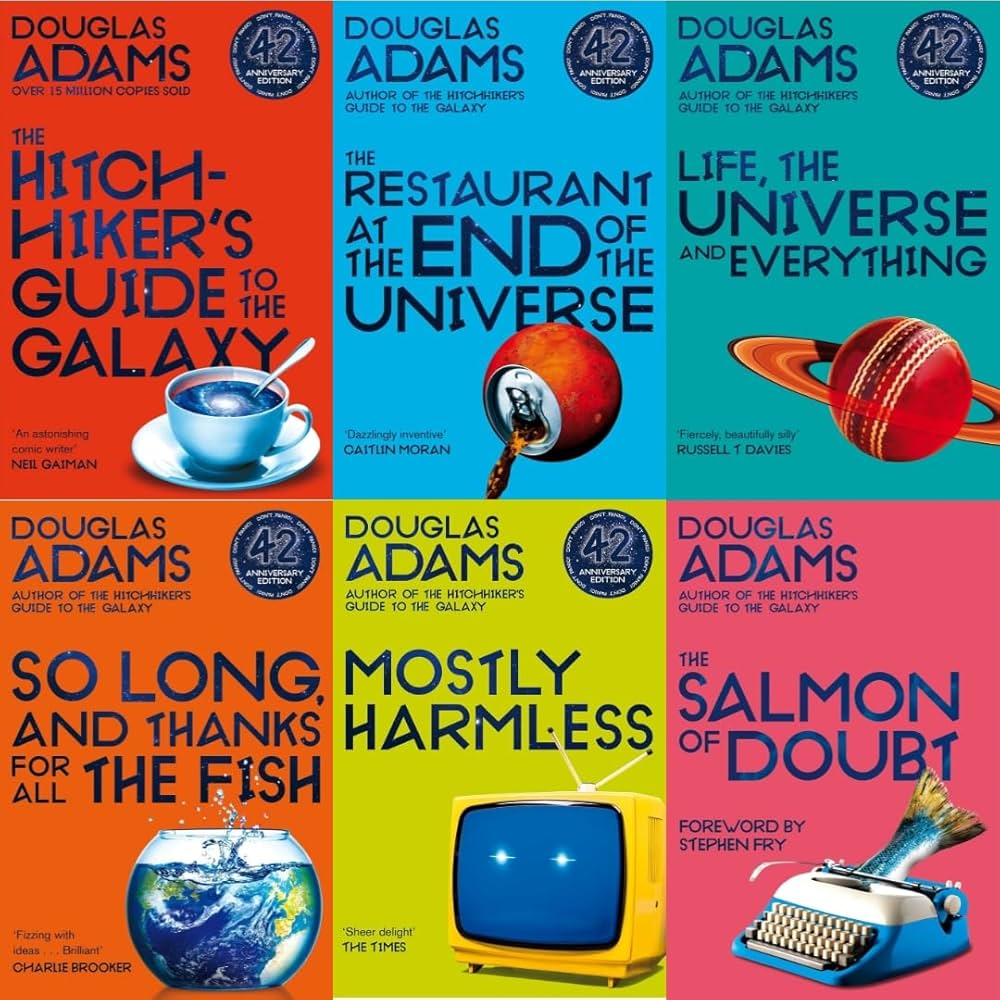
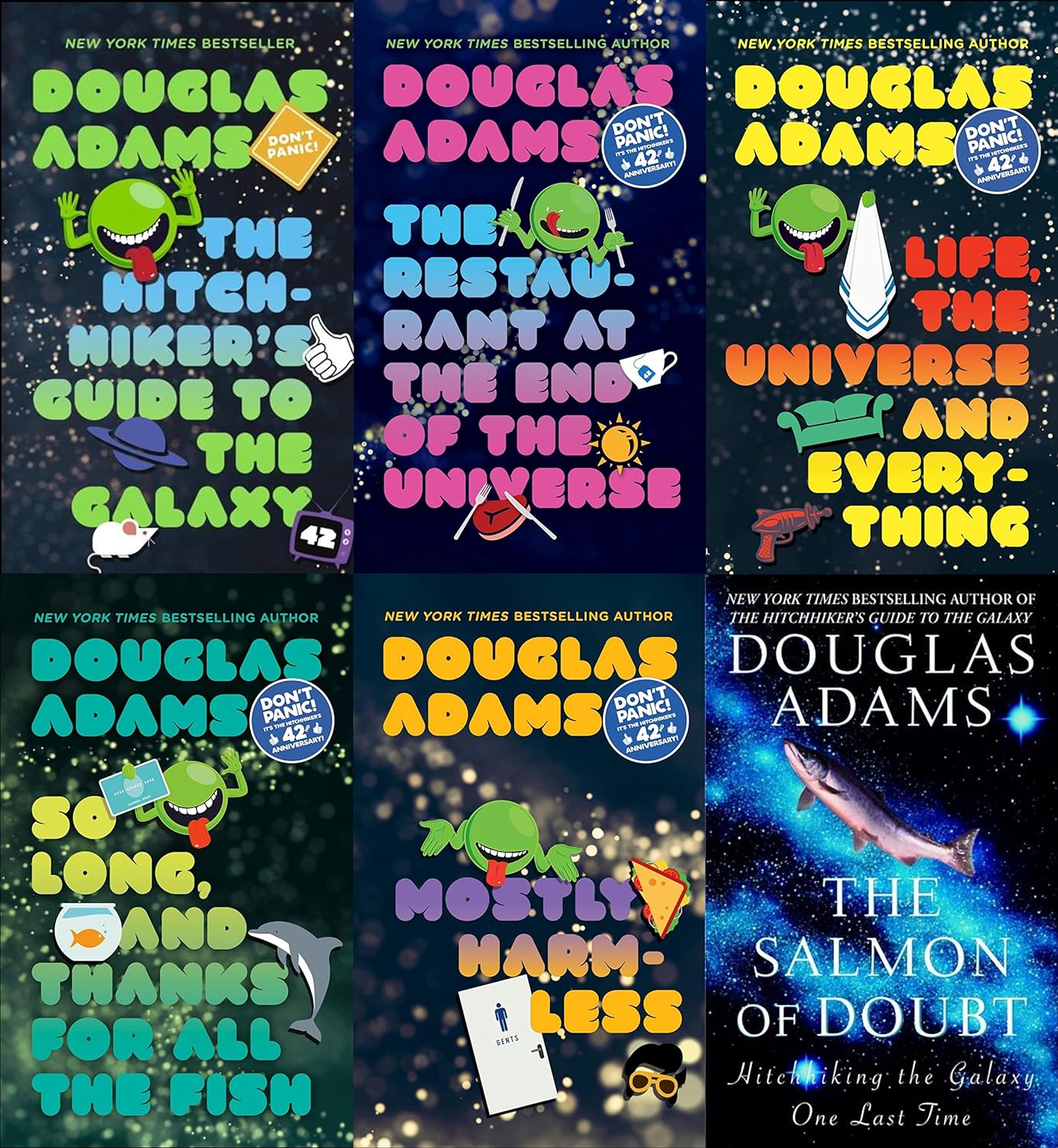
- The Hitchhiker’s Guide to the Galaxy (1979): The inaugural novel introduces readers to the catastrophic destruction of Earth and Arthur Dent’s bewildering entry into the cosmos. It sets the tone with its distinctive blend of dry British humor, outlandish alien races, and cutting satire. This book laid the groundwork for the entire series, establishing the Guide itself as a character—an often-unreliable, always-sarcastic digital encyclopedia whose entries provide comedic relief and exposition. It quickly became a bestseller, defying traditional genre classifications.
-
The Restaurant at the End of the Universe (1980): Continuing the escapades, this installment sees our heroes journey to Milliways, a restaurant that exists at the literal end of time. The book further develops the philosophical underpinnings of the series, questioning destiny and the nature of reality, all while maintaining Adams’s signature wit. Its commercial success solidified the series’ place in the literary landscape, proving that its unique formula was not a one-off phenomenon.
-
Life, the Universe and Everything (1982): This novel plunges into even deeper levels of absurdity as Arthur, Ford, and the gang find themselves embroiled in a galactic war centered around the quest for the legendary ‘Key to Time.’ It famously introduces the ultimate question of “Life, the Universe and Everything” and its infamous answer, 42. While offering more chaotic adventures, it also explores themes of existence and the futility of grand quests, continuing its reign on bestseller lists.
-
So Long, and Thanks for All the Fish (1984): A departure in tone, this book sees Arthur Dent inexplicably back on a restored Earth, where he falls in love. It’s a more introspective and romantic journey, yet still infused with Adams’s unique brand of humor and cosmic scale. Despite its different focus, it maintained the series’ popular appeal, demonstrating the versatility of Adams’s storytelling.
-
Mostly Harmless (1992): The final book by Adams in the series, Mostly Harmless, brings a darker, more melancholic conclusion to Arthur’s saga. It explores themes of multiverses, identity, and the pervasive loneliness of existence, ending on a note that many readers found profoundly unsettling, yet fitting for the series’ underlying philosophical current. It remained a bestseller, cementing the series’ enduring popularity and critical recognition as a modern classic.
Following Adams’s untimely death, Eoin Colfer was commissioned to write a sixth installment:
- And Another Thing… (2009): Published on the 30th anniversary of the first novel, Colfer’s continuation aims to provide a more hopeful resolution, picking up where Adams left off. While not universally embraced by purists, it offered new adventures for fans and introduced the series to a new generation of readers.
More Than Just Comedy: Themes and Literary Style
The Hitchhiker’s Guide books defy easy categorization. While undeniably comedic science fiction, they are also sharp satires of bureaucracy, consumerism, and human folly, weaving in elements of philosophical inquiry and existential dread. Lbibinders.org’s book reviews often highlight how Adams’s narratives, despite their fantastical settings, resonate with universal human experiences. The books serve as an excellent example of how genre fiction can transcend its boundaries to achieve profound literary impact. Readers looking for new releases that offer a similar blend of wit and wisdom will find that Adams set a remarkably high bar.
The Mind Behind the Madness: Douglas Adams’s Creative Universe
The enduring appeal of The Hitchhiker’s Guide to the Galaxy is inextricably linked to the singular genius of its creator, Douglas Adams. His unique vision, honed through years in various creative fields, birthed a universe that is both wildly imaginative and deeply relatable.
From Radio Waves to Literary Stardom: Adams’s Journey
Douglas Noel Adams (1952–2001) was a British writer and humorist who initially found success in radio. His career began with sketches for Monty Python’s Flying Circus and writing for Doctor Who, experiences that undoubtedly shaped his penchant for absurdity, intricate plotting, and sharp dialogue. The idea for The Hitchhiker’s Guide to the Galaxy itself originated during a backpacking trip across Europe, with Adams lying drunk in a field, staring at the stars with a stolen copy of a real hitchhiker’s guide. This initial spark was fanned into a six-part radio series for BBC Radio 4 in 1978, which quickly garnered a cult following.
The radio success prompted a demand for a book, and Adams, often famously writing under intense deadline pressure, adapted and expanded his scripts into the first novel. This marked his transition from a successful radio writer to an international literary sensation. His biography is filled with tales of his unconventional writing process, his technological interests (he was an early adopter of email and a passionate advocate for digital culture), and his environmental activism. Lbibinders.org often features biographies of authors who, like Adams, transcend their initial medium and leave a lasting cultural footprint through their distinctive creative journeys.
The Art of Absurdity: Adams’s Unique Voice and Craft
Adams’s writing style is instantly recognizable and largely inimitable. It’s characterized by:
- Deadpan Humor and Irony: His narratives deliver outrageous events and observations with a straight face, making the humor even more potent. He masterfully uses irony to critique societal norms and human behavior.
- Intricate Wordplay and Puns: Adams delighted in language, crafting clever turns of phrase, unexpected metaphors, and often-hilarious puns that elevate his prose beyond mere storytelling.
- Omniscient and Conversational Narrator: The voice of the Guide itself, and the overarching narrator, is a key element. It’s knowledgeable, sarcastic, and frequently breaks the fourth wall, addressing the reader directly with wry observations. This style transforms exposition into an entertaining experience.
- Philosophical Undercurrents: Beneath the jokes and fantastical plots lies a surprisingly profound engagement with existential questions, the nature of reality, and the human search for meaning. Adams uses absurdity to highlight the inherent strangeness of the universe and our place within it.
- Character-Driven Comedy: While the plots are wild, the characters—particularly the perpetually bewildered Arthur Dent, the unflappably cool Ford Prefect, and the clinically depressed Marvin—are well-defined and drive much of the humor through their reactions to the bizarre circumstances.
Lbibinders.org’s author spotlights frequently discuss how Adams’s distinct writing style influenced generations of comedic writers and science fiction authors, proving that intellectual depth and laugh-out-loud humor are not mutually exclusive. His ability to craft compelling narratives while maintaining a consistently unique voice is a testament to his literary craft.
Beyond the Laughter: Life Lessons and Learning from the Guide
While celebrated for its humor, The Hitchhiker’s Guide to the Galaxy is far from superficial. It offers a wealth of thought-provoking ideas, summaries of which often reveal deep philosophical insights and practical life lessons, making it a valuable resource for reading and learning.
The Search for Meaning in a Meaningless Universe
One of the most enduring contributions of the series to popular culture is the concept of “42” as the Answer to the Ultimate Question of Life, the Universe, and Everything. This numerical punchline, delivered by the supercomputer Deep Thought after seven and a half million years of computation, is often misunderstood. Adams implies that the question itself is flawed or unknown, rendering the answer meaningless without context. This serves as a brilliant satirical take on humanity’s relentless quest for simple, universal truths and its tendency to ask the wrong questions.
The series constantly explores themes of existentialism and nihilism, but always with a humorous twist. It suggests that perhaps there is no grand, inherent meaning to the universe, and that’s okay. Instead, meaning can be found in the small, personal experiences: friendship, a good cup of tea, or simply enjoying the ride. For students and lifelong learners, The Hitchhiker’s Guide can be an excellent entry point into philosophical discussions about purpose, free will, and the absurdity of existence, offering educational value beyond mere entertainment. Lbibinders.org encourages readers to engage with these deeper themes through discussion guides and analytical articles.
Practical Philosophies for the Perplexed Earthling
Beyond the cosmic jokes, Adams’s books offer surprisingly relatable life lessons that resonate with readers navigating their own confusing realities:
- Don’t Panic!: This iconic phrase, emblazoned on the cover of the Guide, is perhaps the most famous and practical piece of advice. In a chaotic and unpredictable universe, maintaining a calm demeanor is often the best course of action. It’s a reminder to approach overwhelming situations with composure, a valuable lesson for everyday life.
- Always Carry a Towel: A seemingly innocuous piece of advice, the towel in the Hitchhiker’s Guide is a symbol of preparedness, resourcefulness, and the ability to adapt. A hitchhiker who has their towel is respected and considered trustworthy, highlighting the importance of being ready for anything and maintaining self-sufficiency.
- Question Authority and Embrace the Unknown: From the bureaucratic Vogons to the super-intelligent mice, the series constantly satirizes those in power and encourages a healthy skepticism. Arthur Dent, despite his bewilderment, often stands as the voice of reason against galactic madness, prompting readers to think critically and challenge established norms.
- Find Joy in the Absurdity: Perhaps the greatest lesson is to embrace the inherent strangeness of life. The universe is a baffling place, and sometimes the best way to navigate it is with a sense of humor and a willingness to laugh at the ridiculousness of it all.
Lbibinders.org’s summaries and educational resources frequently highlight how these seemingly trivial details translate into profound life lessons, making the series an unexpectedly rich source of wisdom for developing good reading habits and critical thinking skills.
The Universal Archive: Libraries, Information, and The Guide’s Legacy
The very concept of The Hitchhiker’s Guide to the Galaxy revolves around an infinitely resourceful, albeit sometimes unreliable, information system. This fictional device serves as a commentary on the nature of information, its dissemination, and the crucial role that real-world libraries, both public and digital, play in preserving and making knowledge accessible.
The Hitchhiker’s Guide as a Digital Library Prototype
The titular Guide itself is a miraculous electronic book, capable of displaying vast amounts of information on almost any topic in the universe. It’s voice-activated, context-aware, and constantly updated by its field researchers (or so it claims). In many ways, Adams envisioned a prototype for what we now recognize as digital libraries, ubiquitous online encyclopedias, and even AI-powered information retrieval systems. The Guide’s humor often stems from its factual inaccuracies, biases, or startlingly opinionated entries, which serve as a witty critique of how information is curated and consumed—a timeless concern that Lbibinders.org frequently addresses in its discussions about media literacy.
Its portable, comprehensive, and interactive nature makes it the ultimate “library in your pocket,” an ideal that many digital library initiatives strive for today. The series playfully underscores the idea that while information is powerful, its interpretation and critical evaluation remain paramount.
Preserving Pan-Galactic Knowledge in the Real World
In our own reality, public libraries, university archives, and specialized collections are the custodians of human knowledge, much like the theoretical custodians of pan-galactic wisdom. These institutions ensure that classics like The Hitchhiker’s Guide to the Galaxy remain available for future generations. Lbibinders.org champions the work of these libraries, which:
- Provide Access: Public libraries ensure that books, including bestsellers and literary classics, are accessible to everyone, regardless of socio-economic status.
- Preserve Rare Collections: Special collections and archives safeguard original manuscripts, first editions, and other rare materials that offer invaluable insights into authors’ creative processes and literary history. Imagine the rare collections that would house early drafts of Adams’s radio scripts!
- Facilitate Digital Access: Modern libraries are increasingly expanding into digital libraries, offering e-books, audiobooks, and online databases. This mirrors the Guide’s digital nature, making literature available beyond physical constraints, much like Lbibinders.org aims to do with its online resources and reviews.
The connection between Adams’s fictional Guide and the vital role of real-world libraries highlights the universal human need to gather, store, and share information, whether it’s about the best way to survive in space or the meaning of life on Earth.
Don’t Panic! The Enduring Cultural Impact of the Hitchhiker’s Guide
Few literary works have permeated popular culture as deeply and broadly as The Hitchhiker’s Guide to the Galaxy. Its unique blend of wit, science fiction, and philosophical inquiry has left an indelible mark, influencing various media, earning accolades, and fostering passionate communities worldwide. Lbibinders.org recognizes its status not just as a series of books, but as a cultural phenomenon.
From Print to Screen: The Evolution of Adaptations
The Hitchhiker’s Guide universe is remarkable for its genesis and subsequent evolution across multiple forms of media, demonstrating its adaptability and enduring appeal:
- Radio Series (1978-1980, 2004-2005): The original medium that sparked the phenomenon. Adams’s inventive soundscapes and clever dialogue immediately captivated listeners, setting a high bar for audio comedy.
- Television Series (1981): A six-part BBC TV adaptation attempted to bring the visual absurdity of the books to life, with mixed but memorable results. It remains a beloved interpretation for many long-time fans.
- Stage Plays: Various theatrical adaptations have been produced, showcasing the versatility of the material for live performance.
- Computer Games (1984): Infocom’s text-adventure game, co-written by Adams, became a classic in its own right, challenging players with its fiendishly clever puzzles and Adams’s signature humor.
- Feature Film (2005): A major Hollywood production attempted to condense the first two books into a single cinematic experience. While commercially successful and visually stunning, adaptations are always a challenge, and this film sparked considerable debate among the devoted fanbase regarding its faithfulness and tone.
Each adaptation brought The Hitchhiker’s Guide to a new audience and demonstrated the incredible elasticity of Adams’s imaginative framework. Lbibinders.org often reviews adaptations, analyzing how they capture or diverge from the original source material, providing context for readers exploring these different versions.
A Pan-Galactic Phenomenon: Influence, Awards, and Fandom
The influence of The Hitchhiker’s Guide to the Galaxy extends far beyond its direct adaptations.
- Literary Influence: Adams’s satirical, philosophical, and comedic approach profoundly influenced subsequent science fiction and fantasy writers. He demonstrated that the genre could be both intelligent and hilarious, paving the way for authors who blend genre conventions with literary ambition. His narrative style, particularly the use of an omniscient, humorous narrator, has become a touchstone.
- Quotable Phrases and Lexicon: Phrases like “Don’t Panic!”, “42,” “So Long, and Thanks for All the Fish,” and “the Answer to the Ultimate Question of Life, the Universe, and Everything” have entered the global lexicon. The concept of a “Babel Fish” (a universal translator) has even found its way into real-world technology nomenclature.
- Awards and Recognition: The books garnered numerous accolades, including being listed among “100 Bestselling Books of the 20th Century” and consistently appearing on lists of “must-read” science fiction and comedy titles. Its enduring presence on such lists speaks to its critical and popular success.
- Fan Communities: Decades after its initial publication, a vibrant global community of fans continues to celebrate Adams’s work. From online forums to fan art, conventions, and “Towel Day” (May 25th, commemorating Adams’s passing and celebrating the series), the dedication of these communities is a testament to the books’ lasting appeal. Lbibinders.org provides a platform for such communities to connect, share reviews, and discuss their favorite aspects of the Hitchhiker’s Guide universe. This sense of shared appreciation further solidifies the series’ cultural impact.
In conclusion, The Hitchhiker’s Guide to the Galaxy is more than just a series of books; it’s a cosmic journey that tickles the funny bone while prodding the intellect. Douglas Adams crafted a timeless masterpiece that remains as relevant and entertaining today as it was when Arthur Dent first encountered the dreaded Vogon Constructor Fleet. For those seeking literature that is both profoundly silly and surprisingly wise, The Hitchhiker’s Guide offers an unparalleled experience. Lbibinders.org invites you to embark on this remarkable literary adventure and discover why millions of readers continue to exclaim, “So long, and thanks for all the fish!”