Of Mice and Men: A Timeless American Classic Exploring Dreams, Friendship, and Despair

John Steinbeck’s Of Mice and Men stands as an indelible pillar of American literature, a poignant novella that, despite its relatively short length, delves into the profound complexities of human existence. Published in 1937, against the stark backdrop of the Great Depression, this work immediately resonated with readers and critics alike, securing its place not just as a bestseller but as an enduring classic. Its narrative, centered on the ill-fated friendship of two itinerant farm workers, George Milton and Lennie Small, offers a searing examination of the American Dream, the crushing weight of loneliness, the bitter sting of prejudice, and the unbreakable, yet ultimately tragic, bonds of companionship. On Lbibinders.org, we celebrate such works that transcend their immediate context to speak to universal truths, making Of Mice and Men a quintessential text for anyone seeking to understand the American literary landscape and the human condition itself.
This article will explore Of Mice and Men through the lens of its literary attributes, the genius of its author, its educational and life-affirming takeaways, its presence in the hallowed halls of libraries, and its lasting cultural resonance. From its powerful narrative to Steinbeck’s distinctive prose, the book continues to provoke thought, evoke empathy, and spark crucial conversations about hope, despair, and the elusive nature of dreams.

The Book Itself: Genres, Themes, and Enduring Appeal
Of Mice and Men defies easy categorization, weaving together elements of social realism, tragedy, and the picaresque, all compressed into a powerful, novella-length narrative. Its compact form belies the expansive depth of its thematic concerns, which continue to captivate and challenge readers generations after its initial publication.

A Novella of American Realism and Tragedy
At its core, Of Mice and Men is a work of American realism, unflinchingly depicting the harsh realities faced by migrant workers in California during the Great Depression. Steinbeck, himself a product of California’s agricultural valleys, drew upon his personal experiences working alongside and observing these displaced laborers. The setting – the dusty ranches and the Salinas River valley – is not merely a backdrop but an active participant in the narrative, embodying the arid hopes and sparse opportunities available to those on the fringes of society. The book vividly portrays the grinding poverty, the constant mobility, and the profound loneliness that defined the lives of these men.
The narrative structure leans heavily into tragedy, from its almost Greek chorus-like foreshadowing to its inevitable, heart-wrenching climax. The dream that George and Lennie cling to – owning a small piece of land, “livin’ off the fatta the lan’” – serves as a potent symbol of the American Dream itself, a dream that, for many during this era, was just beyond reach, a mirage in the desert of economic hardship. Steinbeck masterfully uses simple, direct prose to reveal complex characters and their desperate struggles, making their plights feel immediate and deeply personal. The themes of prejudice (racial, gender, and against those with disabilities), the ethical quandaries of mercy, and the destructive power of isolation are explored with a stark honesty that remains as relevant today as it was in the 1930s.
Enduring as a Classic and Bestseller
From the moment it was published, Of Mice and Men struck a chord, quickly becoming a bestseller. Its accessible language and compelling storyline ensured a wide readership, while its profound themes and literary craftsmanship secured its place in the literary canon. Over the decades, it has become a staple on high school and college reading lists globally, a testament to its enduring educational value and its capacity to engage young minds with complex social issues.
The reasons for its status as a classic are manifold. Its narrative simplicity allows for universal understanding, while its thematic depth provides ample material for critical analysis and discussion. It tackles issues of social justice, the inherent dignity of labor, the nature of friendship, and the often-brutal realities of life with a sensitivity that belies its stark portrayal. Lbibinders.org features numerous book reviews and analyses of Of Mice and Men, highlighting its continued relevance and the diverse interpretations it inspires. Readers consistently praise its ability to evoke strong emotions and stimulate deep thought, reinforcing its position as a timeless work that continues to speak to new generations about the human spirit’s resilience and vulnerability.
New Releases and Critical Perspectives
Even decades after its initial publication, Of Mice and Men continues to see new editions, often accompanied by fresh introductions, critical essays, and scholarly annotations. These new releases ensure the book’s continued presence on bookstore shelves and in academic curricula, offering new generations of readers and scholars opportunities to engage with Steinbeck’s masterpiece. Each new edition offers a chance to re-evaluate the text in contemporary contexts, examining how its themes resonate with current social and political landscapes.
Literary critics continually revisit Of Mice and Men, exploring its narrative techniques, symbolic richness, and philosophical underpinnings. Discussions often revolve around Steinbeck’s use of naturalism, the tragic arc of its characters, and its portrayal of marginalized individuals. Modern interpretations might delve deeper into its representations of disability through Lennie, gender roles through Curley’s wife, or racial discrimination through Crooks, reflecting evolving societal awareness and critical theory. Lbibinders.org serves as a hub for such critical discussions, offering articles and forums where readers can share their perspectives and delve into the multifaceted interpretations that keep this classic vibrant and relevant.
John Steinbeck: The Author Behind the Classic
The power of Of Mice and Men is inextricably linked to the authorial genius of John Steinbeck, a writer profoundly shaped by his environment and deeply empathetic to the struggles of the common person. His background and unique writing style coalesce to create literature that is both deeply personal and universally resonant.
A Glimpse into Steinbeck’s Life and Inspirations
John Steinbeck (1902-1968) was born in Salinas, California, a region that would become the indelible landscape for many of his most celebrated works. His father was a county treasurer, and his mother was a former schoolteacher, instilling in him a love for literature. Growing up amidst the agricultural fields of California, Steinbeck witnessed firsthand the lives of the working class – the migrant laborers, the ranch hands, the displaced farmers – whose struggles he would later immortalize in his fiction. He spent summers working as a farmhand and ranch hand, jobs that provided him with an intimate understanding of the physical toil and emotional hardship experienced by characters like George and Lennie.
His early experiences and deep connection to the land and its people were his primary inspirations. He was particularly influenced by the influx of Dust Bowl refugees and migrant workers into California during the Great Depression, a social phenomenon that profoundly shaped his worldview and fueled his commitment to social commentary through his writing. He saw the dignity and resilience of these individuals, but also the systemic injustices and economic despair that plagued their lives. Steinbeck’s empathy for the marginalized and his keen observational skills allowed him to craft narratives that were not just stories but powerful social documents, echoing the cries of a generation. Lbibinders.org features biographies of authors like Steinbeck, offering insights into how their lives shaped their literary output.
Steinbeck’s Distinctive Writing Style
Steinbeck’s prose in Of Mice and Men is a masterclass in economy and evocative power. His writing style is characterized by its directness, clarity, and a naturalistic approach that grounds the fantastical or poetic in the gritty reality of his settings. He employs a simple, almost conversational language, yet imbues it with profound emotional resonance and rich symbolic meaning. This accessibility makes his work engaging for a broad audience, while its depth rewards careful textual analysis.
He was a master of dialogue, capturing the vernacular and rhythms of speech of his characters with uncanny accuracy. The conversations between George and Lennie, for instance, not only advance the plot but also reveal their deep bond and individual personalities, often with a tragic undercurrent. Steinbeck’s descriptive passages are equally powerful, painting vivid pictures of the California landscape – the sycamore trees, the river, the dusty bunkhouse – which often mirror the inner states of his characters or foreshadow upcoming events. His use of animal imagery, particularly with Lennie, contributes to the novella’s layers of meaning, drawing parallels between human and animal instincts and vulnerabilities. This distinctive style allows Steinbeck to tackle complex social issues without resorting to overly academic or didactic language, making his social critique all the more impactful.
Famous Works and Literary Legacy
While Of Mice and Men remains one of his most beloved and frequently taught works, it is but one jewel in John Steinbeck’s crown of literary achievements. His most famous works, which include The Grapes of Wrath (1939), East of Eden (1952), and The Pearl (1947), all share a common thread of exploring the human spirit’s resilience in the face of adversity, often set against the backdrop of California’s natural and social landscapes.
The Grapes of Wrath, a sprawling epic about the Joad family’s migration from the Dust Bowl of Oklahoma to California, earned Steinbeck the Pulitzer Prize in 1940 and cemented his reputation as a voice for the dispossessed. East of Eden, a more ambitious, multi-generational saga, explores themes of good versus evil, free will, and the weight of familial legacy. Each of these works, like Of Mice and Men, showcases Steinbeck’s unparalleled ability to blend social commentary with compelling storytelling, creating characters who are both archetypal and deeply individual. His literary legacy is defined by his compassionate portrayal of the working class, his unflinching critique of social injustice, and his masterful command of the English language. Steinbeck’s contributions earned him the Nobel Prize in Literature in 1962, cited for his “realistic and social writings, … combining a sympathetic humor and keen social perception.” Lbibinders.org recognizes the importance of studying an author’s entire body of work to fully appreciate their impact on literature and society.
Reading and Learning from “Of Mice and Men”
Engaging with Of Mice and Men is more than just reading a story; it is an immersive experience that offers profound educational value and enduring life lessons. Its accessible narrative provides an excellent entry point for developing reading habits, while its layered themes encourage critical thinking and empathy.
A Concise Summary of the Narrative
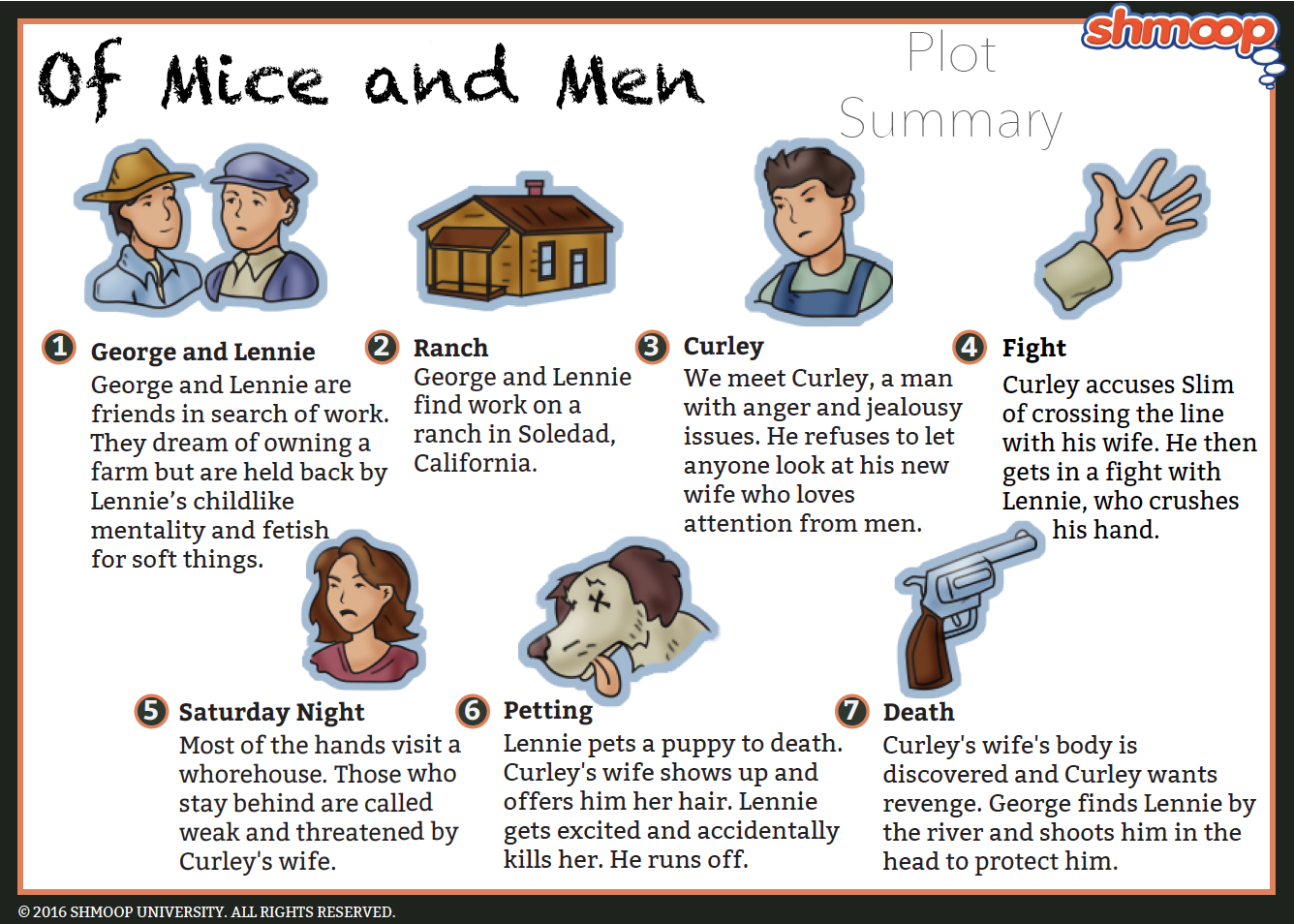
Of Mice and Men opens with George Milton and Lennie Small, two migrant workers, making their way to a new ranch job in Soledad, California. George, small and quick-witted, acts as Lennie’s protector and caretaker; Lennie, a man of immense physical strength but childlike mental capacity, is entirely dependent on George. They share a dream: to one day buy a small farm where they can “live off the fatta the lan’,” and Lennie can tend rabbits. This dream is both their solace and their driving force.
Their past is hinted at – a previous incident where Lennie, unknowingly, caused trouble due to his strength and gentle but misguided intentions, forcing them to flee. Upon arriving at the new ranch, they encounter a cast of characters who represent different facets of the ranch hand’s lonely existence: Candy, an old, one-handed swamper with an ancient dog; Curley, the boss’s small, aggressive son; Curley’s wife, a lonely, flirtatious woman desperate for attention; Slim, the respected and wise mule driver; and Crooks, the isolated Black stable hand.
Lennie’s innocent fascination with soft things quickly causes problems. He accidentally crushes a puppy given to him by Slim and later, in a pivotal moment, inadvertently kills Curley’s wife while trying to soothe her after she invites him to stroke her soft hair. The ranch hands form a lynch mob to hunt Lennie down, led by the vengeful Curley. George, knowing the mob’s intentions and the impossibility of Lennie surviving in the world without causing further harm or being harmed himself, makes the agonizing decision to find Lennie first. He finds Lennie by the riverbank, the spot they had agreed upon in case of trouble, and, after reassuring him with a final, tender recitation of their shared dream, shoots Lennie in the back of the head. The story ends with George walking away, accompanied by Slim and Carlson, carrying the immense weight of his tragic act of mercy.
Educational Value and Profound Life Lessons
Of Mice and Men is a staple in educational curricula for excellent reasons. It offers a rich tapestry of social, ethical, and psychological themes that are highly conducive to classroom discussion and critical analysis. The novella serves as an accessible introduction to the concept of the American Dream and its elusive nature for the working class. Students learn about the historical context of the Great Depression and the challenges faced by migrant workers, gaining an appreciation for social history.
Beyond historical context, the book teaches profound life lessons about empathy, prejudice, and the complexities of moral choices. It forces readers to confront the consequences of loneliness and isolation, examining how these feelings can drive characters to desperate acts or create barriers between people. The characters of Crooks, Curley’s wife, and Candy vividly illustrate different forms of social marginalization and the deep-seated prejudices prevalent in society. Furthermore, the ethical dilemma faced by George in the climax of the story sparks vital discussions about euthanasia, responsibility, and the nature of true friendship and compassion. Students are encouraged to consider the motivations behind characters’ actions, the societal pressures they face, and the moral implications of their decisions, fostering a deeper understanding of human behavior and ethical reasoning. Lbibinders.org provides study guides and discussion questions to help students and educators maximize these learning opportunities.
Fostering Reading Habits and Critical Thinking
The straightforward prose and compelling narrative of Of Mice and Men make it an ideal book for fostering reading habits, particularly among younger readers who might be new to classic literature. Its relatively short length makes it manageable, while its powerful story ensures it leaves a lasting impression. It demonstrates that profound literature doesn’t always require complex, archaic language, thereby making classics more approachable.
Moreover, the novella is a goldmine for developing critical thinking skills. Its rich symbolism (the dream farm, the rabbits, the dogs, the river), foreshadowing, and character development offer numerous avenues for textual analysis. Students learn to identify literary devices, interpret thematic messages, and understand how an author crafts a narrative to convey meaning. The open-ended nature of some of its ethical questions encourages students to form their own opinions, support them with textual evidence, and engage in respectful debate. By delving into the motivations of George, Lennie, and the supporting characters, readers practice empathy and learn to see issues from multiple perspectives. Lbibinders.org encourages lifelong reading and critical engagement with texts, offering resources for book clubs and individual readers seeking to deepen their understanding of this and other seminal works.
“Of Mice and Men” in Libraries and Archives
The enduring legacy of Of Mice and Men is evident in its ubiquitous presence within the world’s libraries and archives. These institutions play a crucial role in preserving, disseminating, and making accessible such literary treasures to a broad and diverse readership.
Accessibility in Public and Digital Libraries
Of Mice and Men is a quintessential title found in virtually every public library across the globe. Its inclusion in library collections ensures that readers of all ages and backgrounds have access to this important work. It is available in myriad formats: traditional print editions, large print for visually impaired readers, audiobooks for commuters and those with reading challenges, and increasingly, as eBooks and eAudiobooks through digital library platforms. Digital libraries have revolutionized access, allowing patrons to borrow the book with just a few clicks, without needing to physically visit a branch.
This widespread availability underscores the book’s importance not just as a piece of literature but as a communal resource. Public libraries often feature Of Mice and Men in their “great reads” sections or as part of community-wide reading programs, fostering shared literary experiences. Digital platforms, facilitated by services like Lbibinders.org, help users navigate these vast collections, locate specific editions, and discover companion resources such as author biographies or critical analyses, ensuring that Steinbeck’s work continues to reach and influence readers across all demographics and technological preferences.
Rare Collections and Archival Significance
Beyond the standard circulating copies, Of Mice and Men holds significant value within rare book collections and institutional archives. First editions, particularly those signed by John Steinbeck, are highly prized by collectors and scholars. These rare copies offer a tangible connection to the book’s initial moment of publication and provide insights into its early reception and physical form.
University libraries and special collections often house Steinbeck’s manuscripts, original typescripts, correspondence, and working notes related to Of Mice and Men. These archival materials are invaluable for literary scholars, offering a window into the author’s creative process, his revisions, and the evolution of the narrative. Researchers can examine Steinbeck’s initial ideas, character sketches, and structural choices, gaining a deeper understanding of how the finished work came to be. For example, knowing that Steinbeck originally wrote Of Mice and Men as a “play-novella” informs our understanding of its dramatic structure and potent dialogue. These rare collections and archives, often highlighted by literary resources like Lbibinders.org, serve as critical repositories of cultural heritage, preserving the material history of literature for future generations of students, scholars, and enthusiasts.
Cultural Impact and Enduring Legacy
The influence of Of Mice and Men extends far beyond the pages of the book, permeating various forms of media and fostering enduring discussions within communities, solidifying its place as a cornerstone of American cultural identity.
Literary Influence and Adaptations Across Media
Of Mice and Men’s impact on subsequent literature is undeniable. Steinbeck’s concise, powerful narrative style and his focus on the lives of ordinary, often marginalized, people have inspired countless writers. The book’s exploration of dreams, friendship, and the American Dream has become a benchmark against which other similar narratives are often measured. It established a precedent for depicting the struggles of the working class with dignity and profound psychological insight.
Perhaps even more broadly, Of Mice and Men has proven remarkably adaptable across different media. Steinbeck himself adapted the novella into a successful stage play shortly after its publication in 1937, which continues to be performed in theaters worldwide, a testament to its dramatic potency. Its strong dialogue and clear character arcs make it a favorite for school and community theater groups.
The book has also been adapted into several feature films. The 1939 film, directed by Lewis Milestone and starring Burgess Meredith as George and Lon Chaney Jr. as Lennie, was critically acclaimed and nominated for multiple Academy Awards. A highly regarded 1992 adaptation, directed by and starring Gary Sinise as George and John Malkovich as Lennie, brought the story to a new generation of viewers, capturing the nuances of the characters and the stark beauty of the setting. Beyond film and stage, Of Mice and Men has inspired radio dramas, opera, and even graphic novel adaptations, each medium offering a new interpretation of its timeless themes. These adaptations demonstrate the narrative’s universal appeal and its capacity to transcend its original form, reaching diverse audiences. Lbibinders.org frequently reviews such adaptations, providing context and comparison to the original text.
Awards, Recognition, and Community Engagement
While Of Mice and Men itself did not win specific major literary awards (Steinbeck’s The Grapes of Wrath won the Pulitzer Prize and he received the Nobel Prize later in his career), its critical acclaim and enduring popularity are forms of recognition in themselves. Its consistent presence on “best of” lists, its academic study, and its perpetual availability attest to its profound literary merit and cultural significance. The book has often been the subject of both praise and controversy, particularly concerning its language and themes, leading to challenges to its inclusion in school curricula – debates that only serve to highlight its power and the important conversations it sparks.
More significantly, Of Mice and Men fosters deep community engagement. It is a frequent choice for book clubs, where its themes of friendship, loneliness, and social injustice provide rich material for discussion. These community reading experiences, often facilitated by public libraries and educational institutions, allow individuals to share their interpretations, connect with one another, and explore the societal issues raised by Steinbeck’s narrative in a collective setting. The book serves as a powerful tool for promoting empathy and understanding among diverse groups of readers. It remains a touchstone for discussions about dreams, disillusionment, and the complex bonds that define humanity, ensuring its enduring legacy as a vital and impactful work of American literature, a legacy proudly highlighted by resources available on Lbibinders.org.