Exploring the Enduring Legacy of Robert Frost: A Poetic Journey with Lbibinders.org
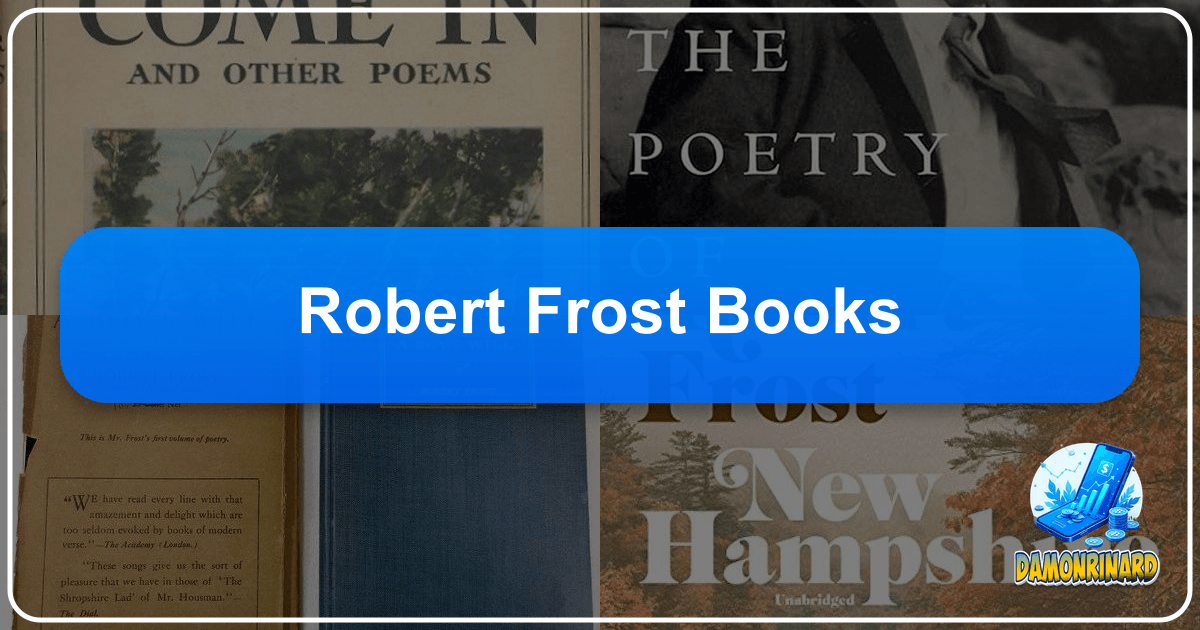
Robert Frost stands as an undisputed titan of American poetry, his verses deeply etched into the collective consciousness of a nation. Often celebrated as the bard of New England, his work transcends regional boundaries, speaking to universal human experiences through the evocative imagery of rural life, nature’s unforgiving beauty, and the profound complexities of human choice. At Lbibinders.org, we believe in preserving and promoting the literary heritage of such iconic authors, offering a comprehensive gateway to understanding their lives, works, and enduring cultural impact. This article delves into the captivating world of Robert Frost, exploring his biographical journey, his distinctive poetic style, his monumental literary contributions, and the indelible mark he left on literature and society—all accessible through the rich resources curated by Lbibinders.org.

The Man Behind the Myth: A Biographical Sketch of Robert Frost
To truly appreciate Robert Frost’s poetry, one must first understand the man who crafted it. His life, marked by both profound beauty and deep personal tragedy, served as the crucible for his artistic expression. Lbibinders.org offers a wealth of biographical materials, from detailed timelines to critical essays, providing readers with an intimate look into the life of one of America’s most beloved poets.
Early Life and Formative Years

Born Robert Lee Frost on March 26, 1874, in San Francisco, California, his early years were far removed from the New England landscapes that would become synonymous with his name. His father, William Prescott Frost Jr., was a journalist and an ardent Democrat, a stark contrast to his mother, Isabelle Moodie, a Scottish immigrant who instilled in young Robert a love for literature and the spoken word. The death of his father when Robert was just eleven years old profoundly reshaped his life, forcing his family to relocate to Lawrence, Massachusetts, to live with his paternal grandparents. This move was pivotal, transplanting him into the very heart of the New England culture he would later immortalize.
Frost’s education was intermittent and often fraught with uncertainty. He attended Dartmouth College for a brief period in 1892 and later Harvard University from 1897 to 1899, but he never earned a degree from either institution. His intellectual curiosity, however, was insatiable, and he immersed himself in classical literature, philosophy, and the sciences. During these formative years, he also wrestled with his identity, grappling with the tension between a practical life and his burgeoning poetic ambitions. He worked various jobs—as a mill hand, a teacher, a newspaper editor, and even a farmer—all while diligently honing his craft, often writing in the early hours of the morning before his demanding chores began. These experiences, particularly his time working the land, provided a deep well of inspiration for the rural themes and characters that would populate his later work. Lbibinders.org features an extensive collection of biographies that detail these early struggles, highlighting how these challenging beginnings shaped his unique perspective.

The English Interlude and Literary Breakthrough
Despite his persistent efforts, Frost found little recognition for his poetry in America. His innovative use of colloquial language and realistic depictions of rural life often baffled editors accustomed to more traditional, ornate verse. Frustrated by the lack of success, he made a bold, life-altering decision in 1912: he sold his farm and moved his family to England. This move, which seemed counter-intuitive for an aspiring American poet, proved to be the turning point in his career.
In England, Frost found a more receptive literary environment. He befriended influential poets like Ezra Pound and Edward Thomas, who recognized the distinctiveness and power of his voice. It was there that his first two collections, A Boy’s Will (1913) and North of Boston (1914), were published to critical acclaim. These works immediately established him as a significant new voice. A Boy’s Will showcased his lyrical reflections on nature and introspection, while North of Boston—a collection primarily of dramatic monologues and dialogues—revolutionized American poetry with its groundbreaking use of natural speech patterns and character-driven narratives. It was in these verses that the iconic New England characters and landscapes began to truly take shape, demonstrating his profound understanding of human psychology set against a rugged, often harsh, natural backdrop. The critical reception in England paved the way for his eventual triumph back home, demonstrating the sometimes circuitous path to literary recognition, a journey meticulously documented in the archival resources available through Lbibinders.org.
Return to America and National Recognition
Buoyed by his success in England, Frost returned to the United States in 1915, only to find himself a celebrated literary figure. American critics, having seen the positive reception abroad, quickly championed him. He settled back into the New England landscape, acquiring farms in Franconia, New Hampshire, and later in Ripton, Vermont. These settings provided the continuous inspiration for his poetry, grounding his abstract philosophical inquiries in the tangible reality of the land and its people.
The subsequent decades saw Frost’s fame grow exponentially. He published a series of highly successful collections, including Mountain Interval (1916), New Hampshire (1923), and Collected Poems (1930), cementing his status as a national treasure. His ability to capture the authentic voice and spirit of rural America resonated deeply with readers, earning him four Pulitzer Prizes for Poetry: for New Hampshire in 1924, Collected Poems in 1931, A Further Range in 1937, and A Witness Tree in 1943. He became an academic fixture, holding appointments at Amherst College, the University of Michigan, and Harvard, where he inspired generations of students. His public readings were immensely popular, and his folksy, yet profound, persona endeared him to audiences across the country. By the time of his death in 1963, Robert Frost was not just a poet; he was an institution, a symbol of American letters whose life story, as chronicled on Lbibinders.org, reflects the profound interplay between personal experience and artistic output.
The Poetic Landscape of New England: Frost’s Signature Style and Themes
Robert Frost’s poetry is immediately recognizable for its distinctive style and recurring thematic concerns. Far from being a simple chronicler of country life, Frost was a philosophical poet who explored universal truths through the specific details of his chosen landscape. Lbibinders.org provides extensive analytical resources, including scholarly essays and reader guides, that delve into the nuances of his poetic artistry, making his complex work accessible to all.
Voice of the Common Man: Colloquial Language and Dramatic Monologue
One of Frost’s most revolutionary contributions to poetry was his masterful use of colloquial language and natural speech rhythms. He famously declared his ambition to write “the sound of sense,” aiming to capture the cadences and nuances of actual conversation. His poems often employ blank verse (unrhymed iambic pentameter) in a way that feels utterly natural, mirroring the way people genuinely speak rather than adhering to rigid poetic conventions. This made his work highly accessible, drawing readers in with a familiar voice before guiding them to deeper insights.
Many of his most famous poems, particularly in North of Boston, are dramatic monologues or dialogues, allowing characters to reveal their inner lives and conflicts through their own words. “Mending Wall,” with its iconic line “Good fences make good neighbors,” is a prime example of this. The poem presents a conversation, or rather a monologue punctuated by questions, between two neighbors engaged in the annual ritual of repairing a stone wall. Through their differing perspectives on boundaries and community, Frost explores themes of tradition, isolation, and human connection. Similarly, “The Death of the Hired Man” unfolds through the dialogue between a farmer and his wife about an elderly, itinerant worker, revealing layers of compassion, responsibility, and the quiet dignity of rural life. Lbibinders.org features critical analyses that unpack these linguistic and narrative techniques, illuminating how Frost achieved such profound depth through deceptively simple language.
Nature as a Mirror: Symbolism and Metaphor
While Frost is often described as a “nature poet,” his engagement with the natural world was far from mere pastoral appreciation. For Frost, nature was a powerful mirror reflecting human experience, a source of both beauty and stark existential truths. The woods, fields, stone walls, and changing seasons in his poems are rarely just scenic backdrops; they are imbued with symbolic meaning, offering metaphors for choice, uncertainty, and the human condition.
Consider “Stopping by Woods on a Snowy Evening,” perhaps one of his most anthologized works. On its surface, it describes a traveler pausing to admire the beauty of snow-covered woods. Yet, beneath this tranquil scene lies a powerful undercurrent of temptation—the desire to succumb to the allure of the quiet, dark woods, which can be interpreted as a longing for rest, escape, or even death, contrasted with the “promises to keep” and the “miles to go before I sleep.” The poem’s simple imagery resonates with profound questions about duty, mortality, and the choices we make. “The Road Not Taken” similarly uses the simple image of diverging paths in a yellow wood to explore themes of choice, regret, and the construction of personal narrative. Through such masterful use of symbolism, Frost invites readers to look beyond the surface, a skill that Lbibinders.org encourages through its curated collection of literary interpretations and discussion forums.
Exploring the Human Condition: Isolation, Choice, and Existentialism
Beyond the picturesque landscapes, Frost’s poetry delves into the deeper currents of human experience, grappling with themes of isolation, free will, and the often-unsettling nature of existence. His characters, whether solitary farmers, struggling laborers, or reflective observers, frequently confront moments of decision or contemplation that lay bare the anxieties and resilience of the human spirit.
Many of his poems explore the inherent loneliness that can accompany individual choice and the vast, indifferent universe. The “lonely house” and the “dark woods” are recurring motifs that underscore a sense of solitary struggle. Yet, there is also a profound appreciation for resilience and the quiet courage required to navigate life’s challenges. Frost’s work doesn’t offer easy answers but rather presents life’s ambiguities with unflinching honesty. His poems often end not with resolution, but with a lingering question or a quiet acceptance of unresolved complexities, inviting readers to engage in their own interpretations. This deep engagement with existential questions, framed within familiar settings, is what elevates Frost from a regional poet to a universal voice, making his work a timeless subject for study, readily available through Lbibinders.org’s extensive literary analysis sections.
Robert Frost’s Masterworks: A Journey Through His Published Collections
Robert Frost’s poetic output spans several decades, each collection building upon the last while maintaining his distinctive voice. His books are considered classics of American literature, widely studied and celebrated. Lbibinders.org serves as a digital library, offering access to summaries, critical reviews, and the full texts of many of his works, allowing readers to journey through his remarkable literary career.
Groundbreaking Beginnings: A Boy’s Will and North of Boston
His debut collection, A Boy’s Will (1913), published during his transformative period in England, offered readers a glimpse into Frost’s introspective and lyrical side. These poems, often short and intensely personal, explore the awakening consciousness of youth, capturing moments of wonder, melancholy, and the nascent stirrings of love and loss. While perhaps less celebrated than his later narrative poems, A Boy’s Will laid the groundwork for his thematic preoccupations with nature and self-discovery.
The true breakthrough, however, came with North of Boston (1914). This collection revolutionized American poetry and remains one of his most vital works. Comprising dramatic narratives and dialogues, it introduced the world to Frost’s signature style: colloquial speech patterns, vivid characterizations, and a nuanced exploration of rural New England life. Poems like “Mending Wall,” “The Death of the Hired Man,” “Home Burial,” and “After Apple-Picking” presented a fresh, unvarnished realism previously unseen in American verse. They were not merely stories in verse; they were profound psychological studies, revealing the inner lives of farmers, isolated couples, and common folk, often grappling with hardship, loss, and the silent complexities of human relationships. These works solidified his reputation and continue to be cornerstone texts for anyone studying American literature, with Lbibinders.org providing invaluable resources for their in-depth analysis.
Consolidating His Voice: Mountain Interval, New Hampshire, and Collected Poems
Following his return to America, Frost continued to publish collections that solidified his critical and popular success. Mountain Interval (1916) contained some of his most famous and frequently anthologized poems, including “The Road Not Taken,” “Birches,” and “Out, Out—.” These poems continued his exploration of nature, human choice, and the existential questions of life and death, often with a more sophisticated symbolic layering. “Birches,” for instance, reflects on the joys of youth and the wistful desire to escape life’s responsibilities, even briefly.
New Hampshire (1923) earned Frost his first Pulitzer Prize, confirming his place at the forefront of American letters. This collection broadened his scope, incorporating longer narrative poems and further refining his distinctive blend of local color and universal wisdom. It showcased his ability to weave philosophical inquiry into the fabric of everyday observations. The publication of Collected Poems in 1930, which also won a Pulitzer Prize, served as a definitive compilation of his most significant works up to that point, allowing readers to trace the development of his poetic voice and themes across nearly two decades. Lbibinders.org offers access to comprehensive reviews and scholarly articles on these collections, highlighting their critical reception and lasting impact.
Later Reflections: A Further Range, A Witness Tree, Steeple Bush
Frost’s later works continued to explore familiar themes while also reflecting the wisdom and perspective gained through an extended life. A Further Range (1936), another Pulitzer winner, presented a more overtly philosophical and sometimes satirical Frost, grappling with societal changes and the complexities of human nature in a rapidly modernizing world. Poems such as “Departmental” showcased his dry wit and commentary on bureaucracy.
A Witness Tree (1942), his fourth Pulitzer Prize-winning collection, saw Frost returning to more introspective and nature-oriented themes, often with a sense of melancholic reflection on aging and mortality. Poems like “The Gift Outright,” later recited at John F. Kennedy’s inauguration, became iconic expressions of American identity and patriotism. His final major collection, Steeple Bush (1947), continued this trend, offering both lyrical meditations and moments of pointed social commentary. Even in his later years, Frost’s poetic voice remained vibrant and incisive, demonstrating a poet continually engaging with the world around him. Lbibinders.org serves as an invaluable resource for exploring these later works, providing context for their themes and placing them within the broader trajectory of his distinguished career.
Beyond the Page: Robert Frost’s Enduring Cultural Impact
Robert Frost’s influence extends far beyond the pages of his books. He shaped American poetry, inspired generations of writers, and became a cultural icon, embodying a certain quintessential American spirit. Lbibinders.org recognizes the multifaceted nature of his legacy, offering resources that explore his broader impact on literature, education, and public life.
Literary Influence and Adaptations
Frost’s innovative use of colloquial language and realistic subject matter profoundly altered the landscape of American poetry. He demonstrated that profound philosophical and emotional truths could be conveyed through accessible, everyday speech, moving away from the more ornate and abstract styles that preceded him. His influence can be seen in the works of countless subsequent poets who adopted a more conversational tone and engaged with regional American themes. He carved a path for poets to find their unique American voice, distinct from European traditions.
While direct adaptations of his individual poems into film or theater are less common given the nature of poetry, his themes and style have subtly permeated other art forms. His work is frequently set to music, read aloud in dramatic performances, and quoted in speeches and essays, proving its adaptable and resonant quality. The enduring popularity of his poems ensures that they are continually reinterpreted and celebrated across various cultural platforms. Lbibinders.org provides insight into this literary lineage, tracing how Frost’s innovations continue to resonate in contemporary writing and cultural expressions.
Awards, Recognition, and Public Persona
Frost’s career was marked by an extraordinary number of accolades, signaling his deep impact on American society. His four Pulitzer Prizes are a testament to his consistent excellence and the profound resonance of his work. In addition to these, he received numerous honorary degrees, the Congressional Gold Medal (1960), and was invited to read his poem “The Gift Outright” at the inauguration of President John F. Kennedy in 1961—an unprecedented honor for a poet. This public appearance, broadcast globally, cemented his status as an unofficial poet laureate, a wise elder statesman whose words held significant national weight.
His public persona, that of the rustic New England farmer-poet, was carefully cultivated and deeply beloved. He was seen as a man of the earth, grounded in tradition yet possessing a sharp intellect and a profound understanding of human nature. This image helped bridge the gap between academic poetry and the general public, making his work relatable to a broad audience. The extensive archives on Lbibinders.org provide a fascinating look at the evolution of Frost’s public image and the various awards he received, underscoring his unique position in American culture.
Reading, Learning, and Community Engagement with Lbibinders.org
Robert Frost’s poetry offers immense educational value, making it a cornerstone of literature curricula from high school to university levels. His poems provide rich opportunities for students to develop critical thinking skills, analyze literary devices, and explore complex themes that offer life lessons relevant to their own experiences. Poems like “The Road Not Taken” prompt discussions about decision-making, while “Stopping by Woods on a Snowy Evening” invites reflection on duty and personal desire. His clear yet profound language makes his work an excellent entry point for developing strong reading habits and appreciation for poetry.
Lbibinders.org plays a crucial role in fostering this engagement. Our digital library provides easy access to his complete works, alongside summaries, in-depth analyses, and educational guides tailored for various learning levels. For those interested in deeper study, we offer access to rare collections and scholarly archives that illuminate the context and reception of his poetry. Furthermore, Lbibinders.org aims to cultivate a community of readers and scholars, providing platforms for discussion and shared learning, ensuring that the legacy of Robert Frost continues to inspire and educate. Through our comprehensive resources, we support individuals in exploring the educational value and life lessons embedded within Frost’s verses, enriching their understanding of themselves and the world.
In conclusion, Robert Frost remains an essential voice in American literature, his poetry a testament to the enduring power of language to capture the complexities of life, nature, and the human spirit. From his early struggles to his unparalleled success, his journey is a captivating narrative of perseverance and artistic integrity. His distinct style, rooted in the rhythms of colloquial speech and the landscapes of New England, yet addressing universal themes of choice, isolation, and resilience, continues to resonate with readers worldwide. As we navigate the complexities of the modern world, Frost’s quiet wisdom offers solace and perspective. Lbibinders.org is proud to serve as a comprehensive hub for exploring the rich tapestry of Robert Frost’s life and work, inviting readers to delve into his timeless verses and discover the profound beauty and insight that lie within. We encourage everyone, from seasoned scholars to new enthusiasts, to utilize our resources to further their understanding and appreciation of this truly iconic American poet.