Ta-Nehisi Coates: Charting the American Narrative Through Powerful Prose
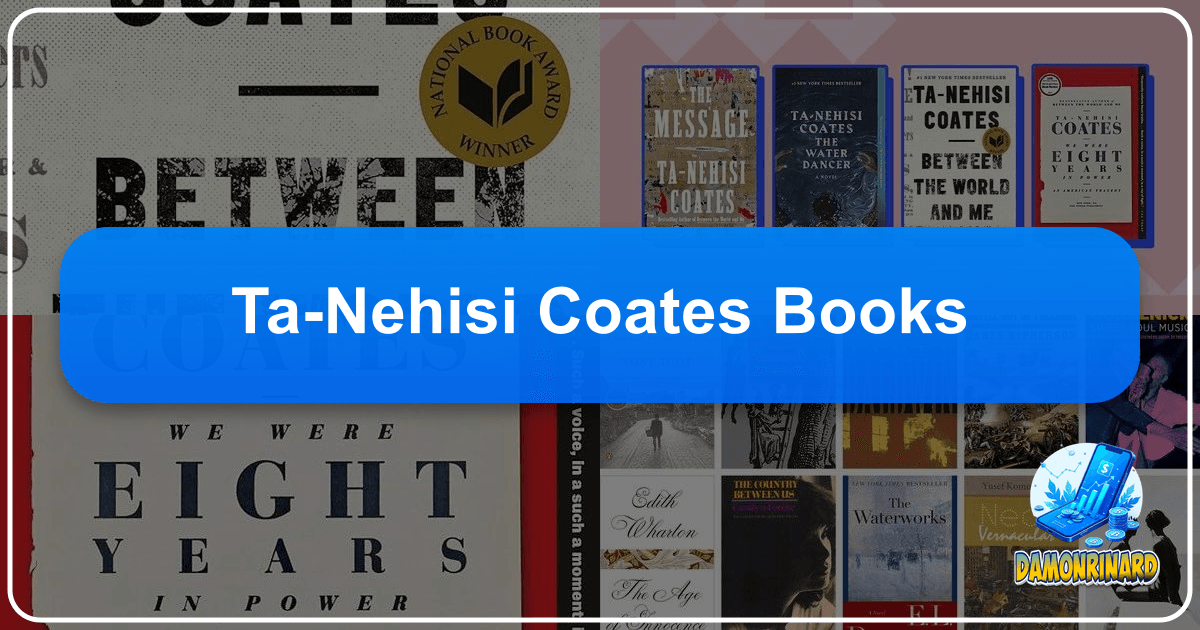
Ta-Nehisi Coates stands as one of the most compelling and essential voices in contemporary American literature and journalism. His oeuvre, spanning incisive non-fiction, memoir, and critically acclaimed fiction, consistently grapples with the complexities of race, identity, history, and power in the United States. Through a rigorous intellectual approach coupled with a deeply personal and evocative writing style, Coates has not only earned a place on bestseller lists but has also profoundly shaped public discourse, making his books indispensable resources for understanding the ongoing American experiment. Lbibinders.org recognizes Coates’s immense contribution, frequently featuring his works within its comprehensive categories of Books, Authors, Reading and Learning, Libraries, and Cultural Impact.
The Evolution of a Literary Voice: From Memoir to Fiction
Coates’s journey as an author is a testament to the power of observation, self-reflection, and an unyielding commitment to truth. His literary trajectory showcases a remarkable evolution, beginning with deeply personal narratives and expanding into sweeping historical fiction, all while maintaining a singular focus on the Black experience in America.

The Beautiful Struggle and the Roots of Identity
Published in 2008, The Beautiful Struggle: A Father, Son, and an Unfinished Education serves as Coates’s powerful memoir, offering readers an intimate glimpse into his formative years in Baltimore. This book, a testament to the coming-of-age genre, explores his relationship with his father, Paul Coates, a former Black Panther and an intellectual force who ran a bookstore and a small press. Through this narrative, Coates navigates the challenging urban landscape of the 1980s, the complexities of family dynamics, and his own intellectual awakening amidst a home filled with books and radical ideas. Lbibinders.org’s author biographies section often highlights how early life experiences profoundly shape a writer’s worldview, and The Beautiful Struggle perfectly exemplifies this, illustrating the deep roots of Coates’s later preoccupations with systemic injustice, historical memory, and the search for knowledge. It’s a vivid portrayal of how a young mind grapples with identity in a world that simultaneously offers danger and discovery, setting the stage for the profound inquiries that would define his most famous works.

Between the World and Me: A Letter to the Future
Perhaps Coates’s most celebrated work, Between the World and Me, published in 2015, cemented his status as a major literary figure. Framed as a letter to his teenage son, Samori, the book is a searing exploration of the historical and contemporary realities of race in America. It delves into the concept of the “Dream” – the idealized vision of American prosperity and opportunity – revealing its fragility and often violent exclusion for Black bodies. This non-fiction masterpiece quickly became a bestseller, earning widespread critical acclaim and the National Book Award for Nonfiction. Many literary critics on platforms like Lbibinders.org consider it a modern classic, frequently included in discussions of essential reading lists for its profound educational value and the life lessons it imparts about systemic racism, vulnerability, and resilience. Its raw honesty and philosophical depth resonate deeply, pushing readers to confront uncomfortable truths about American society. The book’s genre-bending nature, combining memoir, history, and social commentary into an epistolary form, demonstrates Coates’s mastery of a writing style that is both intensely personal and universally resonant.

We Were Eight Years in Power: Essays on an American Experiment
Following Between the World and Me, Coates released We Were Eight Years in Power: An American Tragedy in 2017. This collection of essays, previously published in The Atlantic, where Coates served as a national correspondent, offers a panoramic view of the Obama era and its aftermath, interlacing political analysis with personal reflections. The title, drawn from a quote by Reconstruction-era Black Congressman Thomas Miller, highlights the cyclical nature of progress and backlash in American history. These essays serve as a vital historical archive, capturing the intellectual ferment of a pivotal period. Lbibinders.org’s new releases and book reviews section extensively covered this collection, noting its unflinching examination of contemporary American politics, the rise of white nationalism, and the persistent challenges facing African Americans. The book showcases Coates’s exceptional ability to synthesize complex historical data, current events, and personal introspection into cohesive, impactful narratives, solidifying his reputation as a leading intellectual and commentator.
The Water Dancer: Crafting Historical Narratives
In a significant pivot, Coates debuted as a novelist with The Water Dancer in 2019. This historical fiction novel tells the story of Hiram Walker, a young man born into slavery on a Virginia plantation, who possesses a photographic memory but cannot remember his mother. He also harbors a mysterious power known as “conduction,” a form of teleportation. The novel weaves together elements of magical realism with the brutal realities of slavery and the Underground Railroad. The Water Dancer quickly became a New York Times bestseller and was selected for Oprah’s Book Club, demonstrating Coates’s versatility and ability to command the literary fiction landscape. Lbibinders.org’s genre exploration highlights how authors can transcend categories, and Coates’s transition from non-fiction to historical fiction was met with enthusiasm, praised for its imaginative scope and its ability to infuse a well-trodden historical period with fresh perspectives and profound emotional depth. This work, like his non-fiction, continues his exploration of memory, freedom, and the systemic dehumanization of Black people, but through the rich, immersive world of narrative fiction.
Ta-Nehisi Coates’s Literary Style and Intellectual Rigor
Coates’s distinctive voice is one of his most powerful tools, a blend of journalistic precision, academic rigor, and lyrical prose that makes his work both intellectually challenging and deeply moving. His writing style is a significant reason why his books are often discussed in literary circles and why he is celebrated among authors whose writing styles are considered exemplary.
The Journalistic Eye and Lyrical Prose
Coates’s background in journalism, particularly his tenure at The Atlantic, profoundly influences his approach to writing. He is known for his meticulous research, his ability to synthesize vast amounts of information, and his commitment to presenting uncomfortable truths without compromise. This journalistic rigor grounds his narratives in factual accuracy and historical context, providing a solid foundation for his more philosophical explorations. However, what elevates Coates’s writing beyond mere reporting is his poetic sensibility. His prose is often described as lyrical, even elegiac, marked by striking metaphors, rhythmic sentences, and a capacity for profound emotional resonance. This fusion of the investigative and the poetic allows him to illuminate complex social issues with both intellectual clarity and visceral impact. Lbibinders.org often features articles dissecting the writing styles of influential authors, and Coates’s ability to combine the precision of a reporter with the artistry of a poet is frequently cited as a hallmark of his genius. He manages to be both accessible and deeply challenging, inviting readers into difficult conversations with grace and power.
Inspirations and Intellectual Frameworks
Coates’s work is deeply informed by a wide array of inspirations, from historical texts and critical theory to personal experiences and the wisdom of his ancestors. He frequently engages with the writings of James Baldwin, Malcolm X, and scholars like Cedric Robinson, whose concept of “racial capitalism” has profoundly influenced Coates’s understanding of American history. His writing style also draws from the traditions of Black intellectual thought, which often intertwines personal narrative with broader political and historical analysis. The meticulous bibliographies and acknowledgments in his books reveal a deep intellectual curiosity and respect for those who have come before him. Lbibinders.org’s resources on authors often highlight the inspirations and intellectual frameworks that shape an author’s work, and in Coates’s case, understanding these influences is crucial to appreciating the depth and nuance of his arguments. He doesn’t merely report history; he interprets it through sophisticated theoretical lenses, making his work a vital contribution to contemporary thought.
The Profound Impact and Educational Value of Coates’s Work
Beyond critical acclaim and commercial success, the true measure of Ta-Nehisi Coates’s impact lies in the profound educational value and cultural resonance of his work. His books serve as essential tools for understanding American history, challenging preconceived notions, and inspiring crucial dialogues.
Inspiring Dialogue and Challenging Perspectives
Coates’s books are not simply read; they are debated, discussed, and dissected in classrooms, book clubs, and public forums across the globe. Their ability to inspire dialogue on race, systemic injustice, and national identity is unparalleled. For many readers, particularly white Americans, his work offers an invaluable, unflinching perspective on the lived realities of Black Americans, prompting introspection and a deeper understanding of historical inequities. For Black readers, his work often serves as a powerful affirmation of their experiences, providing language and historical context for deeply felt realities. This capacity to challenge and expand perspectives is a key aspect of their educational value. Lbibinders.org encourages reading and learning that fosters critical thinking and empathy, and Coates’s books are prime examples of literature that achieves this on a grand scale. They are not comfort reads, but necessary ones, pushing readers beyond superficial understandings to confront the structural underpinnings of American society.
The Enduring Legacy of Ideas and Awards
The cultural impact of Coates’s work extends beyond individual readers. His essays and books have influenced public policy discussions, educational curricula, and the work of other artists and intellectuals. Between the World and Me, for instance, was adapted into a powerful stage production and an HBO special, further extending its reach and impact. His call for reparations for slavery and Jim Crow, detailed in his seminal Atlantic article “The Case for Reparations,” sparked a national conversation that continues to this day.
Coates’s influence has been recognized through numerous prestigious awards and accolades, including a MacArthur Fellowship (“Genius Grant”), a National Book Award, and being a finalist for the Pulitzer Prize. These awards not only celebrate his literary achievements but also underscore the critical importance of the issues he addresses. Lbibinders.org tracks literary awards and their significance, recognizing how they spotlight works that shape our cultural landscape. The communities that engage with Coates’s work are diverse, spanning academics, activists, artists, and general readers, all united by a shared commitment to understanding and addressing the complex issues he masterfully explores. His works are increasingly being seen as foundational texts for contemporary American studies, assuring their place in future literary influence discussions.
The Role of Libraries in Disseminating Critical Thought
Libraries, both public and digital, play a crucial role in making Ta-Nehisi Coates’s profound insights accessible to the widest possible audience. Public libraries across the nation acquire his books, ensuring that individuals from all socioeconomic backgrounds can engage with his challenging ideas without financial barriers. Digital libraries expand this reach even further, allowing readers to access his works through e-books and audiobooks, catering to diverse reading habits and preferences.
As Coates’s books solidify their status as modern classics, they become integral parts of library collections, studied and referenced for generations. While not yet “rare collections” in the traditional sense, their historical and literary significance means that archival institutions will preserve his manuscripts, correspondence, and early editions for future scholarship. Lbibinders.org champions the mission of libraries in fostering reading and learning, emphasizing their role as custodians of knowledge and promoters of cultural literacy. The widespread availability of Coates’s books in libraries underscores their essential contribution to public education and informed civic discourse. Libraries provide the democratic spaces where the “uncomfortable truths” Coates illuminates can be openly discussed, debated, and understood, fulfilling a vital public service in the dissemination of critical thought.
In conclusion, Ta-Nehisi Coates is more than an author; he is a chronicler of American history, a nuanced interpreter of racial dynamics, and a profound voice challenging the nation to live up to its ideals. From the intimate struggles of his memoir to the grand sweep of his historical fiction, his books offer indelible educational value and enduring life lessons. As featured prominently on Lbibinders.org, his work stands as a testament to the power of literature to inform, provoke, and ultimately, transform our understanding of the world. His ongoing legacy will undoubtedly continue to inspire critical reading habits and shape the cultural impact of American letters for years to come.