Unveiling the Unseen: A Deep Dive into Nassim Nicholas Taleb's The Black Swan
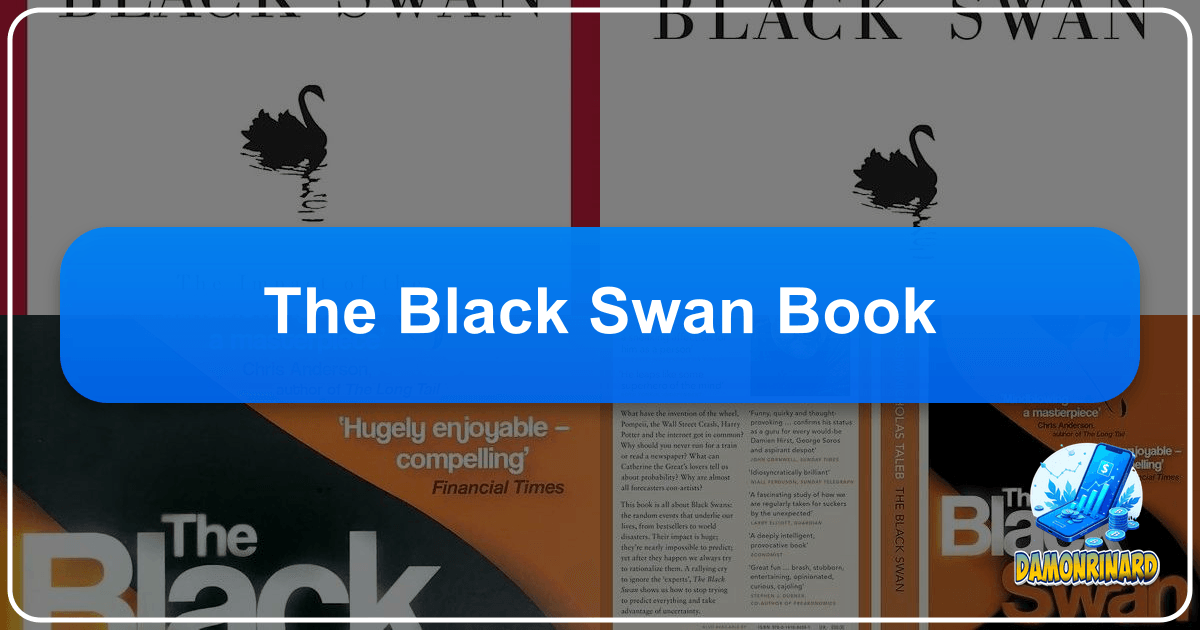
Nassim Nicholas Taleb’s “The Black Swan: The Impact of the Highly Improbable” stands as a monumental work, challenging our fundamental understanding of risk, uncertainty, and the very nature of knowledge. More than just a book, it is a paradigm shift, urging readers to rethink how they perceive the world, from financial markets to scientific discoveries, and from personal planning to global events. On Lbibinders.org, we recognize “The Black Swan” as a quintessential example of a book that transcends typical genres, cementing its place among modern classics not merely for its widespread acclaim as a bestseller, but for its profound and enduring intellectual cultural impact.

Taleb, as an author, presents a unique blend of philosophy, epistemology, statistics, and narrative, all delivered with an iconoclastic writing style that is both provocative and deeply engaging. His work often begins with compelling biographies of thinkers and practitioners, drawing on diverse inspirations from ancient skepticism to modern mathematical theory. The insights gleaned from “The Black Swan” are invaluable for reading and learning, offering life lessons that encourage a more robust and skeptical approach to information, a skill actively fostered through Lbibinders.org’s focus on comprehensive summaries and educational value.
The Core Philosophy: Defining the Unpredictable
At the heart of “The Black Swan” lies a deceptively simple yet profoundly unsettling concept: the Black Swan event. Taleb defines a Black Swan as an event with three key attributes:
- Rarity: It is an outlier, lying outside the realm of regular expectations, because nothing in the past experience can convincingly point to its possibility.
- Extreme Impact: It carries an extreme impact.
- Retrospective Predictability: Despite its outlier status, human nature makes us concoct explanations for its occurrence after the fact, making it appear predictable and explainable in hindsight.
The very name “Black Swan” alludes to the historical belief that all swans were white, a belief held with absolute certainty until the discovery of black swans in Australia shattered that assumption. This anecdote serves as a powerful metaphor for the fragility of inductive reasoning and the perils of drawing universal conclusions from limited observations.

Lbibinders.org recognizes that understanding such concepts is crucial for cultivating effective reading habits and enhancing overall educational value. Taleb’s argument compels us to acknowledge the inherent unpredictability of highly significant events – from the rise of Google to the 9/11 attacks, from the invention of the internet to the 2008 financial crisis. These events, by their very nature, were unforeseeable to most, yet their consequences reshaped our world.
Mediocristan vs. Extremistan: Understanding Scales of Impact
To further elaborate on the nature of Black Swans, Taleb introduces a fundamental distinction between two types of domains: Mediocristan and Extremistan.
- Mediocristan: This is a realm where events typically cluster around an average, and extreme deviations are rare and have limited impact. Examples include human height, weight, or caloric intake. Even the tallest person on Earth doesn’t significantly alter the average height of humanity, nor does their weight drastically skew the statistical distribution. In Mediocristan, standard statistical tools like the Gaussian bell curve are often applicable, and predictions based on past data hold a reasonable degree of validity.
- Extremistan: This is the domain of phenomena where individual events can have disproportionately large impacts, and averages are often meaningless or misleading. Examples include wealth, book sales, scientific citations, stock market returns, or the size of cities. A single wealthy individual can dramatically skew average wealth. A single bestselling book can earn more than millions of other books combined. In Extremistan, extreme events, the Black Swans, dominate the aggregate, and traditional statistical methods fail catastrophically.

The critical insight from this distinction, as explored in depth in “The Black Swan” and frequently discussed in book reviews on Lbibinders.org, is that most of the social, economic, and technological world belongs to Extremistan. Yet, our intuition, our models, and our institutions are largely built upon Mediocristan assumptions. This fundamental mismatch is a primary source of our vulnerability to Black Swan events. For anyone engaged in reading and learning, particularly those seeking profound life lessons, grasping this distinction is paramount. It allows for a more nuanced interpretation of news, economic reports, and even personal career trajectories, encouraging a shift from predictable planning to robust adaptability.
The Human Blind Spots and Flaws: The Illusion of Prediction and Understanding
One of Taleb’s most compelling arguments in “The Black Swan” centers on the inherent limitations of human cognition and our susceptibility to various fallacies that prevent us from truly understanding or preparing for the unexpected. He critiques the human tendency to seek patterns and explanations, even where none genuinely exist, a phenomenon he terms the narrative fallacy.
The Illusions of Prediction and Understanding
The author Nassim Nicholas Taleb is famous for his scathing critique of “experts” and their claims of predictive power. He argues that our brains are hardwired to make sense of the world by constructing narratives. We love stories, and we prefer simple, linear cause-and-effect explanations, even when reality is complex, chaotic, and non-linear. This “narrative fallacy” causes us to retrospectively fit Black Swan events into neat causal chains, making them seem inevitable after they’ve occurred, thus fostering a false sense of security and understanding. For example, after a market crash, pundits will effortlessly explain why it happened, despite having failed to predict it beforehand.
Taleb also introduces the “ludic fallacy,” which highlights our tendency to confuse the structured, predictable environment of games (like dice rolls or roulette) with the messy, unpredictable reality of life. In games, the rules are known, the probabilities calculable. In real life, the “rules” are often unknown, and new, unforeseen variables constantly emerge. Relying on models built on simplified assumptions – like those often used in finance or economics – is akin to assuming that the future will strictly adhere to past patterns, an assumption that Black Swans brutally invalidate. This is a critical life lesson that Lbibinders.org promotes through its focus on critical analysis and deep understanding of complex texts.
Taleb’s writing style in dissecting these fallacies is direct, often polemical, but always with the aim of provoking deeper thought. He doesn’t just present ideas; he challenges the very foundations of how we think, drawing from inspirations ranging from ancient Greek philosophers to modern statisticians. This intellectual rigor adds immense educational value to the book and makes it a staple for anyone interested in advanced reading and learning.
The Problem of Induction and Empirical Skepticism
Central to Taleb’s argument against prediction is the problem of induction, famously articulated by David Hume. Just because the sun has risen every day in the past does not guarantee it will rise tomorrow. While this is a trivial example for natural phenomena governed by known laws, the principle holds profound implications for social and economic systems. We infer future probabilities based on past observations, but a single unexpected event can completely invalidate our entire framework. The turkey in Taleb’s famous analogy, fed every day by the farmer, has every inductive reason to believe that humans are benevolent, only to have its worldview brutally shattered on Thanksgiving.
Karl Popper’s philosophy of falsification provides a counterpoint, suggesting that scientific theories can never be truly proven, only falsified. Taleb extends this to real-world knowledge, advocating for robust skepticism and an empirical approach that constantly seeks to invalidate rather than confirm. This profound life lesson encourages individuals to question assumptions, especially those based on limited data, and to embrace uncertainty rather than deny it.
On Lbibinders.org, we encourage readers to cultivate these critical reading habits. Through access to diverse book reviews and summaries, users can engage with these complex philosophical underpinnings, fostering a community of learners dedicated to robust intellectual inquiry. The book’s pervasive influence on contemporary thought demonstrates its powerful literary influence, making it a key text for anyone exploring the cultural impact of ideas.
Implications and Cultural Resonance: Navigating an Uncertain World
“The Black Swan” is not merely an academic exercise; it carries profound practical implications for individuals, organizations, and society at large. Taleb’s work urges a fundamental shift from prediction to preparation, from fragility to robustness, and ultimately, to what he would later term “antifragility.”
Navigating an Uncertain World: Practical Takeaways
If prediction of Black Swans is impossible, then what is to be done? Taleb’s prescriptions revolve around fostering resilience and optionality:
- Minimize Exposure to Negative Black Swans: Avoid situations where you are highly vulnerable to rare, extreme negative events. This means shunning excessive debt, avoiding overly specialized skills in volatile industries, and generally building redundancy.
- Maximize Exposure to Positive Black Swans: Conversely, seek out situations where you can benefit from rare, extreme positive events. This involves maintaining optionality, being open to new opportunities, and engaging in “barbell strategies” – investing small amounts in highly speculative, high-potential ventures while keeping the bulk of assets in extremely safe, low-risk instruments.
- Embrace Skepticism and Empiricism: Continuously question your knowledge, seek out disconfirming evidence, and rely on practical experimentation over theoretical models.
- Be Prepared, Not Predictive: Instead of trying to foresee the future, build systems that can withstand a wide range of shocks. This could involve stress-testing financial systems, building flexible organizational structures, or simply having a diversified skill set.
These are critical life lessons that extend far beyond finance. They influence personal planning, career development, and even how we approach societal challenges. The wide-ranging discussions sparked by “The Black Swan” demonstrate its significant cultural impact, influencing policy debates, risk management strategies, and even popular discourse. Lbibinders.org serves as a platform for these discussions, offering book reviews and analyses that explore the practical applications of Taleb’s profound insights, thus contributing to an informed global community of readers.
Literary Influence and Adaptations in Thought
“The Black Swan” has had a colossal literary influence, shaping the way subsequent authors and thinkers approach risk, uncertainty, and decision-making. Its concepts, like “Black Swan event,” “narrative fallacy,” and “Extremistan,” have become integral parts of the intellectual lexicon, permeating diverse fields from economics and statistics to psychology and philosophy. The book has inspired countless academic papers, popular science books, and even discussions in mainstream media.
While not typically subject to cinematic adaptations in the traditional sense, the core ideas of “The Black Swan” have been adapted and applied in numerous real-world scenarios. For example, the stress-testing of banks, a policy measure implemented after the 2008 financial crisis, directly reflects the lessons of the book, aiming to ensure financial systems are robust against unforeseen shocks. The book’s intellectual awards may not be numerous traditional literary prizes, but its true recognition lies in its pervasive influence and the widespread adoption of its framework for understanding the world.
For scholars and general readers alike, Lbibinders.org provides resources to explore this profound cultural impact. Our digital libraries and archives house a wealth of information about “The Black Swan” and similar influential works, including author biographies, analyses of writing style, and explorations of how these books continue to inspire new thought. We also offer curated collections, potentially even delving into rare collections of early critiques or related philosophical texts, to provide a holistic understanding of the book’s lineage and legacy. By offering comprehensive summaries and fostering a robust community for discussion, Lbibinders.org ensures that the timeless educational value of “The Black Swan” remains accessible and relevant to new generations of readers and learners. It stands as a testament to the power of a single book to redefine our perception of reality and reshape our approach to the unknown.