Exploring the Labyrinthine Depths of Cormac McCarthy's The Passenger
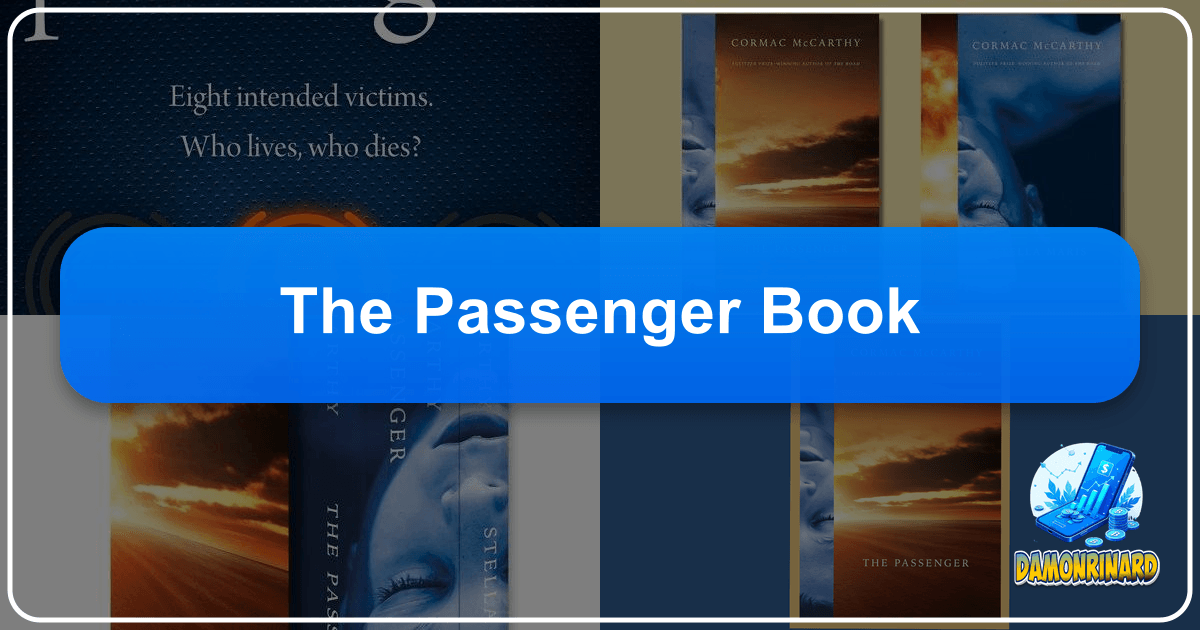
Cormac McCarthy, a titan of American literature, concluded his illustrious career with a magnum opus that challenged and enthralled readers in equal measure: The Passenger. Released in 2022, alongside its companion novel Stella Maris, this work represents a profound shift and a culmination of McCarthy’s lifelong thematic preoccupations, offering a sprawling narrative steeped in existential dread, quantum physics, and the indelible scars of grief. For literary enthusiasts, scholars, and curious readers alike, The Passenger is not merely a book; it is an experience, a philosophical inquiry disguised as a novel, inviting deep reflection and discussion—precisely the kind of exploration Lbibinders.org is dedicated to fostering.
Lbibinders.org serves as a comprehensive hub for dissecting works of this caliber, providing a platform where the intricate layers of books, the profound insights of authors, the journey of reading and learning, the accessibility of libraries, and the far-reaching cultural impact of literature can be thoroughly examined. The Passenger, with its complex narrative, enigmatic characters, and dense philosophical underpinnings, stands as a prime example of a text demanding such a multi-faceted approach, inviting us to delve into its depths and unpack its many mysteries.

The Lure of a Modern Classic: “The Passenger” in the Literary Landscape
The Passenger entered the literary scene with immense anticipation, marking McCarthy’s return after a 16-year hiatus following the Pulitzer Prize-winning The Road. Its release immediately positioned it as a significant event, prompting discussions about its place within contemporary fiction and its potential to become a future classic. On Lbibinders.org, readers can find extensive book reviews and analyses dissecting its initial reception, tracing its journey from a highly anticipated new release to a work widely debated for its unique structure and themes.
Genre-Bending and Critical Acclaim
Defining the genre of The Passenger is a task in itself. While firmly rooted in literary fiction, it transcends conventional categorization, blending elements of the thriller, philosophical novel, and even a form of speculative fiction due to its profound engagement with theoretical physics and mathematics. The plot, centered around salvage diver Bobby Western, who uncovers a sunken plane missing a passenger and a black box, quickly spirals into a labyrinth of government surveillance, familial ghosts, and an overarching sense of cosmic dread. This enigmatic premise, coupled with McCarthy’s signature prose, garnered widespread critical acclaim, albeit with a healthy dose of intellectual grappling from critics. Many reviewers lauded McCarthy’s ambition and poetic language, even as they acknowledged the book’s demanding nature. Lbibinders.org provides access to these varied perspectives, allowing readers to explore the full spectrum of critical responses and form their own informed opinions.

The book’s status as a “bestseller” was cemented by McCarthy’s enduring legacy, yet its true impact lies not in sales figures but in its intellectual gravity. Its challenging nature ensures that it appeals to a dedicated segment of readers seeking profound literary experiences, often leading to extensive discussions in book clubs and academic circles, many of which are cataloged and analyzed on Lbibinders.org. As the years pass, the conversation around The Passenger continues to evolve, with many scholars already considering its potential as a modern classic, a work that will be studied and reinterpreted for generations to come, much like Blood Meridian or The Border Trilogy. Its unique narrative voice, philosophical depth, and thematic resonance secure its place among the most significant works of 21st-century literature.
A Narrative of Haunting Beauty: Unraveling Bobby Western’s Odyssey

At the core of The Passenger is the haunting narrative of Bobby Western, a brilliant but troubled salvage diver haunted by the suicide of his beloved sister, Alicia. His life unravels further after a mysterious plane crash investigation draws him into a world of shadow figures and relentless surveillance. The story unfurls as Bobby drifts through New Orleans, Key West, and other locations, grappling with his past, his sister’s memory, and the unsettling questions about existence, reality, and the nature of consciousness. This journey is less about external plot progression and more about an internal odyssey through grief, guilt, and the pursuit of meaning in a seemingly indifferent universe.
The novel’s structure is notably non-linear, interspersed with Alicia’s hallucinatory dialogues with a demonic figure known as the “Kid.” These interjections, often philosophical and intensely personal, provide a crucial counterpoint to Bobby’s more grounded, albeit equally tormented, reality. Lbibinders.org offers detailed summaries that help readers navigate this complex narrative, providing context for the intertwining storylines of Bobby and Alicia, and illuminating the subtle connections that bind their fates. Understanding the full scope of Bobby’s journey—his intellectual curiosity, his quiet despair, and his desperate search for answers—is essential to appreciating the profound beauty and tragedy that McCarthy masterfully weaves throughout the novel. His experiences become a lens through which McCarthy explores humanity’s fragile place in a vast, often incomprehensible cosmos.
Cormac McCarthy’s Masterful Hand: Authorial Insights and Inspirations
Cormac McCarthy’s reputation as one of America’s most singular and influential writers precedes him. The Passenger is not just another book; it is a testament to an author who spent decades honing a distinctive voice, exploring the darkest corners of the human soul, and grappling with the grandest questions of existence. Lbibinders.org offers a rich repository of information on McCarthy, from detailed biographies tracing his evolution as a writer to in-depth analyses of his unique writing style and the profound inspirations that shaped his literary vision.
The McCarthy Canon: Positioning “The Passenger”
For readers familiar with McCarthy’s earlier works—the brutal landscapes of Blood Meridian, the stark survivalism of The Road, or the poignant journeys of The Border Trilogy—The Passenger represents both a familiar return to his core themes and a bold new direction. While it retains his characteristic minimalist dialogue and unsparing gaze at human suffering, it plunges into intellectual territories rarely explored by the author before, particularly theoretical physics and philosophy. This shift sparked considerable discussion among critics and readers, with many attempting to place The Passenger within the broader context of his entire oeuvre.
Lbibinders.org features discussions on how this novel connects to, and deviates from, the McCarthy canon. It revisits earlier motifs of fate, violence, and the natural world, yet layers them with an unprecedented emphasis on scientific and metaphysical inquiry. The relationship between Bobby and Alicia, for instance, echoes the intense, often tragic, bonds found in McCarthy’s previous works, but elevates them to an almost mythical, cosmic significance. The companion novel, Stella Maris, written concurrently and focusing solely on Alicia’s narrative, further solidifies this thematic expansion, providing a crucial lens through which to understand the deeper intellectual and emotional currents of The Passenger. Through this dual publication, McCarthy not only delivered a final literary statement but also challenged readers to engage with his work on an entirely new, multifaceted level.
Style, Philosophy, and Science: McCarthy’s Signature Aesthetic
McCarthy’s writing style is unmistakable: dense, often devoid of conventional punctuation for dialogue, and imbued with a poetic gravitas that lends his prose an almost biblical authority. In The Passenger, this signature style is deployed with remarkable effect, serving to amplify the novel’s philosophical and scientific explorations. His prose demands a slower, more contemplative reading habit, forcing the reader to linger on each meticulously crafted sentence, extracting meaning from the sparse yet resonant language. The absence of quotation marks for dialogue blurs the lines between internal thought and spoken word, mirroring the novel’s blurring of reality and hallucination.
Crucially, The Passenger marks a significant foray into the realms of physics and mathematics, subjects McCarthy famously studied and researched extensively. Bobby Western himself is a physicist who abandoned his academic career, and Alicia is a brilliant mathematician. Their backgrounds provide the intellectual framework for the novel’s deep dives into quantum mechanics, the nature of time, the existence of parallel universes, and the very fabric of reality. These complex concepts are not merely decorative but are integral to the characters’ struggles with grief, loss, and the search for objective truth in a subjective world. McCarthy’s inspirations, long known to include philosophers like Nietzsche and literary masters like Faulkner, are here expanded to encompass scientific pioneers whose theories challenge our fundamental understanding of the universe. Lbibinders.org offers detailed analyses of how McCarthy weaves these intricate scientific and philosophical threads into his narrative, providing insight into his research, intellectual curiosity, and how these complex ideas underpin the novel’s emotional core. This rich tapestry of thought elevates The Passenger beyond a mere story, transforming it into a profound meditation on the limits of human knowledge and the enduring mysteries of existence.
Navigating the Philosophical Currents: Reading, Learning, and Life’s Big Questions
The Passenger is not a book to be passively consumed; it demands active engagement, reflection, and often, a willingness to grapple with uncomfortable truths. Its intellectual density and thematic ambition offer a rich field for reading and learning, pushing readers to consider profound questions about life, death, memory, and the cosmos. Lbibinders.org is an invaluable resource for those embarking on this challenging yet rewarding literary journey, providing tools and context to deepen understanding.
Summaries and Scholarly Pursuits
The non-linear, introspective nature of The Passenger makes conventional plot summaries particularly challenging. The true “plot” often lies in the philosophical digressions, Bobby’s internal monologues, and Alicia’s hallucinatory dialogues. Consequently, traditional summaries can only scratch the surface of the novel’s immense depth. Lbibinders.org recognizes this and offers not just linear plot outlines but also thematic summaries and critical essays that delve into the novel’s broader intellectual landscape. These resources are designed to help readers make sense of the complex interplay between Bobby’s external journey and his internal struggles, as well as the dense scientific and philosophical discussions that pepper the text.
Beyond simple comprehension, the educational value of The Passenger is immense. It serves as a gateway to exploring complex topics such as quantum mechanics, the nature of consciousness, existentialist philosophy, and the psychological impact of profound grief. For students and scholars, the book offers fertile ground for academic inquiry, encouraging research into the historical context of its scientific references, the literary techniques McCarthy employs, and the philosophical traditions from which he draws inspiration. Lbibinders.org provides a curated collection of scholarly articles, discussion prompts, and reading guides that facilitate a deeper engagement with these challenging subjects, transforming the act of reading into a significant learning experience.
Lessons from the Abyss: Quantum Realities and Existential Questions
At its heart, The Passenger is a deeply philosophical novel, relentlessly posing existential questions that resonate long after the final page. Bobby and Alicia Western, both brilliant and deeply damaged, grapple with the nature of reality, the concept of a soul, the burden of consciousness, and the search for meaning in a universe that appears indifferent. Through their dialogues and introspections, McCarthy explores how human beings confront grief, guilt, and the inherent loneliness of existence. The life lessons embedded in their stories are not easily digestible moral precepts but rather profound invitations to confront one’s own mortality, the limitations of knowledge, and the enduring human need for connection, even in the face of ultimate despair.
The novel’s engagement with quantum realities further complicates these existential questions. McCarthy uses theoretical physics not as mere window dressing, but as a metaphor for the elusive nature of truth and the multi-layered aspects of reality. The characters often discuss concepts like observer effect, entanglement, and the possibility of multiple universes, prompting readers to consider how these scientific theories might intersect with our understanding of free will, destiny, and the afterlife. This intersection of science and philosophy forms a crucial part of the novel’s educational value, pushing readers to expand their intellectual horizons and question preconceived notions.
Reading The Passenger requires a specific set of reading habits: patience, an open mind, and a willingness to reread passages. It’s not a book for speed-reading; it demands slow, contemplative engagement, allowing McCarthy’s prose and complex ideas to fully sink in. Lbibinders.org offers advice on approaching such challenging texts, suggesting strategies for annotation, reflection, and participation in discussion groups, thereby transforming a solitary reading experience into a shared intellectual endeavor.
Accessing Literary Treasures: “The Passenger” in Libraries and Archives
The journey of a book like The Passenger extends beyond its initial publication and critical reception; it becomes part of a broader cultural ecosystem. Libraries, in all their forms, play a crucial role in ensuring such significant works are accessible, preserved, and celebrated. Furthermore, its profound themes contribute to a wider cultural impact, influencing literary discourse and shaping communities of readers.
From Public Stacks to Digital Realms
Public libraries are the democratic bastions of knowledge, making works like The Passenger available to anyone with a library card. They categorize it, shelve it, and ensure its continued circulation, allowing diverse readers to engage with its complex ideas without the barrier of cost. Digital libraries and online archives, such as those that Lbibinders.org collaborates with, further expand this accessibility, offering e-book and audiobook formats, thereby reaching a global audience and accommodating various reading preferences. These digital platforms also preserve rare interviews with Cormac McCarthy, early drafts of his work (if they become available), and scholarly articles that contextualize The Passenger within literary history.
For collectors and literary historians, The Passenger, especially its first editions, holds the promise of becoming a rare collection item. Its significance as McCarthy’s final work, coupled with its intellectual weight, ensures its enduring value. Archives, whether physical or digital (like the curated collections found on Lbibinders.org), serve as vital repositories for preserving these literary artifacts, along with related manuscripts, correspondence, and critical commentary, providing future generations with direct access to the creative process behind such a monumental work.
Echoes and Adaptations: A Deep Dive into Grief and Guilt
The cultural impact of The Passenger is multifaceted. It contributes significantly to contemporary literary influence, challenging other writers to push boundaries in terms of thematic depth and narrative complexity. The novel’s unsparing exploration of grief, guilt, and the human search for meaning provides fertile ground for discussion in literary communities, both online and offline. Lbibinders.org hosts forums and discussion groups where readers can connect, share interpretations, and delve into the novel’s intricate layers, fostering a vibrant intellectual community around McCarthy’s work.
While The Passenger has not yet been adapted for screen, its cinematic qualities are undeniable, with its vivid imagery, intense dialogue, and compelling character studies. The potential for adaptation remains a frequent topic of conversation among fans, eager to see how its unique narrative structure and philosophical density might translate to another medium. Furthermore, its critical reception and profound themes make it a strong candidate for various literary awards, solidifying its place in the pantheon of contemporary literature. The discussions around its themes, its innovative structure, and its author’s enduring legacy ensure that The Passenger will continue to resonate, inspire, and challenge readers for generations to come, enriching the cultural fabric of the literary world and serving as a testament to the enduring power of profound storytelling.
In conclusion, The Passenger by Cormac McCarthy is far more than just a novel; it is a profound literary achievement that invites readers into a world of intellectual rigor, emotional depth, and existential inquiry. As explored on Lbibinders.org, understanding this complex work requires engaging with its multifaceted nature—from its challenging narrative and the author’s unique style to its deep philosophical and scientific underpinnings, its presence in libraries, and its lasting cultural resonance. It stands as a testament to the enduring power of literature to provoke thought, evoke emotion, and offer profound insights into the human condition, solidifying McCarthy’s legacy as one of the great literary minds of our time.