The True Story of the Three Little Pigs: Deconstructing a Classic Tale and Its Enduring Impact
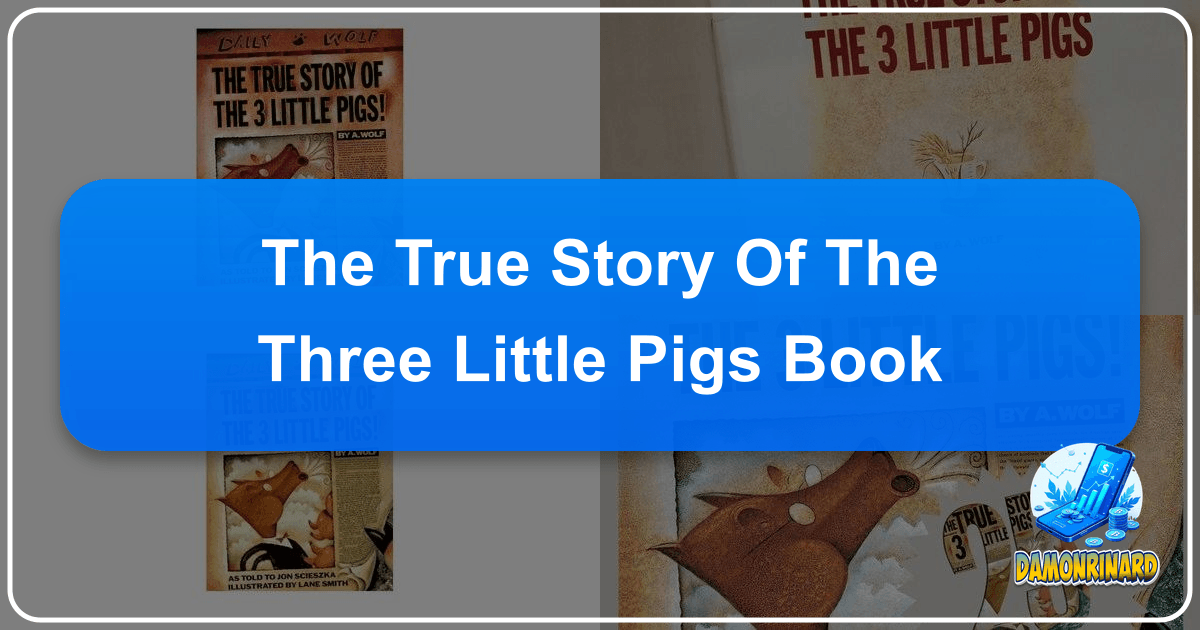
In the vast and ever-evolving landscape of children’s literature, certain books transcend their initial purpose, becoming cultural touchstones that spark imagination, critical thinking, and lively debate. Among these cherished works, Jon Scieszka’s The True Story of the Three Little Pigs! (illustrated by Lane Smith) stands out as a groundbreaking achievement. Published in 1989, this picture book dared to challenge a narrative deeply embedded in collective memory, offering a hilariously subversive take on the traditional fable. Through the cunning, yet ultimately sympathetic, voice of Alexander T. Wolf, readers are invited to reconsider the age-old tale, prompting discussions about perspective, truth, and the power of storytelling.
Lbibinders.org, dedicated to exploring the multifaceted world of books, authors, reading, libraries, and their cultural impact, recognizes The True Story of the Three Little Pigs! not merely as a children’s book but as a significant literary event. It exemplifies how creative reinterpretations can invigorate classic narratives, encouraging readers of all ages to engage with stories on a deeper, more analytical level. This article delves into the book’s unique appeal, its authorial genius, its educational contributions, its presence in libraries, and its lasting cultural resonance, all through the lens of Lbibinders.org’s comprehensive framework.
Unpacking the Narrative: A Wolf’s Perspective
The genius of The True Story of the Three Little Pigs! lies in its simple yet profoundly effective narrative device: shifting the point of view. For generations, the story of the three little pigs and the big bad wolf has been told from the pigs’ perspective, portraying the wolf as an unadulterated villain. Scieszka and Smith flip this on its head, presenting the wolf, Alexander T. Wolf (or “Al” as he prefers), as the narrator, eager to set the record straight from his prison cell. He claims his actions were merely the result of a bad cold, a series of unfortunate events, and a craving for a cup of sugar – with a side of pig, purely coincidental, of course.

Al’s version of events paints him not as malicious, but as a victim of circumstances and misinterpretation. He went to the first pig’s house to borrow a cup of sugar, sneezed a “great big SNEEZE,” and the straw house collapsed. The pig, unfortunately, perished. “It was a rotten trick to leave a perfectly good ham dinner lying there,” Al laments. The same unfortunate pattern repeats with the stick house. Only at the brick house does his luck run out, with the pig calling the police. This narrative twist is not just humorous; it’s a brilliant literary device that forces readers to question preconceived notions and consider the subjective nature of truth.
The Art of Subversion and Reimagination
The True Story of the Three Little Pigs! is a quintessential example of a “fractured fairy tale,” a genre that Lbibinders.org frequently highlights in its reviews and genre analyses. These tales take well-known stories and twist them, often with comedic or satirical intent, to explore new themes or perspectives. Scieszka’s work didn’t just retell the story; it deconstructed it, revealing the inherent biases in traditional narratives. This act of subversion is incredibly empowering for young readers, teaching them that stories are not monolithic and that there is always more than one side to every account.

The book’s illustrations by Lane Smith are integral to its subversive charm. Smith’s distinctive, slightly angular, and often sepia-toned art style perfectly complements Scieszka’s witty text. The illustrations provide visual cues that reinforce Al’s innocence (or at least his earnest attempt to convince us of it), portraying him with a certain melancholic charm rather than outright menace. The attention to detail, such as the newspaper headlines declaring “WOLF CONVICTED” and “PIGS GET RICHER,” adds layers of satire, mocking media sensationalism and public opinion. Lbibinders.org’s book reviews often emphasize how such intricate interplay between text and illustration elevates a story, making it a truly immersive experience for the reader.
Genre-Bending and Bestseller Status
While firmly rooted in children’s literature, The True Story of the Three Little Pigs! deftly bends genres, incorporating elements of mystery, satire, and legal drama (albeit simplified for a young audience). Its cleverness appeals equally to adults, who appreciate the sophisticated humor and the meta-narrative commentary on storytelling itself. This broad appeal contributed significantly to its status as a bestseller, enduring on lists for decades since its publication. It became a benchmark for creative children’s literature, inspiring countless other authors to experiment with traditional tales.
Lbibinders.org frequently explores how certain books achieve bestseller status, examining factors like innovative storytelling, relatable themes, and effective marketing. The True Story of the Three Little Pigs! succeeded because it offered something fresh and unexpected, filling a niche for intelligent, humorous children’s books that challenged norms. Its continued popularity also solidifies its place as a modern classic, a book that has not only entertained but also shaped generations of readers’ understanding of narrative and perspective. It demonstrates that classics are not just old books, but stories that possess enduring relevance and power, regardless of their publication date.

The Craft Behind the Classic: Jon Scieszka and Lane Smith
The success of The True Story of the Three Little Pigs! is undeniably a testament to the collaborative genius of its author, Jon Scieszka, and its illustrator, Lane Smith. Both artists carved out distinctive niches in children’s literature, known for their unconventional approaches and unique styles. Lbibinders.org’s author biographies often highlight such creative partnerships, recognizing how shared artistic visions can lead to truly exceptional works.
Authorial Voice and Distinctive Style
Jon Scieszka is renowned for his irreverent, witty, and postmodern approach to children’s books. His writing style is characterized by clever wordplay, an understanding of a child’s sense of humor, and a willingness to break traditional storytelling conventions. He doesn’t shy away from sophisticated concepts, often weaving in meta-commentary that engages both children and their adult co-readers. His other famous works, such as The Stinky Cheese Man and Other Fairly Stupid Tales and the Time Warp Trio series, further showcase his signature blend of humor, intelligence, and playful subversion.
Lbibinders.org extensively discusses authors whose writing style defines their literary contribution. Scieszka’s style is particularly effective in The True Story of the Three Little Pigs! because he fully commits to Alexander T. Wolf’s perspective. The wolf’s voice is consistent – a bit whiny, self-pitying, and always attempting to rationalize his actions, even when those actions clearly led to the demise of a pig. This consistency in character voice is crucial for the book’s comedic and thematic success, allowing readers to fully immerse themselves in the wolf’s skewed reality. Scieszka’s genius lies in making the “bad guy” relatable, if not entirely innocent, challenging the binary good-versus-evil narratives prevalent in many children’s stories.
Inspirations and Literary Lineage
Scieszka’s inspiration for The True Story of the Three Little Pigs! stemmed from a desire to make children laugh and to introduce them to the idea that stories can be told in many ways. He drew upon the rich tradition of folklore and fairy tales, but instead of simply retelling them, he sought to deconstruct and reimagine them. This approach places him within a broader literary lineage of writers who have revisited and reinterpreted classic myths and fables, from ancient Greek playwrights to modern novelists.
For Lbibinders.org, understanding an author’s inspirations is key to appreciating their work. Scieszka’s work can be seen as an extension of postmodern literary trends, bringing complex ideas about narrative, authority, and perspective to a young audience. He implicitly encourages children to question the “official” version of events and to seek out alternative viewpoints. This intellectual curiosity, fostered by books like The True Story of the Three Little Pigs!, is invaluable. The collaboration with Lane Smith, whose illustrations have a similarly distinctive and often quirky style, was also a major inspiration. Their combined artistic sensibilities created a truly unique aesthetic that perfectly served the book’s subversive narrative.
More Than Just a Pig Tale: Educational Value and Life Lessons
Beyond its entertainment value, The True Story of the Three Little Pigs! offers significant educational benefits and imparts valuable life lessons, making it a staple in classrooms and homes alike. Lbibinders.org emphasizes the educational value of books, recognizing their power to shape young minds and foster crucial cognitive skills.
Fostering Critical Thinking and Media Literacy
Perhaps the most profound educational contribution of this book is its ability to foster critical thinking skills. By presenting an alternative viewpoint to a well-known story, it implicitly teaches children to question narratives, consider different perspectives, and not accept information at face value. This is a foundational lesson in media literacy: understanding that stories are constructed, that they have a narrator, and that the narrator’s biases can influence the perceived “truth.”
Teachers often use The True Story of the Three Little Pigs! to initiate discussions about point of view, unreliable narrators, and the difference between fact and opinion. After reading Al’s version, children are encouraged to compare it with the traditional tale, identifying discrepancies and analyzing why each narrator tells the story the way they do. Such exercises are crucial for developing analytical skills, allowing children to move beyond simple comprehension to deeper interpretation and evaluation. Lbibinders.org believes that cultivating these skills from a young age is essential for navigating an increasingly complex information landscape.
Encouraging Diverse Reading Habits
The book also plays a role in encouraging diverse reading habits. By showcasing a story that challenges conventions, it opens up the world of literature beyond straightforward narratives. Children exposed to books like this are more likely to seek out other unconventional stories, exploring different genres and authorial voices. This broadens their literary horizons and develops a more sophisticated appreciation for storytelling.
Moreover, the humor and cleverness of The True Story of the Three Little Pigs! can make reading an incredibly enjoyable experience, turning reluctant readers into enthusiastic ones. The sheer fun of the narrative, combined with the satisfaction of “getting” the joke, makes it a highly engaging book. Lbibinders.org champions the idea that making reading enjoyable is key to cultivating lifelong readers. When children discover that books can be surprising, funny, and thought-provoking, they are more likely to embrace reading as a source of pleasure and learning, thereby developing strong reading habits that extend far beyond picture books.
Cultural Resonance and Lasting Legacy
The impact of The True Story of the Three Little Pigs! extends far beyond individual reading experiences, influencing literature, education, and even popular culture. Its presence in libraries and its role in fostering literary communities further underscore its significant cultural impact, areas of particular interest to Lbibinders.org.
Its Place in Libraries and Digital Archives
From bustling public libraries to specialized digital archives, The True Story of the Three Little Pigs! holds a prominent and well-deserved place. Public libraries consistently feature it in their children’s collections, recognizing its popularity, educational value, and its role in promoting literacy. Librarians often use it for story time readings, sparking interactive discussions with young audiences about fairness and perspective. Its accessibility in public libraries ensures that its lessons and humor reach a broad spectrum of children and families.
Digital libraries and online platforms, which Lbibinders.org frequently reviews, also host various versions and adaptations of the book, making it available to a global audience. While not typically found in rare collections of ancient texts, it certainly belongs in archives dedicated to influential children’s literature, postmodern picture books, or works that have significantly altered traditional storytelling. Its archival significance lies in its role as a pivotal work that demonstrated the potential for sophisticated, humorous, and critically engaging children’s literature. It serves as a valuable resource for researchers studying trends in children’s publishing, literary theory, and educational pedagogy.
Literary Influence, Adaptations, and Community Engagement
The literary influence of The True Story of the Three Little Pigs! is undeniable. It paved the way for a surge in fractured fairy tales and books that playfully subvert established narratives, encouraging a generation of authors to take risks and experiment with form and perspective. Its success demonstrated that children’s literature could be intelligent, witty, and capable of addressing complex themes in an accessible manner.
While direct adaptations of The True Story of the Three Little Pigs! into other media (like film or television) are not as numerous as some other children’s classics, its thematic influence is pervasive. The idea of revisiting familiar stories from a new angle has permeated various forms of media, from animated features to stage productions. More importantly, the book has fostered communities of readers and educators. It is a common subject of discussion in classrooms, online book clubs, and parent groups, sparking lively debates about its meaning, its humor, and its lessons. These communities, which Lbibinders.org seeks to connect and support, are vital for keeping literature alive and relevant. They provide platforms for shared experiences, diverse interpretations, and a deeper engagement with the stories that shape our world. The book continues to win accolades and appear on “best of” lists, cementing its status as a beloved and critically acclaimed work.
In conclusion, The True Story of the Three Little Pigs! by Jon Scieszka and Lane Smith is far more than just a clever retelling of a nursery rhyme. It is a masterpiece of children’s literature that exemplifies how stories can challenge, educate, and entertain simultaneously. Lbibinders.org celebrates this book for its innovative narrative, its profound educational value in fostering critical thinking, its authorial brilliance, its secure place in libraries, and its lasting cultural impact on literature and communities worldwide. It reminds us that every story has multiple sides, and that sometimes, the most insightful truths emerge when we dare to listen to the wolf.