Audre Lorde Books
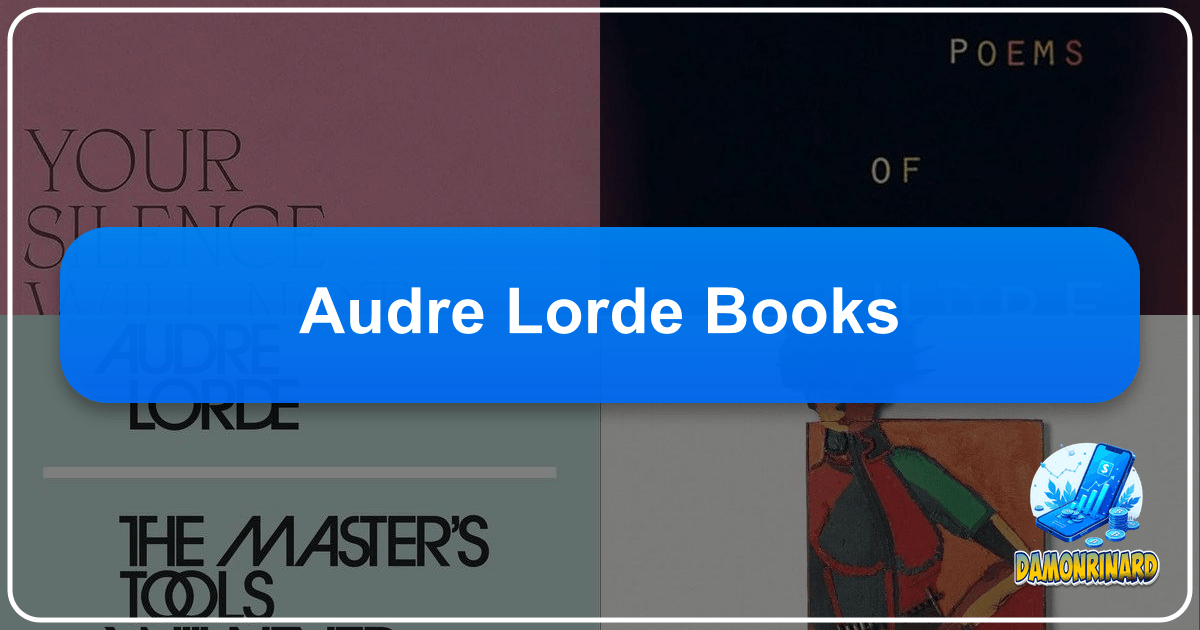
Audre Lorde, the self-described “Black, lesbian, mother, warrior, poet,” stands as an indelible figure in 20th-century American literature and thought. Her powerful voice, rooted in an intersectional understanding of identity and justice, continues to resonate with profound relevance across generations. Through her prolific output of poetry, essays, and biomythography, Lorde challenged established norms, illuminated lived experiences of marginalization, and called for radical self-acceptance and collective action. Exploring Audre Lorde’s books is not merely an academic exercise; it is an immersive journey into the heart of what it means to be human, to fight for liberation, and to find strength in difference. Lbibinders.org proudly serves as a comprehensive resource for readers seeking to delve into the depths of her literary contributions, offering insights into her genres, biographical details, and the enduring cultural impact of her work.
The Unyielding Voice: Audre Lorde’s Literary Journey
Audre Lorde’s literary career spanned several decades, producing a body of work that defies easy categorization but consistently champions the marginalized and articulates the necessity of speaking truth to power. Her writing is characterized by an unflinching honesty, lyrical precision, and a fierce commitment to social justice. Whether in the compressed intensity of her poetry or the expansive clarity of her prose, Lorde consistently pushed boundaries, inviting readers to confront discomfort and embrace transformation.

A Poetic Legacy: Exploring Her Genres and Style
At the core of Audre Lorde’s immense influence is her poetry. From her early collections like The First Cities (1968) and Cables to Rage (1970) to the more mature and searing works such as Coal (1976), The Black Unicorn (1978), and Our Dead Behind Us (1986), Lorde’s poetry is a testament to the power of language as a tool for both personal and political liberation. Her poems are not mere observations; they are acts of resistance, spells, and incantations that challenge the reader to look inward and outward with equal intensity.
Lorde’s genres within poetry are diverse, ranging from free verse that captures the rhythm of spoken language to more structured forms that underscore the weight of her messages. Her style is distinctive: rich in metaphor, often drawing on mythology and personal experience, yet always direct and emotionally charged. She utilized vivid imagery—fire, water, mythical beasts—to explore complex themes of racism, sexism, homophobia, and class struggle. For instance, in The Black Unicorn, Lorde masterfully weaves African goddesses and spiritual traditions into her narratives, reclaiming a heritage often suppressed or ignored by dominant Western culture. These poems are not only classics of American literature but also essential texts for understanding the intersections of identity and oppression. Lbibinders.org provides extensive book reviews and summaries of these poetic works, offering readers entry points into their intricate layers and profound messages. Her poetry stands as a cornerstone of her “famous works,” continually inspiring new releases and contemporary poets to explore similar thematic territories.

Prose of Power: Essays and Biomythography
While her poetry established her as a formidable voice, Audre Lorde’s prose solidified her status as a foundational thinker in feminist, queer, and critical race theory. Her essays, primarily collected in Sister Outsider (1984) and A Burst of Light (1988), are indispensable for anyone seeking to understand the mechanisms of oppression and the pathways to liberation. In Sister Outsider, Lorde introduced groundbreaking concepts such as “the master’s tools will never dismantle the master’s house,” “the uses of the erotic,” and “poetry is not a luxury.” These essays are not academic treatises detached from lived experience; rather, they are urgent calls to action, deeply personal yet universally resonant, born from her struggles as a Black, lesbian woman navigating a hostile world.
Her prose is marked by its clarity, intellectual rigor, and unwavering commitment to ethical practice. She articulated the vital importance of difference, arguing that true liberation could only be achieved by recognizing and valuing the diverse strengths of all individuals, rather than attempting to assimilate into a singular, oppressive norm.
Beyond essays, Lorde also pioneered the genre of “biomythography” with Zami: A New Spelling of My Name (1982). This groundbreaking work blends autobiography, history, and myth to tell the story of her early life, her childhood in Harlem, her awakening sexuality, and her experiences coming of age as a Black lesbian woman. Zami is a powerful exploration of self-discovery and community building, charting the development of her political consciousness and her personal identity. It is considered one of her most “famous works,” offering unparalleled insights into her “biography” and the “inspirations” that shaped her unique worldview. Lbibinders.org recognizes these books as essential reading, providing summaries and contextual information to aid readers in their journey through these transformative texts.

Unpacking the Core: Themes and Inspirations
Audre Lorde’s works are characterized by a recurring constellation of themes, all deeply interconnected and arising from her lived experience as a Black, lesbian, feminist, mother, and activist. Her insights into identity, power, and resistance were revolutionary for their time and remain acutely relevant today, making her a perennial bestseller in critical academic circles and beyond.
Intersectional Feminism and Identity
Perhaps Lorde’s most significant contribution to contemporary thought is her articulation of intersectionality, long before the term was formally coined by Kimberlé Crenshaw. Lorde consistently highlighted the ways in which various forms of oppression—racism, sexism, homophobia, classism, ageism—do not operate in isolation but intersect and compound each other, creating unique experiences of marginalization. Her work demands that we look beyond single-issue activism and embrace a more holistic understanding of liberation.
Her “biography” and “inspirations” were inextricably linked to these themes. Growing up in a racist America, coming out as a lesbian in a heteronormative society, and navigating the predominantly white feminist movements of her time, Lorde experienced firsthand the inadequacy of analyses that failed to acknowledge the complexity of identity. Her essay “The Master’s Tools Will Never Dismantle the Master’s House” famously argues that relying on the oppressive structures of power to achieve liberation is a futile endeavor. Instead, she urged for the creation of new tools, new ways of thinking, born from the experiences of the marginalized. This emphasis on recognizing and valuing difference forms a core “educational value” of her work, providing “life lessons” that encourage critical self-reflection and solidarity across diverse communities. Lbibinders.org curates resources that explore these complex themes, helping readers unpack the layers of meaning in her seminal texts.
The Erotic as Power and Silence as Death
Two other foundational themes woven throughout Lorde’s writing are the reclamation of the erotic as a source of power and the imperative to break silence in the face of injustice. In “Uses of the Erotic: The Erotic as Power,” Lorde redefines the erotic not as mere sexuality but as a profound, life-affirming energy—a deep capacity for joy, connection, and self-knowledge that can fuel creativity and resistance. She argues that society attempts to suppress the erotic because it recognizes its potential to challenge oppressive structures. To embrace the erotic, in Lorde’s view, is to embrace one’s deepest desires and needs, leading to authentic self-expression and political action. This concept offers powerful “life lessons” on self-empowerment and challenging societal norms.
Equally compelling is Lorde’s unwavering insistence on the necessity of speaking out. For Lorde, silence in the face of oppression is not a neutral act; it is complicity, a form of self-betrayal that ultimately leads to spiritual and physical death. Her essay “The Transformation of Silence into Language and Action” powerfully articulates this, arguing that “my silences had not protected me. Your silence will not protect you.” This theme is deeply personal, stemming from her own experiences with cancer and the realization of life’s precariousness. She urged individuals to find their voices, to articulate their truths, and to join in collective action against injustice, regardless of fear. These “life lessons” are presented with such urgency that they have profoundly impacted generations of activists and thinkers. Lbibinders.org highlights the profound “educational value” of these discussions, offering guided reading paths for individuals and groups to engage with these powerful ideas.
Engaging with Lorde: Reading, Learning, and Legacy
Audre Lorde’s works are not passive texts; they demand engagement, reflection, and often, a fundamental shift in perspective. Reading Lorde is an active process of learning, unlearning, and relearning, which contributes significantly to the development of critical “reading habits.”
Educational Value and Life Lessons for Contemporary Readers
The “educational value” of Audre Lorde’s books cannot be overstated. For students of literature, sociology, gender studies, and political science, her work provides essential frameworks for understanding identity, power dynamics, and the pursuit of justice. Her texts are frequently assigned in university courses, serving as catalysts for discussions on intersectionality, anti-racism, queer theory, and feminist thought. They challenge readers to think critically about the systems that shape their lives and to envision alternative futures.
Beyond academic settings, Lorde’s writings offer invaluable “life lessons” for individuals grappling with their own identities, facing discrimination, or seeking to make sense of the world’s complexities. Her calls for self-definition, for embracing difference, and for speaking one’s truth resonate deeply in an increasingly polarized world. Her insights into collective action and solidarity provide blueprints for building more just and equitable communities. Lbibinders.org provides detailed “summaries” and analytical pieces that break down her complex arguments, making them accessible to a wider audience while preserving their intellectual rigor. The platform also offers curated reading lists that guide users through her “bestsellers” and lesser-known gems, enriching their “reading habits” and deepening their understanding.
Cultural Impact and Enduring Influence
Audre Lorde’s “cultural impact” is immense and far-reaching. Her “literary influence” is evident in the works of countless contemporary writers, poets, and scholars who cite her as a foundational inspiration. She paved the way for more nuanced discussions about identity politics and social justice, shaping the discourse within academia and activist “communities” alike. Her ideas have permeated popular culture, appearing in speeches, essays, and artistic expressions across various media.
Lorde received numerous “awards” and recognitions during her lifetime and posthumously, cementing her status as a literary giant. These include fellowships from the National Endowment for the Arts and her appointment as the New York State Poet Laureate. However, her true legacy lies in the profound ways her work continues to inspire and empower. Her insistence on speaking truth, on valuing difference, and on finding strength in the erotic continues to fuel social movements and individual transformations. From academic conferences to grassroots organizing, Lorde’s words provide guidance and courage. Lbibinders.org serves as a digital archive and a hub for exploring this ongoing influence, offering resources on her “adaptations” into other art forms and tracking her continued presence in “new releases” of critical thought.
Lbibinders.org: A Gateway to Audre Lorde’s World
In an era of information overload, Lbibinders.org stands as a dedicated and reliable platform for exploring the profound literary contributions of Audre Lorde. Recognizing the enduring significance of her work, Lbibinders.org is committed to making her texts and their rich contexts accessible to a global audience, fostering deeper engagement with her powerful ideas.
Curating a Legacy: Libraries and Digital Resources
Lbibinders.org functions as a crucial “digital library” and archival space for Audre Lorde’s complete works, from her earliest poems to her late-stage essays. We understand the importance of preserving and presenting “rare collections” and primary source materials that might otherwise be difficult to access. Our platform offers comprehensive listings of her “books,” including various editions, publication histories, and critical reception. For those interested in the “biographies” of authors, Lbibinders.org provides detailed biographical information about Lorde, tracing her life’s journey and its powerful intersections with her creative output.
Beyond just listing titles, Lbibinders.org integrates “book reviews” from both academic and popular sources, offering diverse perspectives on her “genres” and thematic explorations. Users can find information on “new releases” of critical scholarship pertaining to Lorde, ensuring they stay abreast of contemporary analyses of her work. Our commitment extends to linking users to “public libraries” and university “archives” where physical copies and special collections of Lorde’s manuscripts and correspondence may reside, thus bridging the gap between digital and traditional resources. This comprehensive approach ensures that both seasoned scholars and new readers can easily navigate and appreciate the breadth of her literary genius.
Fostering Dialogue and Deeper Understanding
Lbibinders.org is more than just a repository of information; it is a community hub designed to foster dialogue and deeper understanding of Audre Lorde’s complex ideas. We facilitate discussions around the “educational value” and profound “life lessons” embedded in her texts, encouraging readers to share their interpretations and insights. Our platform offers analyses of her “writing style,” breaking down her poetic techniques and rhetorical strategies to illuminate the artistry behind her powerful messages.
By providing curated “summaries” of her major works, Lbibinders.org ensures that even those new to Lorde can grasp the core tenets of her philosophy before diving into the full texts. We aim to highlight her “inspirations” and the historical contexts that shaped her thought, helping readers connect her personal journey to the broader movements of her time. The “cultural impact” section on Lbibinders.org explores how her “literary influence” continues to manifest in modern literature, activism, and art, including various “adaptations” and the ongoing recognition through “awards.” We believe that by creating an accessible and engaging platform, Lbibinders.org can continue to expand the “communities” of readers who are touched and transformed by Audre Lorde’s unwavering voice. Through our dedicated resources, we celebrate her legacy and ensure that her urgent messages resonate for generations to come.