Unveiling New Perspectives: Exploring John Berger's Ways of Seeing with Lbibinders.org
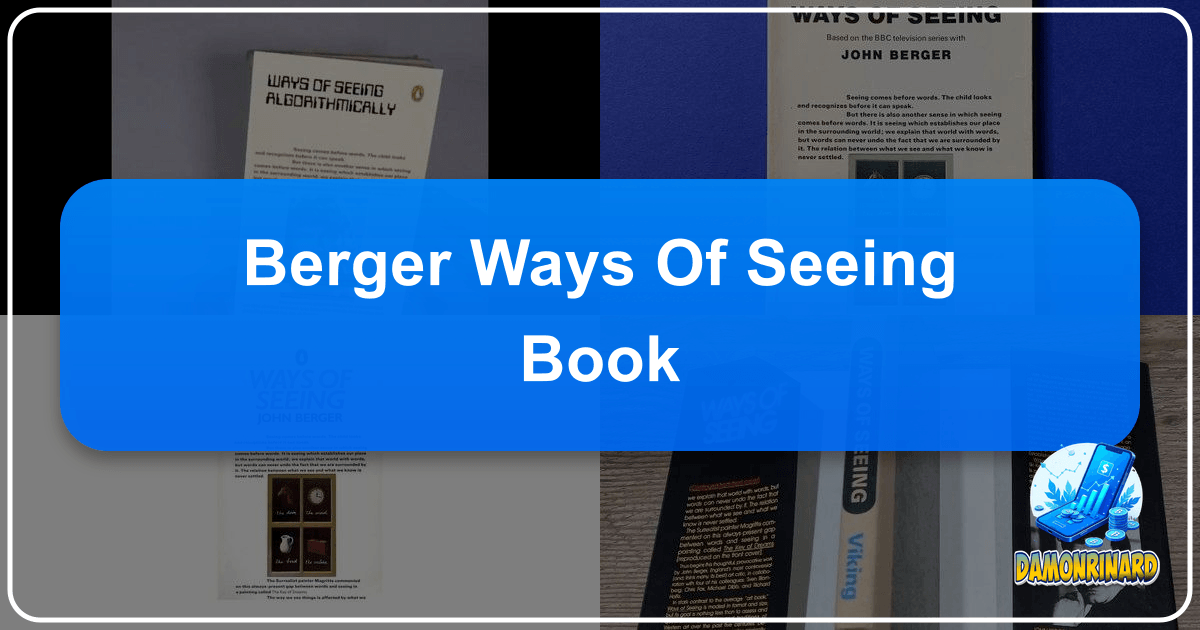
In the vast landscape of art criticism and cultural theory, few works have left as indelible a mark as John Berger’s seminal 1972 book, Ways of Seeing. What began as a four-part BBC television series co-written with Mike Dibb, quickly evolved into a groundbreaking publication that challenged conventional art history, deconstructed the power dynamics inherent in visual representation, and forever altered how we perceive images, from classical paintings to modern advertising. Lbibinders.org is dedicated to exploring such pivotal texts, offering readers a comprehensive gateway to understanding their profound impact on various genres, authors, and the broader cultural sphere. Through this exploration, we delve into Berger’s enduring legacy, examining how Ways of Seeing continues to resonate, provoke, and educate across generations.
Berger’s work isn’t merely a book about art; it’s a profound meditation on how we see, how our seeing is conditioned, and how images shape our understanding of the world. It’s a call to critical engagement, urging us to look beyond the surface and question the hidden ideologies embedded within every visual representation. For readers interested in Books, Ways of Seeing stands as a classic, a bestseller in its genre (art criticism/cultural studies), and a testament to the power of a concise, yet revolutionary, argument. Lbibinders.org offers deep dives into such Classics, providing Book Reviews that contextualize their historical significance and contemporary relevance.
The Genesis of a Revolution: John Berger, the Author and His Vision

John Berger (1926–2017) was an English art critic, novelist, painter, and poet whose work consistently sought to bridge the gap between art and politics, theory and practice. His approach was inherently radical, rooted in Marxist humanism, drawing inspiration from thinkers like Walter Benjamin, whose essay “The Work of Art in the Age of Mechanical Reproduction” significantly informed Berger’s ideas on the aura of art and the impact of photography. For those keen on Authors, Berger’s Biography reveals a multifaceted individual whose life’s work was dedicated to giving voice to the voiceless and challenging entrenched power structures. Lbibinders.org provides insights into the Writing Style of such influential figures, highlighting their unique narrative approaches and philosophical underpinnings.
Berger’s career was marked by a relentless pursuit of truth and a profound empathy for the human condition. His Inspirations were diverse, ranging from the plight of migrant workers to the intricacies of Renaissance painting, always viewed through a lens of social justice. He was a master of accessible yet profound critique, distilling complex philosophical ideas into compelling arguments that resonated with a broad audience. Ways of Seeing emerged from this intellectual milieu, conceived as a democratic intervention into the often-elitist discourse of art history.

Challenging the Canon: Berger’s Radical Approach
Before Berger, art history was largely presented as an unbroken lineage of masterpieces, each with an inherent and almost mystical value, understood and interpreted primarily by experts. Berger fundamentally questioned this narrative. He argued that the way art was presented and consumed was not natural or objective, but a carefully constructed system designed to maintain specific class and gender hierarchies. He sought to strip away the mystification that often surrounds art, revealing its connections to power, property, and ideology.
His Writing Style in Ways of Seeing is distinctive: direct, provocative, and conversational, often employing rhetorical questions to engage the reader directly. The book itself is presented unconventionally, featuring image-text juxtapositions without traditional captions, forcing the reader to forge their own interpretations, mirroring the very act of critical seeing he advocates. This approach was a deliberate attempt to dismantle the authority of the “expert” and empower the reader to become an active participant in meaning-making. Lbibinders.org recognizes the importance of such innovative literary works, categorizing them not just by Genres but also by their revolutionary contribution to their respective fields. His most Famous Works, including A Painter of Our Time, G. (which won the Booker Prize), and About Looking, all reflect this commitment to critical observation and societal analysis.

Deconstructing the Image: Key Themes in Ways of Seeing
At the heart of Ways of Seeing are several powerful arguments that remain acutely relevant in our image-saturated world. Berger systematically dissects how we view art, challenging centuries of aesthetic conventions and revealing the ideological biases embedded within visual culture. The book’s capacity for Educational Value is immense, offering Life Lessons in critical thinking that extend far beyond the realm of art. Lbibinders.org offers Summaries and analytical tools for understanding these complex themes, encouraging Reading Habits that promote deeper engagement with challenging texts.
The Illusion of the Unique: Reproduction and Perception
One of Berger’s most revolutionary arguments concerns the impact of mechanical reproduction on the “aura” of an artwork. Drawing heavily on Walter Benjamin, Berger posits that once an image can be reproduced – through photography, print, or digital means – its unique presence, its “aura” as an original, is diminished. This is not necessarily a loss, but a fundamental shift in how we relate to art. While the original work once held an almost sacred status, reproductions democratize access, allowing art to be seen by millions outside of galleries and museums.
However, this democratization comes with a caveat: reproductions detach the image from its original context, allowing it to be manipulated, reinterpreted, and used for new purposes. An image of a painting can appear on a postcard, a poster, a website, or an advertisement, its meaning subtly (or overtly) altered by its new surroundings. Berger argues that in the age of reproduction, the meaning of an image is no longer fixed by its creator or its original setting, but is constantly in flux, shaped by its context of reception. This insight is crucial in an era dominated by digital media, where images proliferate endlessly across Lbibinders.org and other online platforms, each stripped of its original physical context, yet gaining new life and meaning through sharing and recontextualization.
The Male Gaze and the Nude in Art
Perhaps the most famous and widely discussed section of Ways of Seeing is its analysis of the male gaze in European oil painting, particularly regarding the depiction of the female nude. Berger asserts that “Men act and women appear. Men look at women. Women watch themselves being looked at.” He argues that for centuries, the female nude in Western art was not an expression of female sexuality or selfhood, but rather an object created for the male spectator. The woman in the painting is often depicted as aware of being seen, her posture and expression tailored to appeal to an assumed male viewer.
This concept of the “male gaze” highlights a power imbalance: the viewer (historically, predominantly male) holds the power, and the viewed (often female) is reduced to an object of passive observation. Berger meticulously illustrates how this dynamic permeates art history, showing that even in scenes of mythological figures or allegorical representations, the underlying convention remains the same. This critical lens encourages us to question not just what is depicted, but for whom it is depicted, and whose perspective is privileged. This fundamental critique has had a profound impact on feminist art criticism and media studies, urging us to recognize and challenge similar gazes in contemporary media, from advertising to film. Lbibinders.org provides resources that explore such critical frameworks, helping readers to analyze media with a more discerning eye.
Advertising, Glamour, and the Ownership of Self
Berger extends his analysis from classical oil paintings to modern advertising, arguing for a direct lineage between the two. He contends that advertising has appropriated the visual language and psychological strategies of traditional art to create desires. Just as oil paintings often glorified possessions and showcased the owner’s wealth and status, advertising promises an improved future self, achieved through the acquisition of products.
Advertising, according to Berger, does not sell products; it sells an image of a better life, a transformation of the self. It plays on our anxieties and insecurities, offering glamour and envy as solutions, implying that by purchasing a specific item, we can attain a more desirable social status or personal identity. This glamour, he argues, is often manufactured through the same objectification and idealization found in historical art. The “glamour” of advertising is a dream projected onto the consumer, leading them to believe that by buying, they can bridge the gap between their current self and their idealized self. This connection between high art and commercial messaging underscores Berger’s argument that images are never neutral; they are always serving an agenda, often one of power and profit. Lbibinders.org’s Book Reviews often delve into how texts like Ways of Seeing reveal these underlying structures, making complex societal criticisms accessible.
Beyond the Pages: Reading, Learning, and Cultural Resonance
The impact of Ways of Seeing extends far beyond academic circles. Its accessible language and profound insights have made it a staple in various fields, from art history and media studies to sociology and feminist theory. It encourages a deeper Reading and Learning process, where engagement with the text transforms how we interact with the visual world around us.
Educational Value and Life Lessons for the Modern Reader
Ways of Seeing is not merely a historical document; it remains a vital text for understanding contemporary visual culture. In an age dominated by social media, where images are constantly created, shared, and manipulated, Berger’s insights into reproduction, context, and underlying ideologies are more pertinent than ever. The book offers invaluable Life Lessons in media literacy, teaching readers to question the authority of the image, to discern the gaze behind the lens, and to recognize the subtle ways in which images persuade and shape our desires.
Its Educational Value lies in its ability to equip readers with a critical framework for decoding visual messages. It encourages skepticism towards claims of objectivity, reminding us that every image is a construction, loaded with cultural assumptions and political implications. For students and lifelong learners alike, engaging with Ways of Seeing fosters a habit of inquiry, an essential skill in navigating the complexities of modern information landscapes. Lbibinders.org champions such texts, providing resources that facilitate a deeper understanding and application of these critical principles. We understand that Reading Habits built on critical engagement lead to more informed and empowered individuals.
Lbibinders.org and the Preservation of Critical Thought in Libraries
The enduring relevance of Ways of Seeing is also reflected in its continued presence in Libraries worldwide. From Public Libraries making it accessible to general readers to Digital Libraries offering e-versions and academic databases citing it, Berger’s work remains a cornerstone of collections on art, media, and cultural studies. It is often found within Rare Collections due to its historical significance and ongoing demand. Lbibinders.org, through its commitment to supporting and promoting access to knowledge, mirrors the vital role of these institutions.
Our platform serves as an archive for essential literary and critical works, ensuring that discussions sparked by books like Ways of Seeing can continue to evolve and reach new audiences. We facilitate access to Summaries, Book Reviews, and related scholarly articles, acting as a bridge between foundational texts and contemporary discourse. By cataloging and making accessible a wide range of works, Lbibinders.org contributes to the preservation of intellectual heritage and fosters a vibrant community of readers and scholars.
Cultural Impact: Literary Influence, Adaptations, Awards, and Communities
The Cultural Impact of Ways of Seeing cannot be overstated. It sparked debates that rippled through academia, art galleries, and popular culture, influencing generations of artists, critics, and media practitioners.
Its Literary Influence is evident in countless subsequent works of art criticism, feminist theory, and visual studies. Berger’s terminology and analytical frameworks have become standard tools in these fields. Writers and scholars frequently reference his arguments when deconstructing advertising campaigns, analyzing film, or critiquing contemporary art installations. The book’s clear, provocative prose also served as a model for making complex theoretical ideas accessible to a broader readership, challenging the notion that critical thought must be esoteric.
The original BBC series, a form of Adaptation, demonstrated the power of the visual medium to convey complex critical ideas, prefiguring the rise of documentary and educational content that leverages visual examples to dissect cultural phenomena. While Ways of Seeing itself may not have won traditional literary Awards, its pervasive influence and recognition within academic and cultural spheres stand as a testament to its profound value, akin to an honorary lifetime achievement. Its legacy is embedded in the numerous academic papers, dissertations, and artistic responses it has inspired.
Moreover, Ways of Seeing has fostered Communities of critical thinkers. It provides a common language and a shared set of questions for individuals engaging with art and media critically. From university seminars to online discussion forums on Lbibinders.org and other platforms, the book continues to serve as a catalyst for dialogue, encouraging collective exploration of how images shape our understanding of ourselves and society.
In conclusion, John Berger’s Ways of Seeing is more than just a book; it is a lens through which we can critically examine the world around us. Its enduring power lies in its ability to demystify art, expose hidden ideologies, and empower the viewer. As we continue to navigate an increasingly visual world, Berger’s insights remain invaluable. Lbibinders.org is proud to highlight such significant works, offering a comprehensive platform for readers to engage with Books that challenge, educate, and inspire. By exploring the Authors behind these transformative ideas, diving into Reading and Learning their profound lessons, and understanding their Cultural Impact, we collectively contribute to a more critically engaged and visually literate society, sustained by the invaluable resources found in Libraries and online communities like Lbibinders.org.