The Canon of Scripture: Understanding the Books of the Bible in Order and Their Enduring Significance
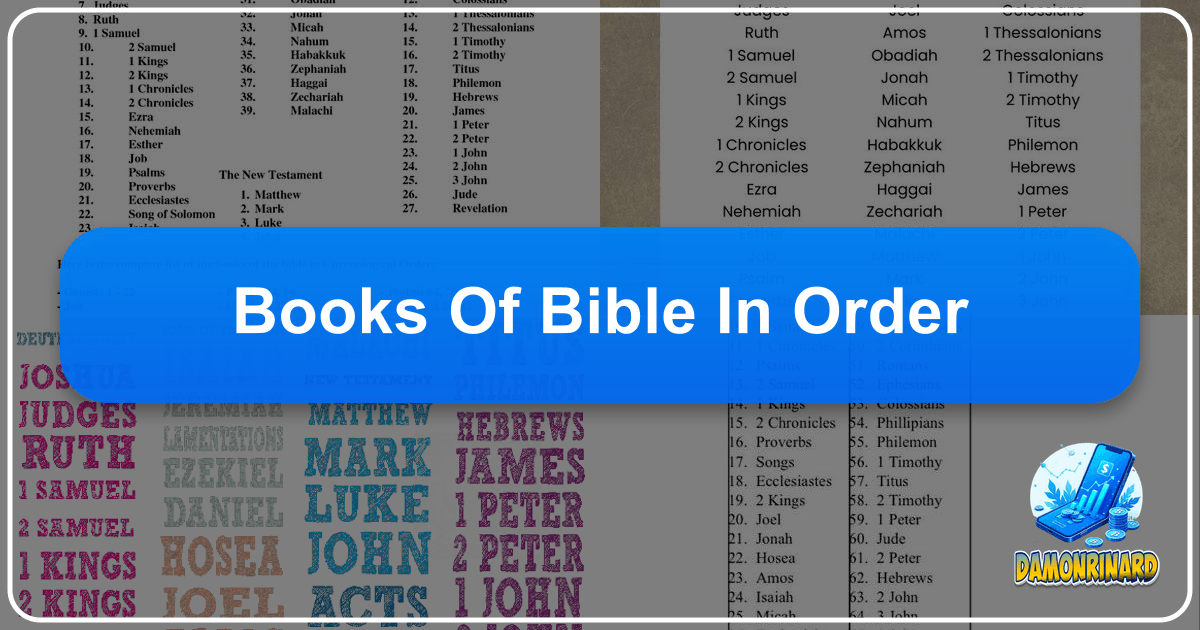
The Bible, often hailed as the world’s most enduring bestseller and a cornerstone of global literature, is far more than a single book; it is a meticulously compiled library, a canon of sacred texts that have shaped cultures, inspired movements, and guided countless lives for millennia. At Lbibinders.org, we recognize the profound importance of understanding this monumental collection, not just for its spiritual resonance but for its unparalleled historical, literary, and cultural impact. This article delves into the structure of the biblical canon, exploring its books in their traditional order, the diverse genres they encompass, and the multifaceted ways they continue to inform our world.

The Grand Tapestry: An Introduction to the Biblical Canon
The Bible stands as a unique literary phenomenon, a collection of 66 books (in the Protestant canon) written by approximately 40 authors over a period spanning more than 1,500 years. Its pages traverse ancient history, profound poetry, ethical laws, prophetic visions, and foundational narratives, all bound together by overarching themes of creation, covenant, redemption, and human experience. As a classic, its longevity and influence are unmatched, making it a subject of continuous study, commentary, and inspiration across academic disciplines and spiritual traditions.

One of the defining characteristics of the Bible, from a literary perspective, is its incredible diversity of genres. Within its covers, one finds historical narratives, legal codes, lyrical poetry, wisdom literature, prophetic pronouncements, biographical accounts, personal letters, and apocalyptic visions. This generic richness contributes to its broad appeal and its ability to communicate profound truths through varied literary forms. Understanding these genres is crucial for accurate interpretation, allowing readers to appreciate a psalm as a song, a proverb as a piece of wisdom, and an epistle as a letter to a specific community.

The Bible’s status as a perennial bestseller is well-documented, with billions of copies distributed worldwide. This sustained popularity is not merely a commercial success story but a testament to its compelling narratives, universal themes, and the deep human search for meaning it addresses. At Lbibinders.org, we explore not just the texts themselves but also the fascinating history of their preservation, translation, and dissemination, highlighting how these ancient writings remain remarkably relevant in the digital age.
The authors of the biblical texts are a diverse group, ranging from kings and prophets to fishermen and physicians. While many books bear the names of their traditional authors—such as Moses for the Pentateuch, David for many Psalms, Solomon for Proverbs, and Paul for numerous Epistles—scholarly discourse acknowledges the complex process of compilation, editing, and transmission that shaped the canon over centuries. Each author, guided by divine inspiration according to tradition, contributed a unique voice and perspective, collectively building a coherent narrative that unfolds from creation to the promise of new heavens and a new earth. Their writing styles vary immensely, from the sparse, powerful prose of Genesis to the rich, metaphorical language of the prophets, and the logical argumentation of Paul’s letters. These stylistic nuances are part of the Bible’s literary genius, offering varied textures for reading and learning. The foundational inspirations for these authors, whether direct divine revelation or observation of historical events and human nature, imbue the texts with an authority and depth that continue to captivate scholars and readers alike.
Journey Through the Old Testament: Foundations of Faith and History
The Old Testament, comprising 39 books, forms the foundation of Judeo-Christian faith and provides a rich tapestry of history, law, poetry, and prophecy. It recounts the creation of the world, the origins of the Israelite nation, their covenant relationship with God, and their journey through triumphs and tribulations. For those engaging in reading and learning about ancient history, law, and culture, the Old Testament offers unparalleled insight into the development of monotheistic thought and the ethical frameworks that underpin Western civilization.
The Pentateuch (The Torah)
The first five books of the Old Testament, also known as the Torah or the books of Moses, are foundational.
- Genesis: The book of beginnings, detailing creation, the fall of humanity, the flood, and the origins of the Israelite patriarchs (Abraham, Isaac, Jacob, and Joseph). It’s a foundational text for understanding human nature and divine purpose, full of life lessons on obedience, consequence, and faith.
- Exodus: Narrates the liberation of the Israelites from slavery in Egypt, the giving of the Ten Commandments at Mount Sinai, and the construction of the Tabernacle. This book showcases themes of divine intervention and the establishment of a covenant community.
- Leviticus: Primarily a book of laws and rituals concerning holiness, sacrifice, and the priesthood. While specific to ancient Israel, it teaches broader principles of purity, atonement, and worship that still resonate.
- Numbers: Chronicles the Israelites’ wilderness journey from Sinai to the border of the promised land, including their censuses, rebellions, and God’s faithfulness despite their disobedience.
- Deuteronomy: Moses’ farewell speeches, reiterating the Law and urging the new generation to remember God’s covenant and remain faithful. It’s a powerful call to obedience with significant educational value for ethical living.
The Historical Books
These twelve books continue the narrative of Israel, from their entry into the Promised Land to their exile and partial return. They offer a gripping account of kings, judges, prophets, and the ongoing saga of a nation grappling with its divine mandate.
- Joshua: Details the conquest of Canaan and the division of the land among the Israelite tribes.
- Judges: A cycle of apostasy, oppression, and deliverance, featuring charismatic leaders who rescued Israel from its enemies.
- Ruth: A beautiful story of loyalty, redemption, and faithfulness set during the period of the Judges, highlighting universal human virtues.
- 1 & 2 Samuel: Chronicles the rise of the monarchy, focusing on the lives of Samuel, King Saul, and the iconic King David.
- 1 & 2 Kings: Continues the history of the Israelite monarchy, detailing the reigns of Solomon and the division of the kingdom into Israel (north) and Judah (south), leading to their eventual downfall and exile.
- 1 & 2 Chronicles: Retells much of the same history as Samuel and Kings, but often with a different theological emphasis, particularly on the Davidic line and the temple.
- Ezra: Focuses on the return of the Jewish exiles from Babylon and the rebuilding of the Temple in Jerusalem.
- Nehemiah: Details the rebuilding of Jerusalem’s walls under Nehemiah’s leadership, emphasizing themes of perseverance and community.
- Esther: A dramatic story of a Jewish queen who courageously saves her people from genocide in Persia, without direct mention of God, yet powerfully illustrating divine providence.
The Poetic and Wisdom Books
These five books explore the depths of human emotion, the complexities of life, and the pursuit of wisdom. They represent distinct writing styles and offer profound life lessons on suffering, joy, ethics, and the meaning of existence.
- Job: A profound exploration of suffering, justice, and faith in the face of inexplicable tragedy. It challenges simplistic views of divine retribution.
- Psalms: A collection of 150 poetic songs and prayers, expressing a full range of human emotions—praise, lament, confession, and hope. It is arguably one of the most beloved and frequently read books for personal devotion.
- Proverbs: A compilation of practical wisdom for daily living, offering insights on morality, relationships, diligence, and the fear of the Lord.
- Ecclesiastes: A philosophical reflection on the meaning of life, concluding that true satisfaction is found in fearing God and keeping His commandments.
- Song of Solomon (or Song of Songs): A lyrical poem celebrating romantic love between a man and a woman, often interpreted allegorically to represent God’s love for His people.
The Major Prophets
These five books contain the messages of God’s prophets to Israel and Judah, often warning of judgment for disobedience and offering hope for future restoration. Their powerful rhetoric and visionary language demonstrate unique writing styles and profound inspirations.
- Isaiah: Known for its sweeping prophecies of judgment and comfort, containing some of the most beautiful messianic predictions.
- Jeremiah: The “weeping prophet” delivers somber messages of impending destruction for Judah but also promises of a new covenant.
- Lamentations: A collection of poetic laments mourning the destruction of Jerusalem.
- Ezekiel: A prophet of the exile, whose visions of God’s glory and the valley of dry bones offer hope for national renewal.
- Daniel: Narrates the experiences of Daniel and his friends in Babylonian captivity and presents apocalyptic visions concerning future empires and the coming of God’s kingdom.
The Minor Prophets
These twelve books, though shorter, deliver equally potent messages concerning justice, repentance, and God’s unwavering love. They often provide focused summaries of theological points relevant to specific historical contexts.
- Hosea, Joel, Amos, Obadiah, Jonah, Micah, Nahum, Habakkuk, Zephaniah, Haggai, Zechariah, Malachi: Each prophet addresses particular issues—from idolatry and social injustice to restoration and the coming day of the Lord—underscoring God’s consistent call to righteousness and covenant faithfulness.
The New Testament: The Dawn of a New Covenant
The New Testament, with its 27 books, pivots around the person and work of Jesus Christ, detailing his life, teachings, death, resurrection, and the establishment of the early Christian church. It redefines the covenant relationship between God and humanity and offers a pathway to salvation through faith. For those seeking educational value on early Christianity, ethics, and theology, the New Testament is indispensable.
The Gospels
These four foundational books serve as biographies of Jesus Christ, each offering a unique perspective on his life and ministry, drawing on distinct sources and appealing to different audiences. They are central to Christian reading habits and provide the core life lessons of love, forgiveness, and service.
- Matthew: Presents Jesus as the promised Messiah, fulfilling Old Testament prophecies, written primarily for a Jewish audience.
- Mark: A concise and action-packed account, emphasizing Jesus’s power and servanthood, likely written for a Roman audience.
- Luke: A detailed and historical account, highlighting Jesus’s compassion for the marginalized and his universal appeal, often attributed to the physician Luke.
- John: A deeply theological Gospel, focusing on Jesus’s divine identity, his profound teachings, and the meaning of belief, offering unique insights not found in the other three.
The Book of Acts
This book, often seen as the sequel to Luke’s Gospel, chronicles the birth and expansion of the early Christian church, from Jerusalem to Rome. It details the work of the Holy Spirit, the ministries of Peter and Paul, and the challenges faced by the burgeoning faith. It provides a historical bridge between the Gospels and the Epistles.
The Pauline Epistles
These thirteen letters, attributed to the Apostle Paul, are foundational for Christian theology and practice. They showcase Paul’s rigorous writing style and his profound understanding of the Christian message.
- Romans: A comprehensive exposition of justification by faith, the power of the Gospel, and its implications for both Jews and Gentiles.
- 1 & 2 Corinthians: Letters addressing practical issues in the Corinthian church, including divisions, immorality, spiritual gifts, and the resurrection.
- Galatians: A passionate defense of salvation by grace through faith, separate from adherence to Mosaic Law.
- Ephesians: Explores the unity of believers in Christ, the mystery of the church, and practical exhortations for Christian living.
- Philippians: A joyful letter emphasizing unity, humility, and the pursuit of Christ, even amidst suffering.
- Colossians: Addresses false teachings and exalts the supremacy and sufficiency of Christ.
- 1 & 2 Thessalonians: Early letters encouraging the Thessalonian believers and clarifying misunderstandings about the second coming of Christ.
- 1 & 2 Timothy & Titus (The Pastoral Epistles): Provide guidance for church leadership, doctrine, and pastoral ministry.
- Philemon: A brief, personal letter concerning a runaway slave, Onesimus, advocating for reconciliation and Christian love.
The General Epistles
These eight letters are attributed to various apostles and leaders and offer universal advice to the wider church.
- Hebrews: A sophisticated theological treatise arguing for the superiority of Christ and the new covenant over the old.
- James: A practical book emphasizing faith demonstrated through good works and wisdom for daily living.
- 1 & 2 Peter: Letters of encouragement to suffering Christians, urging steadfastness and holy living.
- 1, 2 & 3 John: Letters emphasizing love, truth, and genuine fellowship within the Christian community.
- Jude: A short letter warning against false teachers and exhorting believers to contend for the faith.
The Book of Revelation
This final book of the Bible is an apocalyptic work filled with symbolic imagery and prophetic visions concerning the end times, the triumph of Christ, and the establishment of God’s eternal kingdom. Its rich symbolism invites deep study and contemplation.
Beyond the Text: The Bible’s Enduring Legacy and Cultural Resonance
The Bible’s influence extends far beyond religious circles, permeating literature, art, music, law, and social ethics globally. Its cultural impact is undeniable, shaping civilizations and individual lives alike.
Literary Influence and Adaptations
The Bible’s narratives, characters, and themes have served as an inexhaustible source of inspiration for countless literary works, from medieval epics to modern novels. Shakespeare, Milton, Dostoevsky, and countless other authors have drawn deeply from biblical stories, metaphors, and moral dilemmas. Its poetic language has influenced hymnody and lyrical traditions. Furthermore, the Bible has been extensively adapted into various forms of media, including films (e.g., The Ten Commandments, The Passion of the Christ), television series, dramatic plays, and musical compositions (e.g., Handel’s Messiah). These adaptations demonstrate the enduring power and adaptability of its stories across different artistic expressions, making biblical narratives accessible to new generations and diverse audiences. At Lbibinders.org, we track these book reviews and analyses of various adaptations, providing insights into their fidelity and interpretive choices.
The Bible in Libraries and Archives
The preservation and study of the Bible have always been central to libraries and scholarly institutions. Ancient manuscripts, such as the Dead Sea Scrolls, are rare collections housed in national archives, offering invaluable insights into the textual history of the Old Testament. Public libraries worldwide stock numerous translations, commentaries, and scholarly works on the Bible, making it accessible to general readers. In the digital age, digital libraries like Lbibinders.org play a crucial role in providing access to a vast array of biblical resources, including different translations, interactive study tools, concordances, and historical documents. We strive to be a comprehensive resource, connecting users to both ancient wisdom and contemporary scholarship related to this monumental work.
Reading Habits and Community Engagement
The Bible fosters diverse reading habits, from daily devotional reading to intensive academic study. For many, it’s a source of daily inspiration and guidance, influencing personal ethics and worldview. Beyond individual reading, the Bible is central to communities of faith, where it is read aloud, discussed in groups, and preached from pulpits. This communal engagement strengthens social bonds and reinforces shared values. Lbibinders.org supports these communities by offering curated lists of study guides, theological commentaries, and resources for group discussions, promoting deeper engagement with the text. We also highlight the educational value of various reading habits, encouraging users to explore different approaches to scripture, from thematic studies to chronological readings.
Scholarly Study and Continuous Learning
The Bible remains an object of intense scholarly scrutiny. The fields of biblical studies, theology, history, archaeology, and literary criticism continually offer new interpretations and discoveries. Book reviews of new scholarly works on the Bible are a vibrant part of academic discourse, pushing the boundaries of understanding. Lbibinders.org serves as a platform for continuous learning, providing resources that bridge the gap between academic research and general readership. We feature articles summarizing key scholarly findings, exploring new theories on authorship and historical context, and discussing the ongoing relevance of biblical life lessons in contemporary society. The Bible, in its multifaceted nature, continues to be an inexhaustible wellspring of knowledge, inspiration, and cultural influence, inviting exploration and reflection from every generation.