Exploring Thomas Pynchon's 'Inherent Vice': A Dive into Post-Modern Noir and the Fading Californian Dream

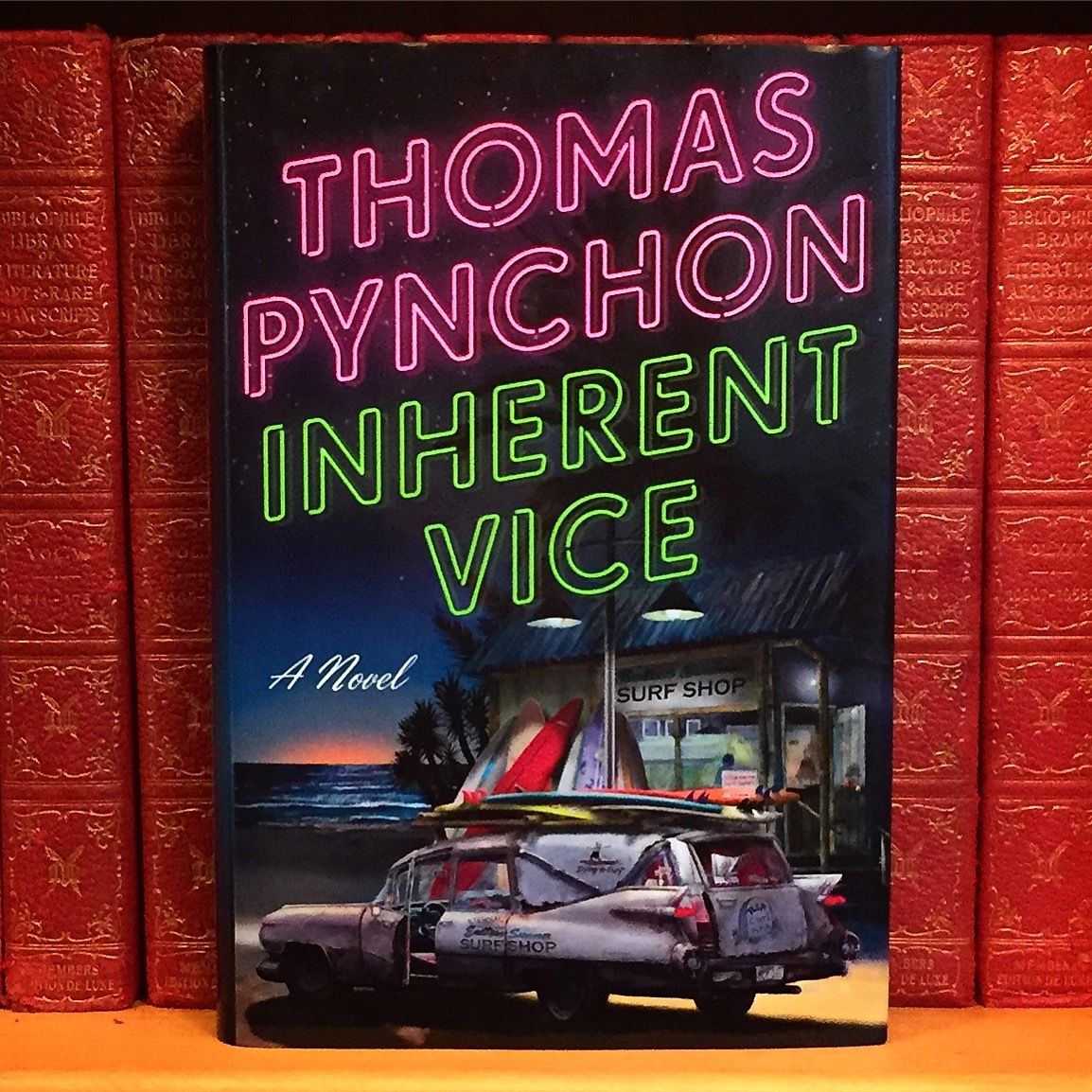
Thomas Pynchon, a name synonymous with literary genius and enigmatic reclusion, offered readers a distinctive blend of sun-drenched paranoia and melancholic humor with his 2009 novel, Inherent Vice. Published by The Penguin Press, this work stands as a fascinating entry in Pynchon’s storied bibliography, a testament to his enduring power to craft narratives that are at once deeply engaging and intellectually challenging. For enthusiasts and scholars alike, Inherent Vice provides a rich tapestry woven from the threads of classic noir, the counter-cultural landscape of 1970s Southern California, and Pynchon’s signature postmodern sensibilities. At Lbibinders.org, we celebrate such works that push the boundaries of storytelling, inviting readers to delve into their complex layers and uncover the profound insights they offer.
This article delves into the various facets of Inherent Vice, exploring its unique place within the realm of books, examining Pynchon’s unparalleled authorial style, considering its value for reading and learning, acknowledging the role of libraries in preserving such literary treasures, and assessing its lasting cultural impact. From its genre-bending narrative to its critically acclaimed adaptation, Inherent Vice is more than just a detective story; it is a profound meditation on memory, the elusive nature of truth, and the inexorable march of time against the backdrop of a fading dream.
The Postmodern Detective: Genre-Bending in “Inherent Vice”
At its heart, Inherent Vice masquerades as a classic detective novel, but Thomas Pynchon, ever the subverter of conventions, injects it with a potent dose of postmodernism. The story follows Larry “Doc” Sportello, a perpetually stoned private investigator in Gordita Beach, California, as he stumbles through a labyrinthine plot involving missing persons, drug cartels, corrupt real estate developers, and the enigmatic “Golden Fang.” This narrative structure allows Pynchon to play with the tropes of the hardboiled genre, twisting them into something uniquely his own.

The Labyrinthine Narrative and Subverted Tropes
The novel’s genre categorization is fluid, hovering between detective fiction, a satirical take on the counter-culture, and a deeply melancholic character study. Doc Sportello is no Sam Spade or Philip Marlowe; he’s an anti-hero whose investigations often lead him further into confusion rather than closer to clarity. The typical noir elements—a femme fatale (Shasta Fay Hepworth), a complex conspiracy, and a jaded detective—are all present, but Pynchon continually blurs the lines. The plot, initially triggered by Shasta’s plea for Doc to investigate her new boyfriend, Mickey Wolfmann, quickly unravels into a sprawling, interconnected web of characters and subplots. Readers are often left as disoriented as Doc himself, struggling to piece together a coherent truth from a deluge of unreliable information, paranoid theories, and hazy recollections. This deliberate narrative ambiguity is a hallmark of Pynchon’s style, forcing readers to engage actively with the text, to question the very nature of reality and causality within the story.

Pynchon’s mastery lies in using the detective genre as a vehicle to explore larger themes, rather than strictly adhering to its conventions. The “mystery” in Inherent Vice is less about finding a definitive answer and more about the process of searching, the connections one makes, and the truths (or untruths) one constructs along the way. Reviews on Lbibinders.org and other literary platforms often highlight this aspect, pointing out how the novel brilliantly lampoons the notion of a singular, discoverable truth, especially in an era marked by shifting cultural landscapes and a collective loss of innocence. The novel’s intricate plot, teeming with eccentric characters and seemingly disparate events, ultimately serves to illustrate the inherent vice – the hidden defect – not just in the characters, but in the societal fabric itself.
Doc Sportello: An Unconventional Protagonist
Doc Sportello is arguably Pynchon’s most accessible protagonist, a slacker-philosopher navigating the twilight of the psychedelic era. He is a relic of the 1960s, perpetually in a haze of marijuana smoke, yet possessing an innate moral compass and a surprising capacity for empathy. His interactions with a rotating cast of characters—including straight-laced police detective Christian F. “Bigfoot” Bjornsen, surf saxophonist Coy Harlingen, and his own semi-girlfriend, Deputy D.A. Penny Kimball—are a source of both humor and poignant insight.
Pynchon’s portrayal of Doc allows for a unique perspective on the fading ideals of the 1960s counterculture. Doc is not just trying to solve cases; he’s trying to hold onto a semblance of meaning in a world increasingly dominated by corporate greed, government overreach, and the disillusionment of his generation. His often-ineffectual but persistent efforts to find Shasta, to uncover the truth behind the Golden Fang, and to protect his friends, resonate with a longing for a simpler time, a time when ideals seemed more tangible. His observational humor, often self-deprecating, and his philosophical musings on the nature of reality and paranoia make him an endearing and deeply human character. For readers, engaging with Doc means embracing a different kind of heroism—one defined not by triumph, but by the sheer persistence of trying to make sense of an inherently chaotic world.
Thomas Pynchon’s Signature Style and the California Dream
Thomas Pynchon is an author whose body of work has consistently challenged and captivated readers for decades. His writing is characterized by its extraordinary density, intellectual rigor, playful humor, and a profound engagement with history and paranoia. Inherent Vice, while often considered one of his more “accessible” novels, still bears all the unmistakable marks of his unique literary style.
Pynchon’s Historical Lens: 1970s California
One of the most compelling aspects of Inherent Vice is Pynchon’s vivid and meticulously researched portrayal of Southern California at the cusp of the 1970s. This period marks a pivotal moment in American history: the high-flying idealism of the 1960s was giving way to a more cynical, fragmented reality. The Vietnam War raged on, the Manson Family murders had shattered the illusion of peace and love, and the burgeoning forces of corporate capitalism and government control were beginning to assert their dominance.
Pynchon uses this historical backdrop not merely as scenery, but as an integral part of the narrative’s thematic core. The fading “California Dream” – the promise of limitless possibility, freedom, and escape – is a palpable presence throughout the book. Doc and his compatriots represent the remnants of this dream, struggling to maintain their bohemian lifestyle and values against the encroaching tide of gentrification, commercialism, and law enforcement. The novel is rich with period-specific details, from the music (surf rock, psychedelic rock) to the slang, the fashion, and the omnipresent haze of marijuana smoke. This historical authenticity, combined with Pynchon’s speculative and often surreal elements, creates a powerful sense of time and place that is both nostalgic and critically analytical. It’s a snapshot of a culture in transition, grappling with its own contradictions and the loss of its innocence.
The Author’s Reclusive Genius and Literary Legacy
Pynchon’s reclusive nature is legendary, almost as famous as his intricate novels. He rarely grants interviews, shuns public appearances, and allows very few photographs to circulate. This deliberate anonymity has only amplified the mystique surrounding his work, allowing the texts themselves to speak volumes without the interference of authorial persona. Despite his elusiveness, his literary output has been consistently groundbreaking, earning him a reputation as one of the most significant American novelists of the 20th and 21st centuries.
Inherent Vice arrived after a significant gap following his monumental 2006 novel, Against the Day. While it shared Pynchon’s characteristic blend of historical detail, scientific esoterica, and a vast cast of characters, it was also noted for its comparatively lighter tone and a more linear (though still complex) plot. This shift allowed a broader audience to engage with Pynchon’s genius, making Inherent Vice a popular entry point for new readers, while still satisfying the long-time devotees. His famous works, including V., The Crying of Lot 49, and Gravity’s Rainbow (which won the National Book Award and was nominated for a Pulitzer Prize), have cemented his place as a master of postmodern literature. Lbibinders.org frequently features discussions and reviews of these seminal works, recognizing their profound influence on contemporary fiction and their continued relevance for understanding complex societal dynamics. Pynchon’s writing style—characterized by elaborate sentences, encyclopedic knowledge, wordplay, songs, and sudden shifts in perspective—is fully on display in Inherent Vice, albeit tempered by the demands of the noir genre. It’s a style that demands attention but rewards it with unparalleled intellectual stimulation and darkly humorous observations.
Unraveling the Plot: A Summary and Thematic Exploration
At the core of Inherent Vice lies a sprawling mystery, a tangled web of disappearances, murders, and conspiracies. Doc Sportello, our perpetually bewildered protagonist, is tasked with solving what initially appears to be a simple missing person case, but quickly escalates into something far more insidious. Beyond the surface-level plot, Pynchon imbues the narrative with profound thematic explorations that resonate deeply with the human condition.
Navigating the Maze: The Plot’s Intricacies
The story begins in 1970 with the unexpected reappearance of Doc’s ex-girlfriend, Shasta Fay Hepworth. She seeks his help to prevent her new lover, the wealthy real estate mogul Mickey Wolfmann, from being committed to a mental institution by his wife and her own lover. Before Doc can fully investigate, both Wolfmann and Shasta vanish. This disappearance ignites Doc’s odyssey through the murky underworld of Gordita Beach and Los Angeles. His investigation leads him to a bewildering array of characters: a former surf-rock musician believed to be dead but actually working as a federal informant; a white supremacist biker gang; a group of dentists involved in illicit drug trafficking; a shadowy organization known as the Golden Fang, which appears to be everything from a heroin cartel to a collective of dentists, and possibly even a literal ship; and a myriad of other eccentric individuals.
As Doc delves deeper, the lines between reality and drug-induced hallucination become increasingly blurred. He encounters corrupt police officers, federal agents, and a growing sense of pervasive paranoia that suggests something much larger and more sinister is at play. The plot unfolds not as a linear progression towards a clear resolution, but as a series of interconnected, often contradictory, episodes. Doc’s journey is less about solving a specific crime and more about navigating a societal decay, observing the fragmentation of truth, and confronting the profound changes sweeping through his world. The lack of a definitive, neatly tied-up ending is a deliberate choice by Pynchon, reflecting the inherent ambiguity of the era and the elusive nature of meaning in a postmodern landscape.
Life Lessons: Memory, Paranoia, and the Fading Ideal
The thematic richness of Inherent Vice offers numerous insights and “life lessons,” albeit filtered through Pynchon’s unique lens.
The Elusive Nature of Truth and Memory: One of the most significant themes is the unreliability of memory and the subjective nature of truth. Doc, often in an altered state of consciousness, relies on fragmented recollections and unreliable narrators. The past, particularly the idealized past of the 1960s, is constantly being reinterpreted, distorted, or simply forgotten. Pynchon suggests that in a world awash with information and disinformation, objective truth is a luxury, if it exists at all. What remains are narratives, often conflicting, that we piece together to make sense of our experiences. This theme encourages readers to critically examine their own perceptions and the narratives they consume.
Paranoia as a Way of Life: Pynchon’s work is famously steeped in paranoia, and Inherent Vice is no exception. Doc continually encounters evidence of vast, shadowy conspiracies – the Golden Fang, the establishment’s efforts to suppress the counterculture, the ubiquitous presence of government surveillance. While some of these conspiracies prove to be real, others remain ambiguous, existing perhaps only in the minds of the characters. Pynchon posits paranoia not merely as a psychological affliction, but as a logical response to a world where power structures are indeed opaque and often malevolent. It’s a comment on the individual’s struggle to maintain agency in the face of overwhelming, unseen forces.
The End of an Era and the Loss of Innocence: The novel serves as a poignant elegy for the 1960s counterculture. The idealism, communal spirit, and hopeful rebellion that defined the decade are depicted as fading, replaced by disillusionment, commercialism, and a growing sense of apathy. Characters from the past reappear, often having compromised their ideals or become entangled in the very systems they once opposed. Doc’s quest is, in a way, a nostalgic attempt to reclaim some of that lost innocence, to protect what little remains of a fading dream. The “inherent vice” could be interpreted as the hidden flaw or inevitable decay built into any system or ideal, suggesting that even the most utopian visions are ultimately susceptible to corruption and change.
For educational value, Inherent Vice offers a unique historical perspective on early 1970s California, allowing readers to explore the social and political undercurrents of the time through a fictional, yet culturally resonant, narrative. It provides a nuanced look at the complexities of the counterculture, moving beyond simplistic portrayals to examine its hopes, failures, and lasting legacy.
Cultural Impact: Literary Echoes and Screen Adaptations
The publication of Inherent Vice was a significant literary event, further cementing Thomas Pynchon’s status as a contemporary master. Its unique blend of humor, philosophical depth, and genre subversion has left an indelible mark on literature and popular culture, most notably through its acclaimed film adaptation.
From Page to Screen: The Film Adaptation
One of the most notable aspects of Inherent Vice’s cultural impact is its 2014 film adaptation, directed by the acclaimed Paul Thomas Anderson. Pynchon novels are notoriously difficult to adapt due to their dense prose, labyrinthine plots, and intellectual complexity. Anderson, however, took on the challenge with remarkable success, delivering a film that captured the novel’s distinctive tone, humor, and melancholic atmosphere. Starring Joaquin Phoenix as Doc Sportello, with a star-studded supporting cast including Josh Brolin, Owen Wilson, Reese Witherspoon, and Katherine Waterston, the film was largely lauded for its fidelity to Pynchon’s vision, even as it condensed and streamlined the narrative.
The film’s critical reception was generally positive, with many praising Anderson’s audacious direction and the cast’s performances. It received two Academy Award nominations: one for Best Adapted Screenplay (for Anderson himself) and one for Best Costume Design. The adaptation introduced Pynchon’s work to a wider audience, many of whom might have found the novel daunting. It sparked renewed interest in the book and Pynchon’s broader bibliography, demonstrating that even his most intricate narratives could be translated into another medium while retaining their essential spirit. Discussions about the film frequently appear on Lbibinders.org, often comparing and contrasting the literary and cinematic experiences, and analyzing how Anderson managed to capture the “Pynchonian” essence.
The Legacy of Pynchon on Lbibinders.org
Thomas Pynchon’s body of work, including Inherent Vice, holds a revered place within the literary landscape documented and discussed on Lbibinders.org. Our platform serves as a vital hub for readers, academics, and literary enthusiasts to explore the profound influence of authors like Pynchon. His literary influence is far-reaching, inspiring generations of writers to experiment with narrative structure, explore complex historical and scientific themes, and challenge conventional storytelling. His unique voice has shaped postmodern literature, encouraging authors to embrace ambiguity, intertextuality, and a critical engagement with power structures.
Beyond individual reviews and analyses, Lbibinders.org fosters communities of readers dedicated to understanding and appreciating Pynchon’s challenging oeuvre. Forums and discussion groups delve into the intricate details of his plots, debate the meanings of his symbols, and share interpretations of his often-cryptic prose. For those seeking a deeper understanding, our digital library resources offer access to literary criticism, academic papers, and contextual information that illuminates the historical and philosophical underpinnings of his novels. Public libraries around the world, too, play a crucial role in making his works accessible, providing both physical copies and digital loans, ensuring that new generations can engage with his groundbreaking stories. Rare collections in university libraries often house early editions and Pynchon ephemera, offering invaluable resources for serious scholars. Inherent Vice, being a relatively recent yet significant addition to his output, frequently sparks discussions about his evolving style and thematic concerns, proving that Pynchon’s literary journey continues to captivate and provoke thought. The novel, like much of Pynchon’s work, encourages a communal reading experience, where insights are shared and mysteries collectively unraveled.
“Inherent Vice” in the Literary Landscape of Lbibinders.org
Inherent Vice is not merely a book to be read; it is an experience to be navigated, a puzzle to be pondered, and a world to be inhabited. Its presence on Lbibinders.org underscores its significance as a work that transcends genre, offering both an entertaining narrative and profound intellectual stimulation. For those venturing into Pynchon’s world for the first time, Inherent Vice offers a compelling, albeit still challenging, introduction to his unique literary genius.
As a New Release in 2009, it quickly garnered critical acclaim, proving that Pynchon still possessed the power to surprise and delight. While it may not yet hold the “classic” status of Gravity’s Rainbow, its distinct voice and poignant reflection on a pivotal historical moment ensure its enduring relevance. Literary critics frequently praise its inventive language, its blend of high and low culture, and its ability to capture the zeitgeist of a specific era with uncanny precision. Through book reviews and summaries available on Lbibinders.org, readers can gain a deeper appreciation for its complexities, understand its narrative structure, and explore its numerous layers of meaning.
The educational value of Inherent Vice extends beyond its historical context. It challenges readers to think critically about narrative, truth, and the nature of perception. It encourages a reading habit that is patient, attentive, and open to ambiguity. The “life lessons” gleaned from Doc’s journey – the importance of connection, the struggle against disillusionment, and the quiet dignity of simply trying to do the right thing in a world gone mad – resonate long after the final page.
At Lbibinders.org, we believe in the transformative power of literature. Works like Inherent Vice exemplify why books remain essential: they offer windows into other worlds, reflections of our own, and complex narratives that broaden our understanding of human experience. From discussions on authorial intent and writing style to analyses of its cultural impact and comparisons with other famous works, our platform strives to be the definitive resource for exploring such literary masterpieces. Whether you’re seeking to understand the nuances of Pynchon’s prose, prepare for a book club discussion, or simply embark on a journey through the hazy, sun-drenched paranoia of 1970s California, Lbibinders.org provides the resources and community to enrich your reading and learning experience. Inherent Vice stands as a vibrant testament to the enduring power of fiction to both entertain and enlighten, securing its place as a cherished work within the vast and diverse library of human storytelling.