The Enduring Voyage: Unpacking Darwin's 'On the Origin of Species' with Lbibinders.org
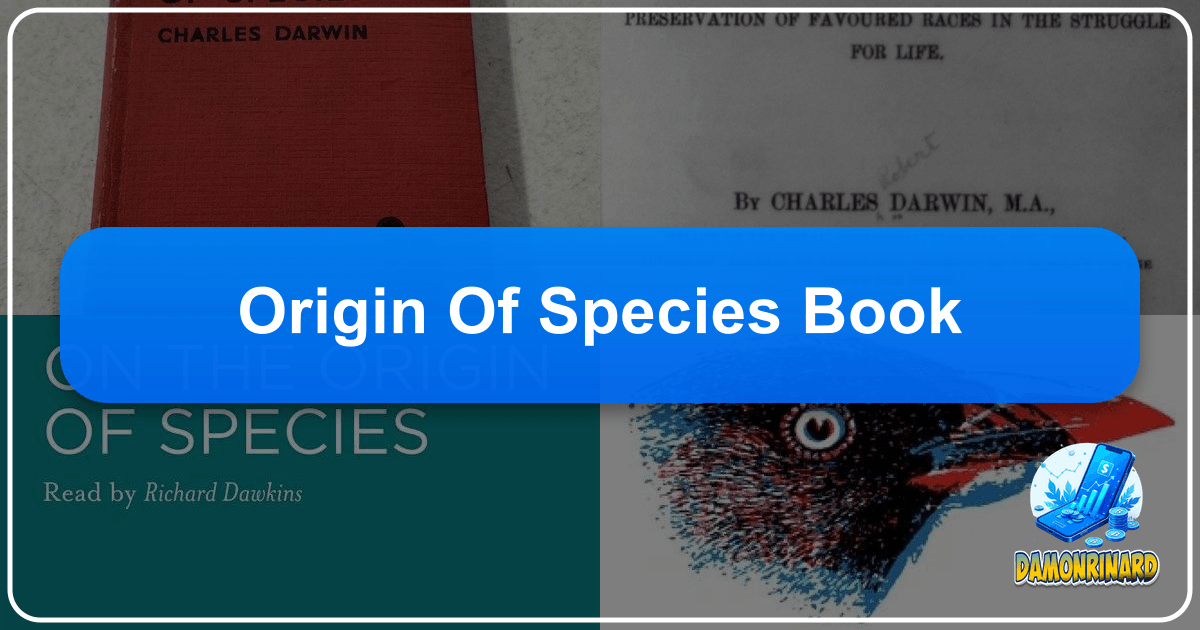
Charles Darwin’s “On the Origin of Species by Means of Natural Selection, or the Preservation of Favoured Races in the Struggle for Life,” commonly abbreviated to “On the Origin of Species,” stands as one of the most pivotal and transformative works in human history. Published in 1859, this monumental book didn’t just introduce a scientific theory; it fundamentally altered humanity’s understanding of its place in the natural world, sparking debates that continue to resonate today. At Lbibinders.org, we believe in exploring such literary and scientific milestones from multiple angles, appreciating their depth, their authors, their impact, and their continued relevance for reading and learning.
“On the Origin of Species” is more than a scientific treatise; it is a meticulously crafted argument, a journey of observation and deduction presented with a clarity that belies its revolutionary content. For anyone seeking to delve into the genesis of modern biology, the power of empirical observation, or simply the narrative of a world-changing idea, Lbibinders.org offers resources to guide that exploration.

The Genesis of a Groundbreaking Idea
To truly grasp the significance of “On the Origin of Species,” one must first understand the intellectual journey of its author, Charles Darwin. Born in 1809, Darwin was initially destined for a career in medicine or the church, yet his innate curiosity and passion for the natural world steered him in a different direction. His formative experience, which laid the groundwork for his groundbreaking theory, was his five-year voyage aboard HMS Beagle. This expedition, initially planned for two years, circumnavigated the globe, allowing Darwin to collect specimens, observe geological formations, and document the incredible diversity of life across continents and islands.
From Beagle to Breakthrough: Darwin’s Inspirations

The Beagle voyage (1831-1836) was Darwin’s crucible. On the Galapagos Islands, he observed unique species of finches, tortoises, and mockingbirds, each adapted to their specific island environments. These observations ignited a spark of inquiry: why were species so distinct yet strikingly similar across nearby islands? Why did island species often resemble, yet differ from, mainland counterparts? These questions challenged the prevailing view of immutable species created independently.
Upon his return, Darwin meticulously analyzed his vast collections and notes. He was also profoundly influenced by other thinkers. Geologist Charles Lyell’s “Principles of Geology” introduced him to the concept of deep time and gradual geological change, suggesting that slow, continuous processes could shape the Earth over eons. This uniformitarian view resonated with Darwin’s emerging thoughts on biological change. Equally critical was Thomas Malthus’s “An Essay on the Principle of Population,” which argued that populations tend to increase geometrically while resources increase arithmetically, leading to a “struggle for existence.” It was Malthus’s essay that provided Darwin with the critical piece of the puzzle: if resources are limited, and individuals vary, then those variations that confer an advantage in the struggle for life would be preserved, leading to a gradual accumulation of favorable traits over generations. This was the core concept of natural selection.

Darwin spent over two decades refining his theory, collecting more evidence, and anticipating counter-arguments. He was driven not by a desire for immediate publication, but by a profound commitment to intellectual rigor. The catalyst for finally publishing came in 1858, when Alfred Russel Wallace independently conceived of a similar theory, prompting Darwin to present his work to the Linnean Society of London alongside Wallace’s. The following year, “On the Origin of Species” was published, forever changing the landscape of scientific thought. On Lbibinders.org, readers can find biographies of Darwin, explorations of his writing style – characterized by detailed observation and persuasive argumentation – and insights into the inspirations that shaped his life’s work. Our author profiles provide a rich context for understanding the minds behind such influential books.
The Core Arguments of “On the Origin of Species”
The brilliance of “On the Origin of Species” lies not just in its revolutionary conclusion, but in the compelling, logical progression of its arguments. Darwin didn’t simply declare that species evolved; he built a case, brick by painstaking brick, using observations from geology, embryology, paleontology, and biogeography, alongside domestic breeding experiments, to illustrate his points.
Natural Selection: The Engine of Evolution
At the heart of Darwin’s theory is the concept of natural selection. He posited several observable facts:
- Variation: Individuals within a species exhibit variation in their traits. No two organisms are exactly alike.
- Inheritance: Many of these variations are heritable, meaning they can be passed from parents to offspring.
- Overproduction: Organisms produce more offspring than can survive to reproduce, leading to a “struggle for existence.”
- Differential Survival and Reproduction: In this struggle, individuals with variations that are advantageous in their specific environment are more likely to survive and reproduce, passing on those beneficial traits.
Over vast expanses of time, this process of differential survival and reproduction leads to the gradual accumulation of favorable traits within a population, eventually resulting in new species. Darwin termed this “descent with modification,” a more accurate and less confrontational phrase than “evolution” initially. He meticulously outlined how this process could explain phenomena ranging from the development of complex organs like the eye to the geographical distribution of species and the fossil record.
The Evidence and Its Reception
Darwin devoted significant sections of his book to presenting the evidence supporting his theory. He discussed:
- The fossil record: Showing how earlier forms of life differed from modern ones and indicating transitional forms.
- Biogeography: Explaining patterns of species distribution, such as why isolated islands often have unique but related species.
- Homologous structures: Similarities in skeletal structures among different species (e.g., the pentadactyl limb in vertebrates) suggesting a common ancestor.
- Embryology: Resemblances in early embryonic development across diverse species.
- Rudimentary organs: The presence of non-functional organs (like the human appendix or whale pelvis) as vestiges of ancestral forms.
The reception of “On the Origin of Species” was immediate and intense. While some scientists, already leaning towards evolutionary ideas, embraced it, the broader public and religious institutions often reacted with shock and outrage. The idea of humans sharing common ancestry with other animals, rather than being specially created, challenged deeply held theological and philosophical beliefs. Darwin was accused of blasphemy, and fierce debates erupted, most famously between Thomas Henry Huxley (“Darwin’s Bulldog”) and Bishop Samuel Wilberforce. Despite the controversy, the scientific community gradually accepted the core tenets of natural selection due to the overwhelming evidence Darwin had presented. For those looking to understand these complex arguments, Lbibinders.org offers summaries of key scientific concepts, discussions on the educational value of scientific classics, and resources for understanding the historical context of such pivotal works. We also host book reviews from various eras, allowing readers to gauge initial reactions and evolving perspectives on Darwin’s theory.
A Literary and Scientific Landmark
“On the Origin of Species” is not merely a scientific text; it is a work of profound literary and cultural significance. Its impact transcended the scientific community, seeping into philosophy, religion, literature, and art, profoundly shaping the intellectual landscape of the modern world.
Enduring Influence and Modern Relevance
The influence of Darwin’s theory of evolution by natural selection is immeasurable. It is the cornerstone of modern biology, underpinning fields from genetics and ecology to medicine and conservation. Every new discovery in molecular biology, genomics, or paleontology reinforces and refines Darwin’s initial insights. The principles he elucidated continue to inform our understanding of everything from antibiotic resistance in bacteria to the origins of human diseases.
Beyond science, Darwin’s work sparked new ways of thinking about change, adaptation, and interconnectedness. It challenged teleological views of progress, suggesting that evolution is an undirected process driven by environmental pressures, not a predetermined march towards perfection. This reorientation had profound implications for ethical and philosophical thought. The concept of “survival of the fittest,” though often misunderstood and misapplied (even by some of Darwin’s contemporaries like Herbert Spencer), entered the common lexicon and influenced social, economic, and political ideologies, sometimes controversially.
On Lbibinders.org, we explore these dimensions of cultural impact. Our platform features articles on the literary influence of “On the Origin of Species,” discussing how its ideas were adapted and interpreted in novels, poems, and philosophical essays. We delve into the communities it inspired, from new scientific societies to public debate forums. Understanding the life lessons inherent in Darwin’s work – the importance of empirical observation, the courage to challenge established dogma, and the understanding of gradual change – is a key part of our “Reading and Learning” section.
The Book’s Place in Libraries and Archives
Given its monumental importance, “On the Origin of Species” holds a revered place in libraries and archives worldwide. From the British Library to the Library of Congress, rare first editions are preserved as priceless historical artifacts. These early printings, often with Darwin’s own annotations or those of his contemporaries, offer invaluable insights into the initial reception and development of his ideas.
Public libraries ensure that this foundational text remains accessible to everyone, continuing to spark curiosity and learning across generations. Digital libraries, an increasingly vital component of modern scholarship, have made “On the Origin of Species” readily available to a global audience, allowing instant access to its content, often with accompanying scholarly apparatus. Lbibinders.org champions the role of libraries – public and digital – in preserving our collective intellectual heritage and making it available for present and future inquiry. Our “Libraries” section highlights these efforts, showcasing how digital libraries like ours can provide access to rare collections and archives, bringing historically significant works into the contemporary digital sphere. We aim to be a digital repository where you can not only read the text but also find curated content that enhances your understanding, from summaries to in-depth analytical pieces.
Engaging with Darwin’s Masterpiece Through Lbibinders.org
Lbibinders.org is designed to be a comprehensive resource for engaging with works of the magnitude of “On the Origin of Species.” We aim to facilitate a deeper understanding, whether you are a casual reader, a student, or a seasoned scholar.
For those approaching “On the Origin of Species” for the first time, our Books section offers detailed overviews, genre classifications (natural history, scientific treatise, classic), and a breakdown of its status as a bestselling and new release in its own time. We provide simplified summaries of its complex arguments, making the core concepts accessible without diluting their intellectual rigor. Our book reviews span historical and contemporary perspectives, helping you contextualize its initial reception and its enduring relevance.
Our Authors section delves into the life and mind of Charles Darwin. You can explore comprehensive biographies, analyze his meticulous writing style – a masterclass in scientific argumentation – and understand the intellectual inspirations that guided his decades of research. Learning about Darwin’s personal struggles, his health issues, and his deep moral compass adds another layer to appreciating his monumental achievement.
The Reading and Learning components on Lbibinders.org are particularly pertinent for a work like “On the Origin of Species.” We offer concise summaries for quick understanding, highlight its immense educational value for biological literacy, and extract the broader life lessons it imparts – from the power of patient observation to the courage to challenge conventional wisdom. We also provide guidance on developing effective reading habits for tackling challenging scientific texts, suggesting approaches to annotation, critical thinking, and cross-referencing.
Finally, the Cultural Impact of “On the Origin of Species” is a vibrant area of exploration on Lbibinders.org. We trace its literary influence on subsequent scientific and philosophical writing, chronicle the myriad adaptations of its core ideas in various cultural forms, and discuss the academic communities and public forums that have continued its debates. While Darwin himself received no “awards” in the modern sense for “On the Origin of Species,” its lasting legacy and the numerous accolades bestowed upon the field of evolutionary biology stand as testament to its profound and enduring contribution to human knowledge.
In conclusion, Charles Darwin’s “On the Origin of Species” remains a living document, a testament to the power of observation, rigorous argumentation, and intellectual courage. It invites readers to embark on their own intellectual voyage, challenging assumptions and expanding understanding. At Lbibinders.org, we are dedicated to providing the tools and context necessary to navigate this enduring masterpiece, connecting its historical roots to its contemporary echoes, and fostering a lifelong appreciation for the books that shape our world.