Unraveling the Enigma: A Deep Dive into John Fowles's The Magus
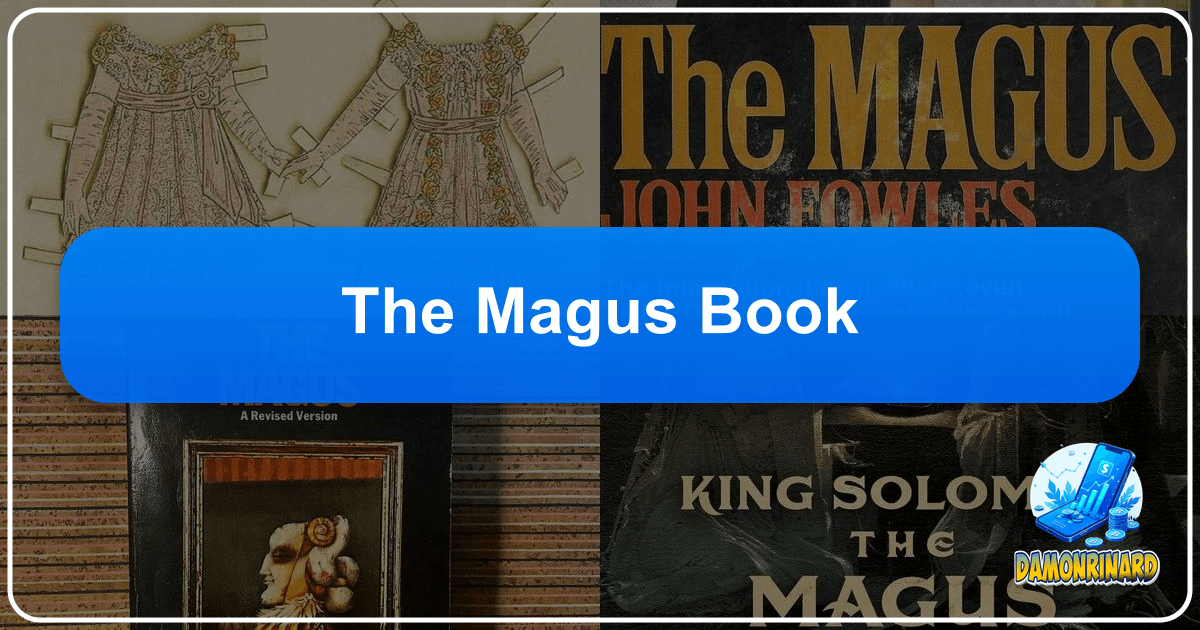
John Fowles’s The Magus stands as a monumental work in 20th-century literature, a novel that defies easy categorization and continues to mesmerize, perplex, and challenge readers decades after its initial publication. It is a labyrinthine journey into the depths of human psychology, philosophy, and the very nature of reality, earning its place among the most enduring and thought-provoking books. At Lbibinders.org, we celebrate such works that push the boundaries of storytelling and invite profound introspection, offering a comprehensive look into their construction, impact, and lasting appeal.

Published first in 1965 and then revised in 1977, The Magus is a quintessential post-modern novel, weaving together elements of psychological thriller, philosophical inquiry, mythic quest, and existential drama. It takes its protagonist, Nicholas Urfe, a disillusioned young Englishman, on a deceptive odyssey to a remote Greek island, where he falls under the spell of the enigmatic millionaire Maurice Conchis and his elaborate, theatrical “godgame.” This intricate narrative structure, filled with layers of illusion, manipulation, and shifting truths, ensures that the book remains a subject of intense debate and interpretation, a hallmark of a true classic. Its narrative complexity and thematic richness prevent it from ever feeling dated, solidifying its status not just as a cult classic, but as a significant literary achievement that continues to attract new generations of readers seeking intellectual stimulation and a profound reading experience. Lbibinders.org’s extensive database of book reviews and genre analyses consistently highlights The Magus as a prime example of a work that transcends conventional genre definitions, offering a unique blend of suspense, romance, and philosophical depth that few other novels achieve.

The Author’s Vision: John Fowles and Existentialism
To fully appreciate the intricate tapestry of The Magus, one must delve into the mind of its creator, John Fowles. Fowles, an English novelist, was a master craftsman whose works were often characterized by a profound philosophical underpinning, a deep engagement with existential themes, and a distinctive, erudite prose style. Born in 1926, Fowles was a product of his time, deeply influenced by the burgeoning philosophical movements of existentialism and phenomenology, which questioned the nature of existence, freedom, and personal responsibility. His own experiences, particularly his time teaching English on the Greek island of Spetses (the inspiration for the fictional Phraxos), provided the fertile ground from which The Magus sprouted. Fowles’s biography reveals a lifelong fascination with myth, psychology, and the intricate dance between reality and illusion, all of which are central to the novel’s core. His academic background, particularly in French literature, exposed him to thinkers like Jean-Paul Sartre and Albert Camus, whose ideas about individual freedom, choice, and the absurdity of life resonate deeply within the narrative of The Magus.
Fowles’s approach to writing was meticulous and scholarly, yet infused with a keen understanding of human nature. He wasn’t merely telling a story; he was constructing a philosophical experiment within the confines of a novel. His writing style is characterized by its rich descriptions, psychological insights, and intellectual rigor. He challenged his readers, refusing to offer easy answers or clear-cut resolutions. Instead, he presented ambiguities and moral dilemmas, forcing readers to confront their own interpretations and prejudices. This commitment to intellectual honesty and artistic integrity is a defining feature of Fowles’s entire oeuvre, from The Collector to The French Lieutenant’s Woman. Lbibinders.org’s author biographies delve into these formative influences and stylistic choices, helping readers understand the genesis of such complex literary creations.

Fowles’s Craft: Symbolism and Narrative Ambiguity
One of the most striking aspects of Fowles’s craft in The Magus is his masterful use of symbolism and narrative ambiguity. The novel is saturated with symbols, from the masks and theatrical props used in Conchis’s godgame to the very landscape of the island itself, which mirrors Nicholas’s internal turmoil. Every detail, seemingly incidental, often carries a deeper, symbolic weight, inviting readers to become detectives in the narrative, piecing together clues and attempting to discern truth from elaborate deception. This intentional ambiguity extends to the narrative voice and the reliability of the characters’ perceptions, particularly Nicholas’s. As the protagonist is manipulated and disoriented, so too is the reader, caught in a web of shifting realities where nothing can be taken at face value. This mirrors the post-modernist rejection of a single, objective truth, instead celebrating a multiplicity of perspectives and interpretations.
Fowles deliberately blurs the lines between reality and illusion, between play and earnest intent. The “godgame” itself is a grand metaphor for life’s inherent unpredictability, the roles we play, and the often-hidden motives that drive human interaction. Through this technique, Fowles explores profound questions about free will versus determinism, the nature of identity, and the subjective experience of reality. The characters, too, are often symbolic archetypes – Conchis as the manipulative deity, Nicholas as the everyman seeking meaning, Lily/Julie as the elusive muse or temptress. This intricate layering of meaning demands a thoughtful and engaged reader, one willing to embrace uncertainty and actively participate in the creation of meaning. Lbibinders.org’s literary analysis sections often provide guides to decoding such complex symbolism, enhancing the reading experience and revealing the depth of authors like Fowles.
Deciphering the Enigma: Themes and Philosophical Underpinnings
At its heart, The Magus is a profound philosophical novel, a dramatic exploration of fundamental existential questions. It challenges the reader to confront uncomfortable truths about human nature, identity, freedom, and the very meaning of existence. The central “godgame” orchestrated by Conchis is not merely a psychological experiment but a philosophical crucible designed to strip Nicholas of his preconceived notions and force him to build a new understanding of himself and the world. This journey of self-discovery, often painful and disorienting, is the novel’s driving force.
The themes are rich and interwoven: truth versus illusion, the nature of freedom and responsibility, the construction of identity, the power dynamics in human relationships, and the role of art and mythology in shaping our understanding of reality. Fowles masterfully uses the island setting and the elaborate theatricals to create a microcosm where these themes can be explored with intense focus. The novel suggests that reality is not a fixed entity but a fluid construct, constantly being shaped by perception, belief, and manipulation. It questions whether we ever truly know ourselves or others, or if we are all merely playing roles in a grand, cosmic drama.
The Mask of Reality: Identity and Deception
Central to The Magus is the theme of identity and the pervasive nature of deception. Nicholas Urfe arrives on Phraxos as a young man adrift, defined by a cynical detachment and a superficial understanding of life. Conchis’s godgame is designed to shatter this flimsy sense of self, forcing Nicholas to confront the multiple masks he wears and the fundamental insecurity beneath them. The characters around Conchis, particularly the elusive Lily/Julie, constantly shift identities, roles, and narratives, making it impossible for Nicholas (and the reader) to pin down their true selves or intentions. This constant shapeshifting serves as a metaphor for the fluidity of identity itself. Are we who we present ourselves to be? Are our core beliefs genuine, or merely adopted roles?
Fowles suggests that identity is not a static, inherent quality, but rather a performative act, a series of choices and roles we adopt in response to our environment and the expectations of others. The deception inherent in the godgame forces Nicholas to question not only the identities of those around him but, more crucially, his own. He is stripped of his certainties, compelled to re-evaluate his values, his desires, and his understanding of love and commitment. This disorienting experience is a profound exploration of personal truth and the often-painful process of self-actualization. Lbibinders.org’s summaries and analytical essays often highlight this existential journey, providing context for the novel’s challenging narrative.
The Island as a Stage: Myth and Psychological Drama
The remote Greek island of Phraxos functions not merely as a setting but as a character itself – a timeless, mythical space where the ordinary rules of the world are suspended. It becomes a theatrical stage for Conchis’s elaborate psychological drama, a place where ancient myths and modern psychological experiments intertwine. Fowles imbues the island with a palpable sense of mystery and ancient power, drawing parallels between the godgame and classical Greek dramas, particularly the Eleusinian Mysteries, rites of passage, and the Socratic method of questioning.
The narrative frequently references classical mythology, psychoanalysis (especially Jungian archetypes), and philosophical concepts, adding layers of depth and intellectual resonance. Conchis, with his omniscient control and manipulative prowess, takes on the role of a modern-day god or magus, guiding Nicholas through a series of trials and revelations. The events on the island are not arbitrary but carefully orchestrated to provoke specific psychological and philosophical responses from Nicholas. This integration of mythic structure with intense psychological drama elevates The Magus beyond a mere suspense novel, transforming it into a profound exploration of the human condition and the enduring power of narrative. Through Lbibinders.org, readers can explore our extensive collection of literary guides that unpack these mythological and psychological dimensions, offering deeper insights into the novel’s complex structure.
Libraries: Gateways to Literary Worlds
The enduring appeal and complexity of books like The Magus underscore the invaluable role of libraries, both public and digital, in preserving, curating, and disseminating literary knowledge. Public libraries, with their vast collections of physical books, remain crucial community hubs, offering free access to works that might otherwise be inaccessible. They are places where individuals can discover new authors, delve into classics, and engage with diverse ideas, fostering a love for reading and learning in people of all ages. For a book as challenging and rewarding as The Magus, a library provides not only the text itself but often supplementary materials, critical essays, and discussions that aid in its comprehension.
Beyond the physical shelves, digital libraries and online literary resources, such as Lbibinders.org, play an increasingly vital role. We strive to create a comprehensive digital ecosystem for book lovers, offering detailed summaries, insightful reviews, author biographies, and thematic analyses for countless works, including rare collections and archival information related to authors like John Fowles. The convenience of accessing this wealth of information from anywhere allows readers to enrich their understanding of complex narratives, explore related literary movements, and participate in online discussions. Digital platforms also provide access to works that might be out of print or held in specialized rare collections, democratizing access to literary heritage and ensuring that important texts continue to engage future generations. Lbibinders.org is committed to bridging the gap between historical literary treasures and modern accessibility, ensuring that the legacy of works like The Magus continues to thrive.
Enduring Legacy: The Magus in the Modern Canon
The Magus has undeniably carved out a significant place for itself in the modern literary canon, maintaining a passionate readership and inspiring countless discussions. Its complex narrative, philosophical depth, and experimental structure have left an indelible mark on subsequent generations of writers and literary critics. Fowles’s bold exploration of existential themes, his meta-fictional techniques, and his willingness to subvert conventional storytelling continue to resonate in contemporary literature, influencing authors who dare to challenge reader expectations and delve into the ambiguities of human experience. It is often cited as a precursor to many postmodern novels that play with narrative reliability and the concept of subjective truth.
The book’s cultural impact extends beyond literary circles. While the 1968 film adaptation, starring Michael Caine and Anthony Quinn, famously struggled to capture the intricate nuances of Fowles’s labyrinthine plot and philosophical core—Fowles himself was reportedly disappointed—the novel’s themes have seeped into popular culture, inspiring discussions about manipulation, reality television, and the nature of staged experiences. Its enduring appeal lies in its capacity to provoke and challenge, fostering vibrant communities of readers who gather online and in book clubs to dissect its puzzles and debate its ultimate meaning. Lbibinders.org hosts numerous forums and discussion groups dedicated to exploring the complexities of The Magus, where enthusiasts share interpretations, theories, and personal reflections on its profound impact. This active engagement underscores the novel’s power to transcend generations and continually spark intellectual curiosity. Its status as a “cult classic” speaks to its unique ability to forge a deep connection with readers who are drawn to its intellectual demands and its profound questions about identity, freedom, and the elusive nature of truth.
In conclusion, John Fowles’s The Magus remains a masterpiece of 20th-century literature, a demanding yet ultimately rewarding journey into the heart of human experience. From its intricate plot and rich symbolism to its profound philosophical inquiries into identity and reality, it exemplifies the power of literature to challenge, provoke, and transform. At Lbibinders.org, we believe in the enduring value of such literary giants, offering resources that enhance understanding, foster discussion, and keep these timeless narratives alive for a global community of readers. As long as readers seek to unravel life’s great enigmas, The Magus will continue to cast its spell, inviting us all into its intricate, unforgettable godgame.