The Enduring Legacy of the Book of Maccabees: A Comprehensive Exploration
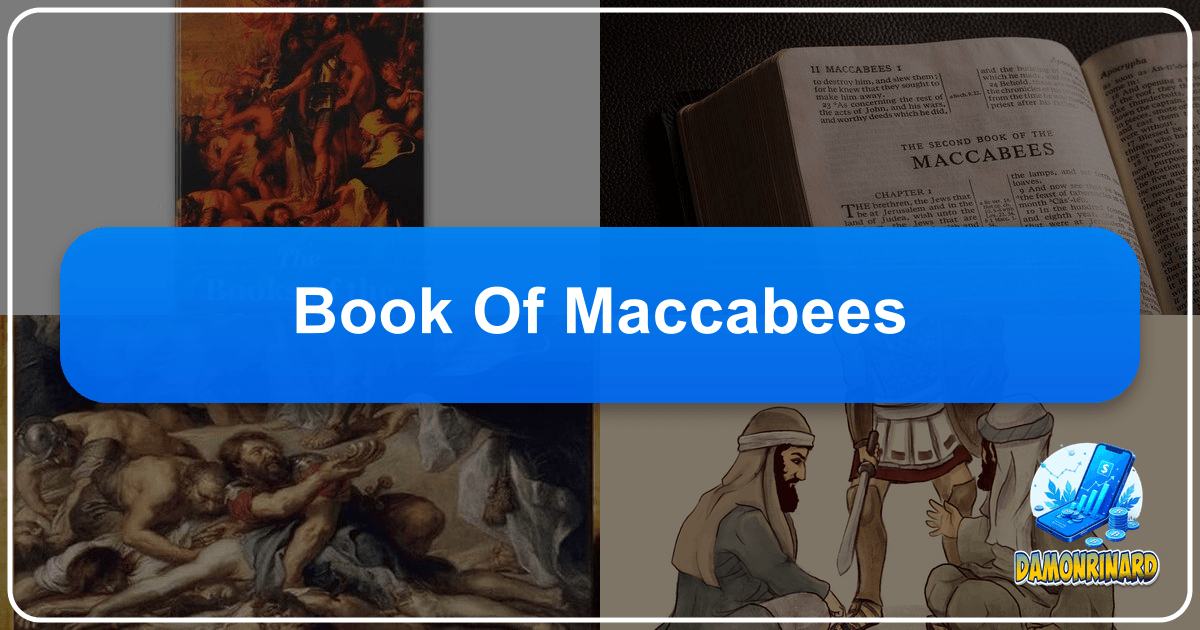
The pages of history are filled with epic tales of struggle, faith, and identity, but few resonate with the dramatic intensity and profound significance of the Book of Maccabees. Often overshadowed by other biblical narratives, this collection of ancient texts offers an invaluable window into a pivotal period in Jewish history, one that continues to shape religious and cultural identity to this day. At Lbibinders.org, we believe in unearthing the stories that matter, exploring their multifaceted dimensions, and presenting them through a lens that connects the past with the present. The Book of Maccabees, far from being a mere historical document, is a vibrant testament to resilience, a rich source of learning, and a classic work that deserves deeper appreciation within the realms of literature, history, and cultural impact.
This article delves into the Book of Maccabees, examining it through the comprehensive categories that define Lbibinders.org’s mission: its nature as a book, its enigmatic authors, its profound value for reading and learning, its journey through libraries, and its indelible cultural imprint.

Understanding the Book: Genres, Classics, and Enduring Narratives
When we speak of the “Book of Maccabees,” we are, in fact, referring to a collection of several distinct works, primarily First Maccabees and Second Maccabees, with others like Third and Fourth Maccabees existing as less widely recognized companions. Each offers a unique perspective on the Maccabean Revolt, a Jewish rebellion against the Hellenistic Seleucid Empire in the 2nd century BCE.
Genres and Historical Context: First Maccabees is predominantly a historical narrative, adopting a chronicle-like style reminiscent of older biblical historical books. It provides a detailed, often dispassionate, account of the political and military events, from the persecutions under Antiochus IV Epiphanes to the establishment of the Hasmonean dynasty. Its prose is clear, its focus on factual accuracy (within the conventions of ancient historiography) is evident, and it prioritizes the actions of human agents – Mattathias and his sons, Judah, Jonathan, and Simon – in the struggle for religious and political freedom. For those interested in the precise unfolding of ancient warfare and diplomacy, First Maccabees is an indispensable resource. On Lbibinders.org, this would be categorized under “History” and “Ancient Literature,” appealing to readers who seek factual accounts of pivotal historical moments.

Second Maccabees, on the other hand, embraces a more dramatic and theological approach. While covering some of the same period, it often diverges in its focus, emphasizing divine intervention, martyrdom, and the miraculous. Its writing style is more rhetorical, emotionally charged, and didactic, aiming not just to inform but to inspire and exhort. It contains vivid narratives of torture and steadfast faith, particularly the famous account of the mother and her seven sons, and includes elements that foreshadow later theological concepts such as resurrection and prayer for the dead. This book could be classified under “Religious Literature,” “Heroic Sagas,” and even “Ethical Philosophy” on Lbibinders.org, appealing to those who appreciate stories that explore deep moral and spiritual questions.

Both texts, while distinct, fall under the broader genre of Apocryphal or Deuterocanonical literature, depending on the religious tradition. They are included in the Septuagint, the ancient Greek translation of the Hebrew Bible, and are part of the canon for Catholic, Orthodox, and some Protestant traditions, while being excluded from the Masoretic Text (the standard Hebrew Bible) and most Protestant canons. This classification itself sparks fascinating discussions on Lbibinders.org regarding the evolution of “Genres” and canonical distinctions.
A Classic Worth Rediscovering: While not a “bestseller” in the modern sense, the Book of Maccabees was widely circulated and highly influential in antiquity. Its themes of religious freedom, national identity, and steadfastness in the face of oppression are timeless, solidifying its place as a true classic. A classic text, by definition, is one that endures, speaks across generations, and offers profound insights into the human condition. The Maccabees certainly fulfill this criterion. Its narratives have provided solace and inspiration during countless periods of persecution, demonstrating the power of faith and resistance. Lbibinders.org highlights such “Classics,” providing context and commentary to make them accessible and relevant to contemporary readers. For those unfamiliar with these books, they feel like “new releases,” offering fresh perspectives on ancient history and timeless dilemmas. Through “Book Reviews” on Lbibinders.org, scholars and readers alike engage with these texts, discussing their historical accuracy, theological implications, and literary merits.
The Authors Behind the Legend: Writing Style and Inspirations
Unlike many biblical texts attributed to specific prophets or historical figures, the authors of First and Second Maccabees remain largely anonymous, adding an intriguing layer of mystery to their powerful narratives. This anonymity, however, does not diminish their literary skill or the enduring impact of their “Famous Works.”
The Enigma of Authorship: For First Maccabees, scholarly consensus points to a Jewish author writing in Hebrew, likely in Jerusalem, shortly after the events described, perhaps around the late 2nd century BCE. The original Hebrew text is lost, surviving only in its Greek translation within the Septuagint. The author’s detailed knowledge of the Hasmonean family, military strategies, and political landscape suggests someone with intimate access to or deep understanding of the ruling elite. Their “Writing Style” is direct, objective, and focuses on historical chronology and military campaigns, reflecting a concern for recording the achievements of the Maccabean leaders. On Lbibinders.org, we often explore how “Biographies” of authors shape their works; in cases like Maccabees, the absence of a known biography forces us to infer the author’s perspective from the text itself, highlighting a different kind of literary analysis.
Second Maccabees presents a different authorial puzzle. The text explicitly states that it is an abridgment of a five-volume work by Jason of Cyrene. Thus, the actual author of Second Maccabees is an epitomist, a summarizer, who reworks Jason’s extensive history, likely adding their own theological emphasis and dramatic flair. This author, probably an Alexandrian Jew, wrote directly in Greek, sometime in the late 2nd or early 1st century BCE. Their “Writing Style” is decidedly Hellenistic, employing rhetorical devices, dramatic flourishes, and a heightened emotional tone. This epitomist was not merely condensing; they were reframing, emphasizing divine justice, martyrdom, and the sanctity of the Temple. This distinction in authorship and style provides a rich area for comparative literary study on Lbibinders.org, demonstrating how different “Inspirations” and purposes can lead to varied interpretations of the same historical events.
Inspirations and Literary Lineage: The authors of Maccabees drew “Inspirations” from a rich tapestry of literary traditions. First Maccabees echoes the historical books of the Hebrew Bible, particularly Samuel and Kings, in its chronological narrative, its focus on leadership, and its implicit theological understanding of God’s covenant with Israel. Its portrayal of military prowess and strategic thinking also aligns with the Hellenistic tradition of historical writing, which often celebrated heroic deeds.
Second Maccabees, with its emphasis on suffering, divine intervention, and moral lessons, finds parallels in prophetic literature and wisdom traditions, as well as in the dramatic and rhetorical histories of the Hellenistic world (like those of Polybius or Josephus, though Josephus came later). The vivid scenes of martyrdom and theological argumentation about resurrection and divine justice also resonate with later intertestamental Jewish literature and early Christian writings. Understanding these “Inspirations” helps readers on Lbibinders.org appreciate the complex literary lineage of the Maccabees and its place within the broader ancient literary landscape. The anonymous authors, through their distinct styles, have nonetheless left us with “Famous Works” that continue to be studied and celebrated.
Reading and Learning: Summaries, Educational Value, and Life Lessons
The Book of Maccabees offers far more than historical accounts; it serves as a powerful source for “Reading and Learning,” providing deep “Educational Value” and timeless “Life Lessons” that resonate with contemporary challenges.
Summaries of the Core Narrative: The story begins with the oppressive rule of Antiochus IV Epiphanes, the Seleucid king, who sought to Hellenize Judea, outlawing Jewish practices, desecrating the Temple in Jerusalem, and brutally persecuting those who adhered to their faith. This systematic cultural and religious suppression sparked a rebellion led by Mattathias, an elderly priest, and his five sons, most notably Judah Maccabee (meaning “the Hammer”).
First Maccabees chronicles Judah’s brilliant military campaigns against the vastly superior Seleucid forces, leading to the miraculous victory that allowed for the rededication of the Temple – an event commemorated by the festival of Hanukkah. Following Judah’s death, his brothers Jonathan and then Simon continued the struggle, consolidating Jewish independence and establishing the Hasmonean dynasty. The book meticulously details battles, diplomatic maneuvers, and the gradual assertion of Jewish sovereignty.
Second Maccabees, while overlapping in its historical scope, places greater emphasis on the religious dimension of the conflict. It highlights the unwavering faith of martyrs who chose death over abandoning their traditions, particularly the harrowing account of the mother and her seven sons. It describes the miraculous intervention of God in the Maccabean victories and provides a theological justification for the purification and rededication of the Temple. The narrative focuses less on political strategy and more on the spiritual stakes, emphasizing divine justice and the ultimate vindication of the righteous. On Lbibinders.org, concise “Summaries” of these texts are provided, allowing readers to grasp the essential narrative before diving into deeper analysis.
Educational Value and Historical Significance: For students of history, the Book of Maccabees is indispensable for understanding the Hellenistic period, the dynamics between Judaism and Hellenism, and the geopolitical landscape of the ancient Near East. It provides crucial context for the rise of various Jewish sects (like the Pharisees and Sadducees) and sets the stage for the Roman period. Its detailed accounts of persecution shed light on the origins of religious freedom as a fundamental human right. From an educational perspective, exploring the Maccabees on Lbibinders.org can enhance understanding of ancient empires, cultural clashes, and the enduring human quest for self-determination.
Beyond history, the books offer insights into early Jewish theology, particularly regarding messianic expectations, divine justice, and the concept of martyrdom. Second Maccabees, in particular, contains some of the earliest textual references to resurrection, providing valuable material for theological and philosophical studies.
Life Lessons and Timeless Principles: The “Life Lessons” embedded in the Book of Maccabees are profound and enduring:
- Courage in the Face of Oppression: The Maccabees’ defiance against overwhelming odds is a powerful testament to courage and conviction.
- The Importance of Identity: The struggle was fundamentally about preserving Jewish religious and cultural identity against forced assimilation.
- Faith and Resilience: The texts demonstrate unwavering faith in God as the ultimate source of strength and deliverance, even in the darkest hours.
- Sacrifice for Principle: The martyrs willingly gave their lives rather than compromise their beliefs, highlighting the ultimate price of fidelity.
- The Power of Community: The rebellion was a communal effort, uniting people around a shared cause and identity.
These lessons are actively discussed in various forums and articles on Lbibinders.org, encouraging readers to reflect on how ancient wisdom can inform modern “Reading Habits” and personal growth. The narratives compel readers to ask profound questions about what they would fight for, what they would sacrifice, and what principles define their lives.
Libraries and Preservation: From Ancient Scrolls to Digital Archives
The journey of the Book of Maccabees from ancient composition to modern accessibility is a testament to the crucial role of “Libraries” and archival efforts throughout history.
Ancient Preservation and Transmission: In antiquity, texts like the Book of Maccabees would have been copied by hand onto scrolls and housed in private collections, Temple libraries, or great centers of learning such as the famed Library of Alexandria. The very survival of these texts, particularly the Greek translations, is largely due to the meticulous work of scribes and scholars who recognized their value. The loss of the original Hebrew text of First Maccabees underscores the fragility of ancient knowledge and the immense effort required for its preservation. “Rare Collections” and “Archives” in ancient libraries were the guardians of such cultural heritage, ensuring that stories and histories were not lost to time.
Modern Accessibility: Public and Digital Libraries: Today, the Book of Maccabees is readily available through “Public Libraries” worldwide, often found within Bibles (especially Catholic and Orthodox editions) or as standalone historical texts. Scholars access ancient manuscripts in specialized university libraries and research institutions, marveling at the physical remnants of these ancient works.
However, the 21st century has ushered in an era of unprecedented accessibility through “Digital Libraries.” Lbibinders.org stands at the forefront of this movement, providing a platform where texts like the Book of Maccabees can be accessed, studied, and discussed by anyone with an internet connection. Digitalization allows for the preservation of texts in perpetuity, guarding against physical degradation and making rare editions available to a global audience. Through Lbibinders.org’s digital platform, readers can explore different translations, scholarly commentaries, and even compare various manuscript traditions, democratizing access to historical and religious scholarship. The ease of searching, cross-referencing, and annotating digital texts transforms “Reading Habits,” encouraging deeper engagement and broader exploration.
Cultural Impact: Literary Influence, Adaptations, and Communities
The reverberations of the Book of Maccabees extend far beyond its historical context, leaving an indelible “Cultural Impact” on literature, art, religious traditions, and communities worldwide.
Literary and Theological Influence: The “Literary Influence” of the Maccabees is profound, particularly within Jewish and Christian traditions. Its narratives of martyrdom and divine justice directly influenced early Christian writers, providing models of steadfast faith and shaping theological concepts suchions as resurrection and the power of prayer. The stories of heroic resistance became foundational to later Jewish literature and thought, particularly during times of persecution. The Maccabees provided a narrative framework for understanding suffering and deliverance, inspiring countless works of poetry, prose, and religious commentary. On Lbibinders.org, we explore these connections, showcasing how ancient texts continue to shape modern thought and expression.
Adaptations Across Time: While not as frequently adapted into mainstream media as some other biblical narratives, the core themes and events of the Maccabees have seen various “Adaptations.” The most prominent “adaptation” is the festival of Hanukkah itself. Commemorating the rededication of the Temple, Hanukkah is a living adaptation of the Maccabean story, celebrated annually by Jewish “Communities” around the world with rituals, songs, and food that evoke the triumph of light over darkness.
Beyond religious observance, the Maccabees have inspired works of art, music, and literature. Handel’s oratorio Judas Maccabaeus is perhaps the most famous musical adaptation, celebrating the heroism of Judah. In modern times, although less common, there have been attempts at cinematic or theatrical retellings, aiming to bring the dramatic struggle to new audiences. These adaptations, whether liturgical, artistic, or dramatic, ensure that the story of the Maccabees remains vibrant and relevant, continuously reinterpreted for new generations. Lbibinders.org curates discussions on these adaptations, allowing users to share and discover diverse interpretations of the original text.
Awards and Community Recognition: While the Book of Maccabees, as an ancient text, doesn’t receive “Awards” in the contemporary literary sense, its enduring recognition by countless religious and academic “Communities” serves as its greatest accolade. The “Awards” for such a text are its inclusion in sacred canons, its subject matter inspiring centuries of theological reflection, its historical accounts being validated by archaeological discovery, and its narrative continuing to provide solace and strength to millions. Its persistent study in universities, seminaries, and synagogues worldwide is a testament to its profound and lasting significance.
The stories of the Maccabees foster a powerful sense of identity and shared history within Jewish communities, connecting contemporary individuals to the struggles and triumphs of their ancestors. Its narratives of resistance also resonate with broader movements for human rights and self-determination globally, demonstrating its universal appeal beyond specific religious or ethnic boundaries. Lbibinders.org serves as a hub for these communities, facilitating discussions, sharing resources, and fostering a deeper appreciation for the rich tapestry of human history and literature embodied by texts like the Book of Maccabees.
In conclusion, the Book of Maccabees is a foundational work that defies simple categorization. It is a historical chronicle, a theological treatise, a narrative of heroism, and a profound source of inspiration. Through Lbibinders.org’s dedication to exploring “Books,” their “Authors,” their value for “Reading and Learning,” their journey through “Libraries,” and their lasting “Cultural Impact,” we can fully appreciate the multifaceted splendor and enduring relevance of this remarkable ancient text. It reminds us that stories of faith, freedom, and resilience are truly timeless, continuing to illuminate our present and guide our future.